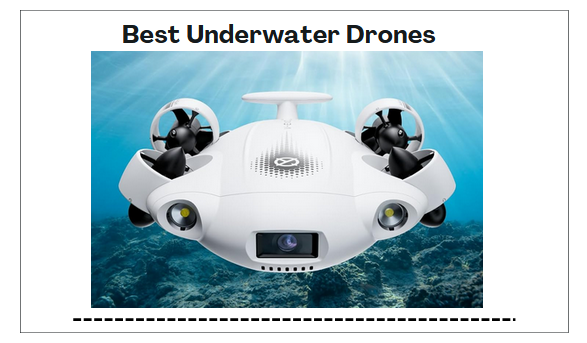
The Best Underwater drones have transformed the way people explore, film, and inspect beneath the surface, offering a safer and more accessible alternative to traditional diving.
These remotely operated vehicles are widely used for marine research, content creation, industrial inspections, and recreational exploration, providing real-time visuals and precise control in environments that are often difficult or dangerous to access.
With advancements in camera technology, mobility systems, lighting, and battery performance, modern underwater drones are capable of capturing high-resolution footage, navigating complex underwater terrain, and operating at varying depths with stability and accuracy.
As interest in ocean exploration and underwater documentation continues to grow, choosing the best underwater drone becomes essential for achieving reliable performance, clear imaging, and efficient operation across different use cases.
Best Underwater Drones
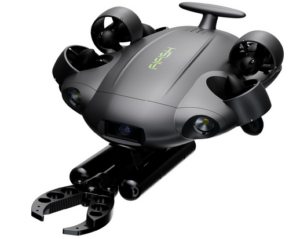
1) FIFISH QYSEA V6 Expert M100A Underwater Drone with Robotic Arm
Get it on Amazon
The FIFISH QYSEA V6 Expert M100A Underwater Drone with Robotic Arm is one of the best underwater drones. It is a professional-grade remotely operated vehicle designed for demanding underwater exploration, inspection, and intervention tasks. It combines advanced maneuverability, strong imaging capabilities, and modular tool integration, making it suitable for both commercial users and serious enthusiasts who require precise control in complex underwater environments.
One of its core strengths lies in its mobility system. The drone is built with omnidirectional movement, allowing full 360-degree control in all directions. This enables smooth navigation in tight or obstructed underwater spaces, which is especially useful for inspections around structures such as hulls, pipelines, or reefs.
The upgraded motor system improves stability and responsiveness while maintaining protection against corrosion, ensuring reliable operation in harsh marine conditions.
The M100A package includes a robotic arm, expanding the drone’s functionality beyond observation into interaction. This allows users to perform tasks such as grabbing objects, sampling, or assisting in light intervention work underwater.
Combined with support for multiple professional tools, the platform becomes adaptable for a variety of missions, including inspection, research, and light industrial operations.
Power performance is another important aspect of this model. It features a high-capacity 14400mAh battery that supports up to approximately 6 hours of operation. Fast charging capability allows the battery to reach about 90 percent in around one hour.
It can also be paired with an onshore power supply system to enable extended or continuous underwater sessions, which is valuable for long inspections or professional workflows.
The imaging system is designed to capture detailed and vibrant underwater visuals. It uses a 4K UHD camera system with a wide 166-degree field of view, supported by high-intensity LED lighting between 4000 and 6000 lumens.
This combination enhances visibility in low-light and turbid water conditions. Smart visual processing and low-latency transmission help reduce distortion and maintain clarity, resulting in stable and accurate real-time video feedback.
Data handling is efficient and user-friendly. The drone includes an integrated Micro SD card slot that allows quick removal and transfer of captured footage. A 128GB storage card is included, providing ample space for high-resolution images and videos. This makes it convenient for users who need to review or share data after missions without complex transfer procedures.
The M100A package configuration also includes a tether reel with approximately 330 feet of cable and an industrial-grade carrying case, which supports portability and protection during transport. The system is designed to be deployed quickly and operate reliably in field conditions, making it practical for professional environments.
Overall, this underwater drone offers a balanced combination of imaging quality, maneuverability, endurance, and modular capability, with the added advantage of a robotic arm for interactive tasks.
It is well-suited for users who require more than simple observation and need a versatile underwater platform for inspection, exploration, and light operational work.
Specifications
- Camera resolution: 4K UHD imaging system
- Field of view: 166 degrees wide-angle lens
- Lighting: LED lights between 4000 and 6000 lumens
- Battery capacity: 14400mAh
- Runtime: Up to 6 hours
- Charging: Fast charging to approximately 90 percent in about 1 hour
- Depth capability: Professional-grade underwater operation with tethered control
- Storage: 128GB Micro SD included with removable storage support
- Movement: Omnidirectional 360-degree maneuverability
- Accessories in M100A package: Robotic arm, tether reel around 330 feet, industrial case
Pros
- Omnidirectional movement allows precise control in all directions
- Robotic arm enables object manipulation and light intervention tasks
- High-resolution 4K imaging with a wide field of view
- Strong LED lighting improves visibility in dark or murky water
- Long battery life with fast charging support
- Modular design supports multiple professional tools
- Stable performance with corrosion-resistant construction
- Convenient data transfer through removable Micro SD storage
Cons
- Premium pricing may be limiting for casual users
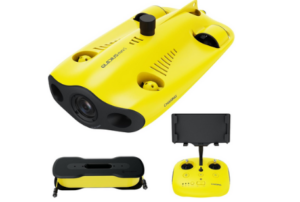
2) Chasing GLADIUS MINI S Underwater Drone
Get it on Amazon
The Chasing GLADIUS MINI S Underwater Drone is a compact and portable remotely operated vehicle designed for underwater exploration, inspection, and photography. It combines high-quality imaging, stable control, and practical depth capability, making it suitable for both professionals and enthusiasts who need reliable performance in underwater environments.
Its lightweight design and quick deployment make it especially convenient for single-person operation in the field.
This underwater drone delivers strong visual performance with a 4K camera system supported by electronic image stabilization. It uses a SONY 1/2.3 sensor to capture detailed 12 megapixel photos and smooth UHD video.
The inclusion of an F2.8 lens along with dual LED lights enhances visibility in low-light conditions, allowing users to capture clear and vivid footage even in darker or murky waters. The stabilization system helps reduce shake, resulting in more consistent and professional-looking recordings.
In terms of movement, the GLADIUS MINI S is equipped with five thrusters that provide agile control and a top speed of up to 4 knots. It can reach depths of approximately 330 feet and operate within a similar horizontal range, giving users a wide area of coverage for exploration or inspection tasks.
Its motor design is engineered to maintain stability and resist issues when operating near sand or rocky surfaces, ensuring smoother performance in challenging underwater conditions.
Battery performance is another important aspect of this model. It uses two batteries with a combined capacity that allows up to about 4 hours of runtime. Charging takes roughly 3.5 hours, which supports efficient turnaround between sessions.
The system also includes onboard storage with a 64GB SD card, while supporting expansion up to 512GB, giving users the flexibility to store large volumes of high-resolution photos and videos.
The drone is designed with practical usability in mind. Weighing around 6 pounds, it is easy to carry and can be deployed quickly by a single user within a few minutes.
The wired remote controller ensures a stable connection during operation, minimizing the risk of signal loss. It also allows real-time monitoring of important data, such as depth and temperature,e while controlling the drone.
Another advantage is its compatibility with additional accessories. It supports attachments such as a grabber claw and external cameras, allowing users to extend its functionality for tasks beyond observation.
This makes it suitable for a range of applications, including underwater inspection, scientific exploration, content creation, and light industrial use. The accompanying mobile application further enhances usability by enabling live streaming, media sharing, time-lapse recording, and direct editing, with the option to output footage to external displays.
Specifications
- Camera resolution: 4K video with 12 megapixel photos
- Image sensor: SONY 1/2.3 CMOS sensor
- Stabilization: Electronic image stabilization
- Lens: F2.8 wide-angle lens
- Lighting: Dual LED lights with 1200 lumens each
- Maximum depth: Up to 330 feet
- Horizontal range: Up to 330 feet
- Thrusters: 5 thruster propulsion system
- Speed: Up to 4 knots
- Battery capacity: Dual 4800mAh batteries
- Runtime: Up to 4 hours
- Charging time: Approximately 3.5 hours
- Storage: 64GB included, expandable up to 512GB
- Weight: Approximately 6 pounds
- Control: Wired remote controller with app support
Pros
- High-quality 4K video with image stabilization for smooth footage
- Strong low-light performance with powerful LED lighting
- A stable wired connection reduces the risk of signal loss
- Long runtime suitable for extended missions
- Compact and lightweight design for easy transport and quick deployment
- Supports expandable storage up to 512GB
- Capable of operating at significant depth and range
- Compatible with accessories for added functionality
Cons
- Wired tether limits mobility compared to wireless systems
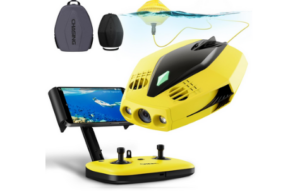
3) Chasing Dory Underwater Drone
Get it on Amazon
The Chasing Dory Underwater Drone is a compact and beginner-friendly remotely operated vehicle designed for casual underwater exploration, photography, and social sharing. Its small size, simple controls, and portable design make it especially appealing to travelers, hobbyists, and anyone looking for an accessible way to capture underwater environments without complex equipment.
This drone is equipped with a 1080p camera paired with an f1.6 lens, enabling it to capture clear photos and videos during real-time operation. Dual headlights rated at 250 lumens each help illuminate darker underwater environments, improving visibility and image clarity.
A built-in color restoration system enhances captured footage by adjusting tones to reflect more natural and vibrant colors, even in varying underwater conditions.
In terms of mobility, the Dory can dive to depths of approximately 49 feet and is connected to a floating Wi Fi buoy through a tether. This setup allows it to stream live 720p video directly to a connected device. The tether provides stable communication between the drone and the user, ensuring consistent control and uninterrupted video transmission during operation.
The device is designed with portability in mind. It has a very compact form factor and weighs less than 2.5 pounds, making it easy to carry in a backpack. This makes it convenient for travel, snorkeling trips, fishing outings, or casual exploration. The built-in battery offers around one hour of runtime, which is suitable for short sessions of underwater observation and content capture.
Ease of use is another important aspect of this model. It operates through the CHASING GO2 mobile application, allowing users to control movement in multiple directions, adjust depth, and maintain stability with simple controls similar to a game controller.
This intuitive interface reduces the learning curve, making it accessible even for first-time users. The drone also supports dual operation mode, allowing two people to share control or experience, which can make it more engaging in group settings.
Sharing and connectivity features further enhance its appeal. Users can stream live footage and share videos directly to social platforms through the app. This makes it suitable not only for personal exploration but also for creating and sharing underwater content during events, trips, or casual gatherings.
Overall, the Chasing Dory Underwater Drone offers a balance of portability, ease of use, and decent imaging capability, making it a practical choice for entry-level users who want a simple and enjoyable underwater drone experience.
Specifications
- Camera resolution: 1080p HD video
- Lens: f1.6 wide aperture lens
- Lighting: Dual headlights rated at 250 lumens each
- Maximum depth: Up to 49 feet
- Live video transmission: 720p via Wi Fi buoy
- Tether length: Approximately 49 feet
- Battery capacity: 4800 mAh
- Runtime: Around 1 hour
- Control: CHASING GO2 mobile app with remote operation
Pros
- Extremely compact and lightweight for easy transport
- Simple controls that are beginner-friendly
- Real-time video streaming with a stable tether connection
- Built-in color restoration improves image quality
- Dual headlights help in low-light underwater conditions
- Supports live streaming to social media platforms
- Dual user mode allows a shared control experience
- Affordable option compared to larger underwater drones
Cons
- Tether length restricts operational range
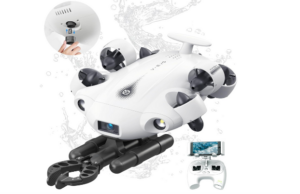
4) FIFISH V-EVO 4K60FPS Underwater Drone with Robotic Arm
Get it on Amazon
The FIFISH V EVO 4K 60FPS Underwater Drone with Robotic Arm is a professional-grade remotely operated vehicle designed for high-quality underwater filming, exploration, and task-oriented operations. It combines advanced imaging, strong lighting, and full directional movement with support for external tools, making it suitable for users who need both creative capture and functional capability in underwater environments.
This drone is equipped with a 4K camera capable of recording at 60 frames per second, producing smooth and detailed footage that is well-suited for cinematic content. The wide 166-degree lens expands the field of view, allowing users to capture more of the surrounding environment in a single frame.
Combined with its high frame rate, the system delivers fluid motion and clear visuals, which are particularly useful when recording moving subjects or navigating dynamic underwater scenes.
Lighting plays an important role in underwater imaging, and this model includes dual LED lights with a combined output of around 5000 lumens and a color temperature of 5500K. These lights improve visibility in dark or murky waters and help restore natural color tones. This allows the camera system to maintain clarity and detail even in challenging lighting conditions where sunlight is limited.
The drone features 360-degree omnidirectional movement, enabling it to move in all directions and maintain stable hovering and positioning. This level of mobility supports precise control during exploration, filming, or inspection tasks. Its hydrodynamic design helps reduce resistance in water, improving efficiency and stability during operation, especially in currents.
The V EVO also includes a removable SD card system for convenient storage and data transfer. Users can easily remove and manage recorded footage without complex procedures. In addition, the drone supports attachment ports that allow integration with various tools and accessories, including a robotic arm, which expands its use beyond observation into interaction tasks such as grabbing or manipulating objects underwater.
Built for versatility, this underwater drone is suitable for a range of applications, including professional videography, research, inspection, and light industrial work. Its combination of mobility, imaging quality, and modular expandability makes it a flexible platform for users who require more than basic underwater viewing capabilities.
Specifications
- Camera resolution: 4K video recording at 60 frames per second
- Lens: 166-degree ultra-wide-angle lens
- Lighting: Dual LED lights with a combined 5000 lumens and 5500K color temperature
- Mobility: 360-degree omnidirectional movement with hovering and stable positioning
- Storage: Removable SD card support
- Design: Hydrodynamic structure for reduced drag in water
- Depth capability: Professional underwater operation with tethered control
- Expandability: Compatible with external tools, including robotic arm attachments
- Control: Remote-operated system with real-time visual feedback
Pros
- High-quality 4K 60FPS video with smooth motion capture
- Wide field of view for expansive underwater scenes
- A strong lighting system improves visibility in low-light conditions
- Full omnidirectional movement allows precise navigation
- Removable SD card simplifies storage and file management
- Supports tool attachments, including a robotic arm for added functionality
- Hydrodynamic design helps improve stability and efficiency
- Suitable for both creative filming and practical underwater tasks
Cons
- Tethered operation limits range compared to untethered systems
Next Read: 5 Best Drones with Obstacle Avoidance
Factors to Consider when Choosing the Best Underwater Drones
Choosing the best underwater drone involves evaluating several important factors that influence performance, usability, and overall value. The right choice depends on how the device will be used, whether for casual exploration, content creation, inspection, or professional underwater operations.
1. Camera quality and resolution
The quality of the camera determines how clear and detailed your underwater footage will be. Higher resolution cameras capture sharper images and more accurate details, which is essential for photography, videography, and inspections. Features such as sensor quality, frame rate, and lens type also play a role in producing smooth and visually appealing results. A good imaging system should maintain clarity even in challenging underwater conditions.
2. Depth rating
Depth capability defines how deep the drone can safely operate. This is a critical factor because different use cases require different operating depths. Recreational users may only need moderate depth limits, while professional or industrial tasks often demand much deeper operation. Choosing a drone with an appropriate depth rating ensures it can handle the intended environment without performance limitations.
3. Maneuverability and control system
The ability to move smoothly in multiple directions affects how effectively the drone can be piloted underwater. Advanced movement systems allow for stable hovering, precise navigation, and full directional control. A responsive control system also improves user experience by making it easier to operate the drone accurately, especially in tight or complex underwater spaces.
4. Battery life and power management
Battery performance determines how long the drone can operate during a single session. Longer battery life is important for extended exploration, filming, or inspection tasks. Fast charging and options for external power supply can further enhance usability by reducing downtime and enabling continuous operation when needed.
5. Lighting and visibility
Underwater environments often have limited natural light, especially at greater depths. Built-in lighting systems help illuminate the surroundings and improve image clarity. Strong and well-positioned lights enhance visibility, restore color accuracy, and allow the camera to capture more detailed footage in dark or murky water conditions.
6. Build quality and durability
Durability is essential for equipment that operates in harsh underwater environments. A well-built drone should be resistant to corrosion, pressure, and environmental stress. Robust construction ensures reliability over time and reduces the risk of damage when operating near sand, rocks, or debris. A hydrodynamic design can also help reduce drag and improve stability.
7. Storage and data handling
Efficient storage options make it easier to capture, save, and transfer data. Support for removable storage cards allows users to quickly export photos and videos without complex processes. Adequate storage capacity is important for high-resolution content, and flexible data management features improve workflow for both casual and professional users.
8. Expandability and accessory support
The ability to attach additional tools increases the versatility of an underwater drone. Support for accessories such as robotic arms, sensors, or specialized equipment allows the device to perform tasks beyond observation. This makes the drone suitable for a wider range of applications, including sampling, inspection, and interaction with underwater objects, adding long-term value to the investment.
Best Underwater Drones FAQs
What should I look for when choosing an underwater drone?
When selecting an underwater drone, key considerations include camera quality, depth rating, battery life, maneuverability, lighting, and durability. The intended use is also important, whether for casual exploration, photography, inspections, or professional tasks. A good balance between performance and portability will help ensure the drone meets your specific needs.
How deep can most underwater drones go?
Underwater drones vary widely in depth capability. Entry-level models typically operate at shallow depths suitable for pools and near-surface exploration, while more advanced units can reach several hundred feet. The right depth rating depends on your intended environment, such as snorkeling, diving, or industrial inspection in deeper waters.
Do underwater drones require a tether or cable to operate?
Most underwater drones use a tethered connection rather than wireless control because radio signals do not travel well underwater. The tether allows for stable communication, real-time video transmission, and reliable control. Some systems connect the tether to a floating buoy that communicates with the controller, ensuring consistent performance during operation.
Conclusion
Choosing the best underwater drone requires careful consideration of factors such as imaging quality, depth capability, maneuverability, battery life, and overall durability. These devices play an increasingly important role in fields such as environmental monitoring, infrastructure inspection, scientific research, and underwater photography, making them valuable tools for both professionals and enthusiasts.
A well-chosen underwater drone not only enhances visibility in challenging aquatic environments but also improves productivity, safety, and creative possibilities.
As technology continues to evolve, underwater drones are becoming more versatile and accessible, solidifying their importance as essential equipment for exploring and understanding the underwater world.
Read Also: 7 Best Waterproof Image Stabilized Binoculars

Albert, the founder of Outdoormoran, is a dedicated outdoor enthusiast with a passion for delivering the most current, accurate, and easy-to-understand information on all different outdoor gear and optics. He shares his expertise with beginners by teaching the technical aspects of outdoor gear and optics through his comprehensive collection of guides.