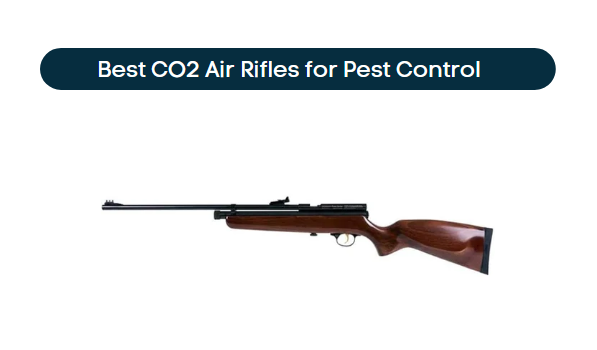
1) Diana Trailscout CO2 Air Rifle
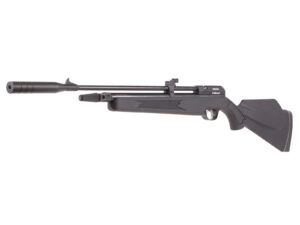
Get it on Airgun Depot
2) Umarex Fusion 2
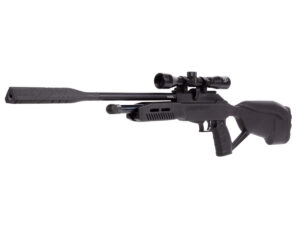
Get it on Airgun Depot or Amazon
The Umarex Fusion 2 is a quiet and efficient CO2-powered air rifle often chosen for backyard pest control and close to mid-range shooting.
It is chambered in .177 caliber and delivers velocities of up to 700 FPS, giving it enough speed and consistency for small pest management and target work.
Its CO2 system is flexible, allowing use of either two 12-gram cartridges or a single 88-gram capsule, giving shooters options depending on shot volume needs and convenience. The rifle also comes with a 4×32 scope and two 9-round rotary magazines, making it ready for repeated shooting sessions right out of the box.
Another defining feature is its integrated SilencAir noise reduction system, which uses a multi-chamber design to significantly reduce muzzle report. This makes the rifle noticeably quieter than many similar CO2 models, an advantage in environments where noise control matters. The bolt-action mechanism operates smoothly and supports quick follow-up shots using the included rotary magazines.
Furthermore, the single-stage trigger offers a simple and predictable pull, which helps with consistency during repeated shooting. The rifle’s CO2 efficiency is also notable, producing over 70 shots from two 12-gram cartridges under typical conditions, making it practical for longer sessions without frequent cartridge changes.
What’s more, the Fusion 2 balances power, quiet operation, and usability in a lightweight platform. It is designed for shooters who want a simple and low-recoil experience without moving into more complex air systems. While it is not built for extreme long-range performance, it performs well within its intended range for pest control and casual shooting.
Specifications
- Caliber: .177
- Velocity: up to 700 FPS
- Power source: CO2 (12g or 88g options)
- Action: Bolt action
- Trigger: Single stage
- Magazine capacity: 9 rounds
- Included optics: 4×32 scope
- Shot capacity: 70+ shots on 2x12g setup
- System: SilencAir noise reduction
Pros
- Very quiet operation compared to many CO2 rifles
- Good shot count per CO2 fill
- Smooth bolt-action cycling
- Includes scope and magazines ready to use
- Lightweight and easy to handle
- Low recoil improves accuracy potential
Cons
- Performance drops in colder temperatures
- Limited effectiveness at longer ranges
3) Crosman 1077
Get it on Airgun Depot or Amazon
Next is the Crosman 1077. This is a practical CO2-powered air rifle widely used for light pest control, plinking, and backyard target shooting.
It is designed to offer consistent shooting performance with a simple operating system that suits beginners and casual shooters. Besides, its semi-automatic style cycling and rotary magazine system make it efficient for situations that require quick follow-up shots while maintaining manageable recoil and steady handling.
Another core strength is its .177 caliber pellet system, which provides flat shooting performance suitable for small pest control tasks at short to medium ranges. The rifle operates using a single 12-gram CO2 cartridge, giving it a clean and straightforward power source that eliminates the need for pumping or spring cocking.
Its 12-shot rotary magazine allows multiple shots before reloading, and the rotating clip is designed for smooth and simple loading, making it convenient during extended shooting sessions.
Accuracy is supported by a rifled steel barrel that helps stabilize pellets for tighter shot grouping compared to smoothbore designs. The rifle comes equipped with a fixed fiber optic front sight paired with a fully adjustable rear sight, allowing shooters to fine-tune aim for different distances.
It also includes an 11 mm dovetail rail for mounting optics, giving flexibility to upgrade with scopes or red dot sights depending on shooting preference.
Moreover, safety is handled through a manual safety system, adding control during handling and storage.
Above all, the trigger system uses a double-action setup with a single-stage pull, offering a consistent firing feel that becomes predictable with practice.
Specifications
- Shoots 4.5 mm .177 caliber pellets
- Powered by one 12-gram CO2 cartridge
- 12-round rotary pellet magazine
- Double action firing with a single-stage trigger
- Rifled steel barrel construction
- Fixed fiber optic front sight
- Fully adjustable rear sight system
- 11 mm dovetail mounting rail
- Manual safety mechanism
Pros
- Easy to operate and beginner-friendly design
- Good multi-shot capacity for quick follow-up shots
- Reasonably accurate for pest control and target shooting
- Smooth pellet loading with rotating magazine system
- Option to mount optics for improved precision
- Low recoil and consistent CO2-powered shooting
Cons
- The CO2 performance drops in cold weather
- Limited power compared to higher-end hunting air rifles
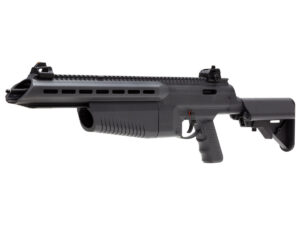
4) Umarex AirJavelin
Get it on Airgun Depot or Amazon
Umarex developed a CO2 system that will send 170-grain arrows downrange at speeds up to 300 FPS, producing 34 FPE at the muzzle. With the Umarex AirJavelin, you’ll have more than enough power to hunt small game and the AR-style buttstock makes maneuvering in the field easy.
This rifle operates using a single 88-gram CO2 cartridge, which provides a total of around 27 usable shots per fill depending on shooting conditions. It features a straight-pull bolt-action system that keeps cycling smooth and fast, reducing downtime between shots.
Furthermore, the inclusion of a fixed fiber optic front sight combined with an adjustable rear sight allows for basic aiming flexibility, while the integrated Picatinny rail expands compatibility with optics and accessories for improved accuracy in different environments.
For handling and customization, the AirJavelin includes an adjustable AR-style buttstock that helps users achieve a comfortable shooting position. It also incorporates M-Lok mounting slots on both sides, offering additional space for accessories such as grips or rails.
Moreover, the rifle is further enhanced with a push-button safety for quick engagement and disengagement, and it accepts aftermarket quivers for improved arrow-carrying convenience. It also comes packaged with three arrows, allowing immediate use right out of the box.
Overall, the Umarex AirJavelin balances practicality and power in a lightweight CO2 air rifle platform. It is built for users who value quick follow-up shots, accessory compatibility, and simple operation in pest control applications.
Specifications
- Velocity: 300 FPS
- Energy output: 34 FPE
- Shot capacity: approximately 27 shots per 88-gram CO2 cartridge
- Power source: one 88-gram CO2 cylinder
- Action type: straight pull bolt action
- Sights: fixed fiber optic front sight with adjustable rear sight
- Stock: adjustable AR-style buttstock
- Mounting system: Picatinny rail and M-Lok slots
- Included accessories: three arrows
Pros
- Delivers strong energy output suitable for pest control tasks
- Simple straight pull action supports fast follow-up shots
- Good accessory compatibility through Picatinny and M-Lok systems
- Adjustable stock improves comfort and fit for different users
- Comes ready to use with included arrows
Cons
- Limited shot count per CO2 cartridge compared to larger systems
- Requires CO2 cartridges, which add ongoing operating costs
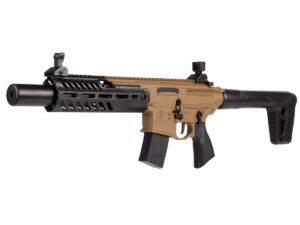
5) SIG Sauer MCX Rattler Canebrake
Get it on Airgun Depot or Amazon
Lastly, we have the SIG Sauer MCX Rattler Canebrake. This is a CO2 powered .177 caliber air rifle that blends realistic design cues with fast semi-automatic shooting performance.
It is built around a compact rifle-style frame with a shrouded barrel and a modern tactical layout that improves handling and accessory flexibility. Additionally, it runs on .177 pellets and operates in a semi-automatic mode using a 30-round magazine, allowing quick follow-up shots without frequent reloading.
As one of the best CO2 air rifles for pest control, its system is powered by a single 88g or 90g CO2 cylinder, giving it consistent shot cycling when properly maintained. Furthermore, it produces up to 711 feet per second with a maximum energy output of 7.1 foot pounds, which places it in the light pest control and target practice category rather than heavy-duty hunting.
The 12-inch barrel supports balance and maneuverability, while the overall length of just over 30 inches keeps it compact enough for confined spaces. Besides, the trigger has a flat blade just like the real steel version, and the textured and ridged pistol grip gives you a secure hold.
Design-wise, it includes a textured pistol grip for improved control and flip-up front and rear sights for quick aiming. A full-length Picatinny rail allows mounting optics, while the MLOK handguard supports additional accessories.
The barrel shroud adds a more finished look and helps with handling comfort. Despite its compact size, it still weighs 7.6 pounds with the magazine, giving it a stable shooting platform.
Specifications
- .177 caliber pellets
- Semi auto
- Max velocity: 711 fps
- Max energy: 7.1 fpe
- 30-round magazine
- Flip up front and rear sights
- Long Picatinny optics rail
- M-LOK handguard
- Barrel Shroud
- Uses one 88g or 90g CO2 cylinder
- Weight: 7.6 lbs. (with magazine)
- Barrel length: 12″
- Overall length: 30.13″
Pros
- High-capacity 30-round magazine for fewer reloads
- Semi-automatic firing for quick follow-up shots
- Solid velocity for light pest control and target use
- Accessory friendly with Picatinny rail and M LOK handguard
- Compact design that is easy to handle in tight spaces
- Realistic rifle-style build with stable weight distribution
Cons
- Power level is limited compared to higher-energy air rifles
- Heavier than many entry-level air rifles
Next Read: 10 Best CO2 Air Rifles for Hunting, Pest Control, Squirrels
Key Factors to Consider when Choosing the Best CO2 Air Rifles for Pest Control
CO₂ systems are especially popular for light pest management because they are quiet, relatively affordable, and easy to operate, but not all models are equally effective. Consider these key factors when making your selection:
Power
For starters, power and muzzle velocity are the foundation of performance. A suitable CO₂ air rifle should generate enough energy to ethically dispatch small pests like rats, sparrows, or squirrels within a controlled range. While CO₂ rifles are naturally limited compared to PCP systems, higher-quality models maximize efficiency by optimizing gas usage per shot. This ensures that each pellet retains enough impact force without excessive spread or drop in performance.
Gas Pressure Consistency
Consistency of gas pressure is equally important because CO₂ is sensitive to temperature changes. In colder environments, performance can drop noticeably, leading to reduced accuracy and weaker shots. The best CO2 air rifles for pest control reduce this issue through better valve systems and regulated airflow, allowing the shooter to maintain predictable shot placement. This consistency is crucial when targeting small, fast-moving pests where even slight deviations can result in missed shots.
Accuracy
Accuracy and barrel design further determine effectiveness in the field. A precision-rifled barrel stabilizes pellets as they travel, improving grouping at medium distances. For pest control, tight shot patterns are more valuable than long-range capability, since most encounters occur within close to moderate ranges. A good trigger system also contributes to accuracy by reducing shooter-induced movement during firing.
Magazine Capacity
Magazine capacity and reload speed become important when dealing with multiple pests in a short period. Semi-automatic or multi-shot CO₂ rifles allow faster follow-up shots, which is especially useful in barns, gardens, or farms where pests often appear in groups. Smooth feeding mechanisms also prevent jams, which can be frustrating during time-sensitive situations.
Ergonomics
Next, ergonomics play a major role in field performance. A well-balanced rifle with a comfortable grip and adjustable stock helps the shooter maintain stability during longer sessions. Lightweight designs reduce fatigue, making it easier to track moving targets or reposition quickly. Features like fiber-optic sights or scope rails also improve aiming flexibility in different lighting conditions.
Build Quality
Durability and build quality ensure the rifle remains reliable over time. Since pest control often takes place outdoors, exposure to dust, humidity, and temperature changes is common. Rifles with strong metal construction, sealed internals, and corrosion-resistant finishes tend to last longer and require less frequent repairs. Good maintenance design also makes cleaning and part replacement easier.
Operation Cost
Finally, cost of operation is a practical consideration. CO₂ cartridges need regular replacement, and pellet consumption can add up with frequent use. The best CO2 air rifles for pest control maximizes efficiency per cartridge, reducing overall expenses. When combined with low maintenance needs and readily available spare parts, the right CO₂ air rifle becomes a cost-effective long-term tool for consistent pest control.
Best CO2 Air Rifles for Pest Control FAQs
What pests can a CO₂ air rifle effectively control?
CO₂ air rifles are best suited for small to medium pests such as rats, mice, pigeons, sparrows, and squirrels. They work well in controlled environments like gardens, farms, and storage areas where targets are within a close to moderate range. However, they are not ideal for larger or tougher games due to limited power compared to PCP or spring-powered rifles.
Are CO₂ air rifles powerful enough for humane pest control?
Yes. When used correctly within their effective range, CO₂ air rifles provide sufficient energy for humane pest control. The key is selecting a model with good muzzle velocity and using the right pellet type. Ethical effectiveness also depends on accurate shot placement, which is why precision matters as much as power.
How does temperature affect CO₂ air rifles?
Temperature has a significant impact because CO₂ pressure changes with heat and cold. In colder conditions, performance may drop, resulting in lower velocity and reduced accuracy. Warmer temperatures generally improve consistency, but extreme heat can also cause pressure fluctuations. This is why regulated or high-efficiency valve systems are preferred.
What is the effective range for pest control?
Most CO₂ air rifles are effective within 10 to 40 meters, depending on the model and pellet type. For pest control, shorter ranges are more reliable since CO₂ power diminishes faster over distance. Staying within the optimal range ensures better accuracy and humane results.
Conclusion
Selecting the best CO₂ air rifle for pest control comes down to balancing power, consistency, and practical usability. While these rifles may not match the raw power of PCP systems, they offer a quiet, affordable, and user-friendly solution for managing common pests effectively. When paired with good accuracy, reliable CO₂ regulation, and ergonomic design, they become highly efficient tools for everyday pest management.
Ultimately, the best choice is one that performs consistently in your local conditions, fits comfortably in your hands, and keeps operating costs manageable. Prioritize accuracy, build quality, and shot consistency for effective pest control and a more reliable and satisfying shooting experience over time.

Albert, the founder of Outdoormoran, is a dedicated outdoor enthusiast with a passion for delivering the most current, accurate, and easy-to-understand information on all different outdoor gear and optics. He shares his expertise with beginners by teaching the technical aspects of outdoor gear and optics through his comprehensive collection of guides.