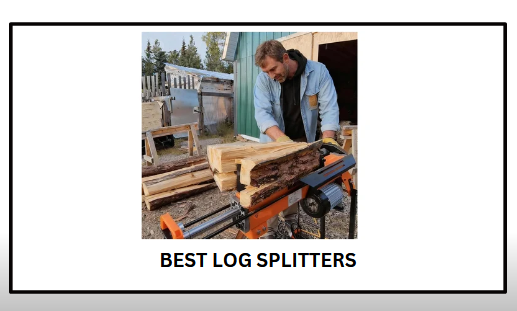
In this guide, we look at the best log splitters and key factors such as splitting force, log capacity, cycle time, power source, portability, and ease of use to help you choose a log splitter that matches your firewood preparation needs.
If you regularly prepare firewood, log splitters can significantly reduce the physical effort and time required to turn large logs into manageable pieces.
From compact electric models suited to homeowners to powerful gas-powered machines designed for larger workloads, there are options for different log sizes, work environments, and budgets.
Our Top Picks at a Glance
- BILT HARD 6.5 Ton Log Splitter — Best Budget Option – Get it on Amazon
- YARDMAX YS0650 6.5 Ton Electric Log Splitter — Best for Homeowners -Get it on Amazon
- SuperHandy 20 Ton Log Splitter Portable — Best Portable Gas Model -Get it on Amazon
- FULL BOAR Store 38 Ton Log Splitter — Best Heavy-Duty Option -Get it on Amazon
- BILT HARD 14 Ton Electric Log Splitter — Best Electric Power -Get it on Amazon
- Landworks Portable 20-Ton Gas Log Splitter — Best for Remote Locations -Get it on Amazon
How We Tested the Best Log Splitters
To identify the Best Log Splitters, we focused on the characteristics that matter most when preparing firewood at home, on a farm, or at a remote outdoor location. Rather than judging the machines on splitting force alone, we considered power, log capacity, operating speed, portability, construction, ease of use, and safety.
• Splitting Power: We considered hydraulic force and how well each machine is suited to different log sizes and wood types.
• Log Capacity: We examined the maximum log length and diameter each splitter is designed to handle.
• Cycle Time: Faster ram-return times were considered for users processing larger quantities of firewood.
• Power Source: We assessed the practical advantages and requirements of electric and gas-powered models.
• Build Quality: Frame construction, wedges, hydraulic components, and overall structural design were considered for durability.
• Portability: Weight, wheels, handles, dimensions, and towing capability were evaluated for ease of movement and storage.
• Ease of Use: We considered controls, operating positions, assembly, and how easily logs can be positioned.
• Safety: Safety controls, overload protection, stability, and other protective features were taken into account.
• Value: Finally, we considered how well each splitter’s performance, features, and design match its intended workload and type of user.
Our testing approach therefore emphasizes practical usability rather than simply choosing the machine with the highest tonnage. The best log splitter for one user may not be the best choice for another, so we considered the complete package and the type of firewood work each machine is designed to handle.
Best Log Splitters
1) BILT HARD 6.5 Ton Log Splitter
Get it on Amazon
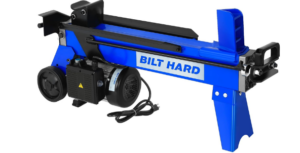
The BILT HARD 6.5 Ton Log Splitter is one of the best log splitters, a practical electric option for homeowners who need to process firewood without relying on a gas-powered machine. Its 15-amp, 1.75 HP motor delivers up to 6.5 tons of splitting force and handles logs up to 20.5 inches long and 9.8 inches in diameter. The 3,400 RPM no-load motor speed and hydraulic system provide consistent operation for routine firewood-splitting tasks.
Built with a steel frame, precision gears, and copper motor windings, the splitter is designed for stable operation during repeated use. It has an approximately 18-second cycle reset between splits, allowing users to continue working through a batch of appropriately sized logs without manually resetting the ram after every operation.
The horizontal design and 5.7-inch transport wheels make the unit relatively easy to reposition around a property. Its stated portability is particularly useful when splitting firewood in areas where the ground may be uneven, muddy, or sandy. At 98 pounds, however, users should still expect to handle some weight when moving or positioning the machine.
For operation, the BILT HARD uses a two-hand control system intended to keep both hands engaged with the controls while the splitting mechanism is active. Because it runs on electricity, it produces no exhaust fumes during use and may be better suited for locations where avoiding engine emissions is important. The manufacturer recommends an extension cord no longer than 15 meters with a cross-section of at least 3.3 mm², along with a 40-amp circuit breaker.
Best Suited for: The BILT HARD 6.5 Ton Log Splitter is best suited to homeowners and occasional-to-regular firewood users who need to split properly sized logs for heating, outdoor fires, or general firewood preparation. Its 6.5-ton capacity makes it appropriate for typical residential splitting jobs, while the electric motor eliminates the need to manage fuel or engine exhaust. Logs should be appropriately seasoned and within the machine’s specified size limits for the intended workload.
Specifications
- Splitting Force: 6.5 tons
- Motor: 1.75 HP, 15 amps, 120V, 60Hz
- Motor Speed: 3,400 RPM no-load
- Power Output: 1,800 watts
- Maximum Log Size: 20.5 inches long × 9.8 inches diameter
- Cycle Reset Time: Approximately 18 seconds
- Hydraulic Oil Capacity: 3.5 liters
- Wheel Size: 5.7 inches
- Weight: 98 lbs
Pros
- 6.5 tons of splitting force for residential firewood processing
- Electric operation produces no exhaust during use
- Two-hand controls provide an added operational safety measure
- Steel construction is designed for repeated use
- Transport wheels simplify repositioning
- Hydraulic system provides consistent splitting action
Cons
- Limited to logs within its specified 20.5-inch length and 9.8-inch diameter capacity
2) YARDMAX YS0650 6.5 Ton Electric Log Splitter
Get it on Amazon
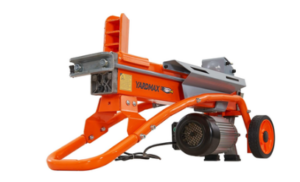
The YARDMAX YS0650 6.5 Ton Electric Log Splitter is designed for homeowners who want a compact electric machine for routine firewood preparation. Its 6.5-ton ram force provides the power needed to split appropriately sized logs, with a stated capacity of up to 20.5 inches in length and 10 inches in diameter. The 15-amp electric motor also provides a cleaner operating experience without the fumes associated with combustion engines.
Operation is designed to be straightforward, with a conveniently positioned lever that allows one-handed control. An optional foot pedal is also available separately for users who prefer an alternative method of operating the splitter. A built-in safety switch adds an additional control measure during operation.
The YS0650 uses a heavy-duty steel construction while maintaining a relatively compact design for an electric splitter. At 104.7 pounds, it can be moved around a property, although users should take the machine’s weight and wheel arrangement into account when positioning it on uneven ground. Its horizontal configuration also means it is intended to be stored in that orientation rather than standing upright.
With an approximately 18-second cycle time, the splitter is suited to processing batches of residential firewood. User feedback cited with the product indicates that it can handle both seasoned and tougher wood, although performance can vary depending on the wood’s condition and size. The manufacturer specifies logs up to 20.5 inches long and 10 inches in diameter, so those limits should be followed for intended operation.
Best Suited For: The YARDMAX YS0650 is most suitable for homeowners, DIY firewood processors, and users who need a manageable electric splitter for seasonal wood preparation. Its compact design can also be useful for users with limited storage space, including garage storage. It is less appropriate for high-volume commercial splitting, and additional accessories such as a stand or log tray need to be purchased separately.
Specifications
- Splitting Force: 6.5 tons
- Motor: 15-amp electric motor
- Maximum Log Size: 20.5 inches long × 10 inches diameter
- Cycle Time: Approximately 18 seconds
- Weight: 104.7 lbs
- Operation: One-handed lever control
- Construction: Heavy-duty steel
Pros
- 6.5-ton ram force handles appropriately sized firewood
- Electric operation produces no fuel fumes during use
- One-handed control makes operation straightforward
- Compact design is convenient for storage and transport
- Steel construction is suited to repeated residential use
- Relatively quiet operation is useful around the home
- Suitable for both seasoned and some tougher wood types
Cons
- Rounded cradle design may allow logs to move during splitting
3) SuperHandy 20 Ton Log Splitter Portable
Get it on Amazon
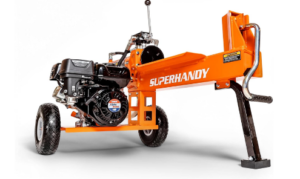
The SuperHandy 20 Ton Log Splitter Portable is a gas-powered machine designed for demanding firewood-splitting jobs where greater splitting force and mobility are important. It uses a 7 HP gas engine with a two-stage Bucher hydraulic gear pump to produce up to 20 tons of splitting force. The horizontal full-beam design and steel wedge are intended to handle logs measuring up to 20.5 inches long and 16 inches in diameter.
A major advantage of the design is its rapid 7.5-second cycle time. The automatic ram return reduces the waiting period between splits, making the machine better suited to processing larger quantities of firewood. The hydraulic system is designed to maintain a consistent splitting force as the wedge moves through the log.
The splitter is also built for use away from electrical outlets. Its gas engine allows it to operate in outdoor and remote locations where access to mains electricity may be limited. The 10-inch transport wheels help with repositioning, while the 130-pound overall weight provides a balance between portability and the machine’s heavy-duty construction. Since it is gas powered, it should only be operated outdoors with adequate ventilation.
Safety remains important when using the SuperHandy. The manufacturer recommends using appropriate eye and hand protection and operating the controls and power switch as intended. Hydraulic fluid is not supplied with the unit, with AW32 specified as the recommended fluid in the provided information.
Best Suited for: The SuperHandy 20 Ton Log Splitter is best suited to homeowners, landowners, and firewood users who regularly process larger or tougher logs, particularly in outdoor or remote locations without convenient electrical access. Its 20-ton force, 16-inch diameter capacity, and fast automatic return make it suitable for substantial firewood workloads. Its low working height may be less comfortable for users who prefer a raised splitting position.
Specifications
- Splitting Force: 20 tons
- Engine: 7 HP gas engine
- Hydraulic Pump: Two-stage Bucher hydraulic gear pump
- Maximum Log Size: 20.5 inches long × 16 inches diameter
- Cycle Time: Approximately 7.5 seconds
- Transport Wheels: 10 inches
- Weight: 130 lbs
- Dimensions: 46 × 24 × 33 inches assembled
- Hydraulic Fluid: AW32 recommended, not included
Pros
- 20-ton splitting force for demanding firewood jobs
- 7.5-second automatic return cycle supports faster workflow
- Two-stage hydraulic pump provides consistent operating force
- Handles logs up to 16 inches in diameter
- 10-inch wheels make repositioning easier
- Gas operation allows use without an electrical outlet
- Horizontal design accommodates larger logs
Cons
- Low operating height requires frequent bending
- No hitch is provided for ATV towing
4) FULL BOAR Store 38 Ton Log Splitter
Get it on Amazon
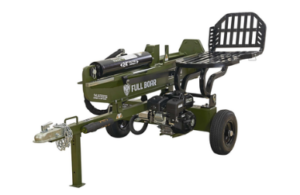
The FULL BOAR Store 38 Ton Log Splitter is a heavy-duty gas-powered machine built for demanding firewood processing. It combines a 306cc FULL BOAR OHV engine with a hydraulic system capable of producing up to 38 tons of splitting force. Its 22.75-inch cylinder stroke allows it to accommodate logs up to 24 inches long, making it suitable for larger splitting jobs.
The machine uses a heavy-duty H-beam frame designed to reduce beam deflection while the wedge is under load. Its specially shaped two-way wedge is intended to split in both directions, while the adjustable auto-return valve helps reduce the time and effort required between individual splits. The stated cycle time is approximately 13.8 seconds.
One of its more useful features is the ability to switch between vertical and horizontal operation. The hydraulic cylinder handle allows the machine to pivot between positions, making it possible to work with larger, heavier logs without having to lift them onto a horizontal beam. This gives users greater flexibility when processing oversized firewood.
The FULL BOAR also has a towable chassis with 16-inch DOT-approved road tires, a 2-inch ball hitch coupler, and safety chains. This allows the splitter to be transported to different work locations rather than remaining in one place. However, at 514 pounds, it is considerably easier to move with a suitable tow vehicle than manually.
The hydraulic oil filter is positioned inside the reservoir, where it is protected from falling logs and reduces the possibility of interference with the operator. The combination of high splitting force, multiple operating positions, and towability makes this a machine intended for substantial outdoor firewood workloads.
Best Suited For: The FULL BOAR Store 38 Ton Log Splitter is best suited to landowners, serious firewood users, and crews processing large or difficult logs in multiple locations. Its vertical/horizontal operation is particularly useful when dealing with heavier logs that would be difficult to lift. Because of its 514-pound weight and large footprint, it is better suited to users with adequate storage space and access to a vehicle capable of towing it.
Specifications
- Splitting Force: 38 tons
- Engine: 306cc FULL BOAR OHV gas engine
- Maximum Log Length: 24 inches
- Stroke Length: 22.75 inches
- Cycle Time: Approximately 13.8 seconds
- Tires: 16-inch DOT-approved road tires
- Hitch: 2-inch ball coupler with safety chains
- Weight: 514 lbs
- Dimensions: 89.5 × 48 × 37 inches
Pros
- 38 tons of splitting force for demanding workloads
- 306cc gas engine provides substantial power
- Vertical and horizontal operating positions improve handling flexibility
- 13.8-second cycle with auto return supports efficient operation
- Heavy-duty H-beam construction is designed to limit beam deflection
- Towable design makes transportation between job sites practical
- Internal hydraulic filter protects falling logs
Cons
- Exterior decals and lettering may have cosmetic durability issues
- Requires suitable towing equipment for convenient transportation
5) BILT HARD 14 Ton Electric Log Splitter
Get it on Amazon
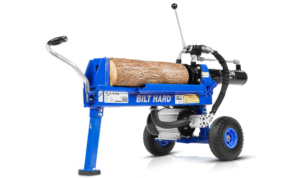
The BILT HARD 14 Ton Electric Log Splitter is designed for homeowners who need substantial splitting power without using a gas-powered engine. Its 15-amp, 1,800-watt electric motor works with a two-stage hydraulic gear pump to produce up to 14 tons of splitting force. It can accommodate logs measuring up to 20 inches long and 16 inches in diameter, making it suitable for processing a variety of residential firewood.
The two-stage hydraulic system is designed to maintain consistent pressure during operation while helping the splitter work efficiently through appropriately sized logs. Since it runs from a 120V household outlet, there is no fuel to store or engine to maintain, and the electric motor produces no exhaust during operation. Its relatively quiet operation can also make it more practical for use around homes and other residential settings.
For safety, the machine incorporates two-hand operation and overload protection. A support leg provides additional stability while splitting, while the heavy-duty steel construction is intended to withstand regular use. Users should also ensure that their electrical supply can accommodate the machine’s requirements, particularly because the provided information indicates that a 20-amp circuit may be necessary.
The splitter weighs 133.3 pounds and has 10-inch transport wheels along with a moving handle. These features make repositioning possible around a property, although its weight may make frequent manual movement challenging. The compact form is useful for storage in places such as a garage or shed.
Best Suited for: The BILT HARD 14 Ton Electric Log Splitter is best suited to homeowners preparing seasonal firewood for fireplaces, wood stoves, cabins, workshops, farms, or backyard use.
It is particularly appropriate for users who want strong hydraulic splitting force while avoiding gasoline, exhaust, and routine engine maintenance. Its electric power source makes it most practical where a suitable household electrical supply is readily available.
Specifications
- Splitting Force: 14 tons
- Motor: 15 amps, 1,800 watts, 120V
- Maximum Log Size: 20 inches long × 16 inches diameter
- Hydraulic Pump: Two-stage hydraulic gear pump
- Hydraulic Oil Reservoir: 1.45 gallons
- Transport Wheels: 10 inches
- Weight: 133.3 lbs
- Power Source: 120V household electricity
- Operation: Two-hand controls
Pros
- 14 tons of hydraulic force for demanding residential firewood
- Handles logs up to 20 inches long and 16 inches in diameter
- Electric operation eliminates gasoline and exhaust emissions
- Two-stage pump provides consistent hydraulic pressure
- Two-hand controls and overload protection add safety measures
- 10-inch wheels and moving handle assist with repositioning
- Compact enough for garage or shed storage
- Quiet operation is useful around residential properties
Cons
- Two-hand controls may be less convenient for some users
- Requires an appropriate electrical circuit for reliable operation
6) Landworks Portable 20-Ton Gas Log Splitter
Get it on Amazon
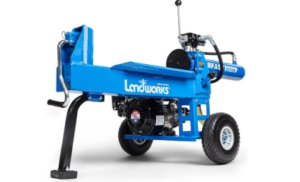
The Landworks Portable 20-Ton Gas Log Splitter is a compact gas-powered machine designed for users who need considerable splitting force without being tied to an electrical outlet. It uses a 7 HP engine and a two-stage Bucher hydraulic gear pump to deliver up to 20 tons of splitting force. The splitter is rated for logs measuring up to 20.5 inches long and 16 inches in diameter.
Its 7.5-second rapid auto-return cycle helps reduce the time between individual splits, making it suitable for processing larger quantities of firewood. The full-beam steel wedge is paired with a hydraulic system designed to provide consistent splitting pressure, while the control valve lever allows the operator to manage the splitting and return functions.
Portability is another important part of the design. The splitter has 10-inch transport wheels and a relatively compact frame, allowing it to be moved between suitable outdoor work areas. The provided information lists the weight at approximately 150 pounds, so while it is portable for a machine in this class, moving it manually can still require considerable effort.
Because it uses a gasoline engine, the Landworks splitter does not require access to household electricity, making it useful for remote firewood-processing locations. It should be operated outdoors with adequate ventilation. Eye and hand protection are also recommended during operation. Hydraulic fluid and engine oil are not included, with AW32 hydraulic fluid recommended for the hydraulic system.
Best Suited for : The Landworks Portable 20-Ton Gas Log Splitter is best suited to homeowners, landowners, and firewood users who regularly split larger logs or work in locations without convenient electrical access. Its combination of 20-ton force, rapid return cycle, and transport wheels makes it suitable for outdoor seasonal firewood preparation and moving between work areas. The horizontal-only design and low working height may be less convenient for users who prefer vertical splitting or a raised operating position.
Specifications
- Splitting Force: 20 tons
- Engine: 7 HP gas engine
- Hydraulic Pump: Two-stage Bucher hydraulic gear pump
- Maximum Log Size: 20.5 inches long × 16 inches diameter
- Cycle Time: Approximately 7.5 seconds
- Transport Wheels: 10 inches
- Weight: Approximately 150 lbs
- Hydraulic Fluid: AW32 recommended
- Power Source: Gasoline
Pros
- 20 tons of splitting force for demanding firewood tasks
- 7.5-second automatic return cycle supports efficient operation
- Two-stage hydraulic pump provides consistent splitting pressure
- Gas engine allows operation without an electrical outlet
- 10-inch wheels assist with transportation
- Compact design is easier to transport than a larger splitter
- Major components are substantially preassembled
- Steel wedge and full-beam construction support regular firewood processing
Cons
- Hydraulic fluid and engine oil must be purchased separately
- Horizontal operation limits how larger logs can be positioned
Next Read: 5 Best Electric Log Splitters
Types of Log Splitters
Log splitters are available in several configurations, with each type suited to different workloads, locations, and user preferences. The main types include electric, gas-powered, horizontal, vertical, and manual log splitters.
1. Electric Log Splitters
Electric log splitters use a motor and hydraulic system powered by a household electrical outlet. They are generally well suited to homeowners who prepare firewood around the house, garage, workshop, or other locations with convenient access to electricity. They do not produce engine exhaust and typically require less engine-related maintenance than gas models. Their main limitation is the need for an appropriate electrical supply and the restriction imposed by the available cord and outlet location.
2. Gas-Powered Log Splitters
Gas-powered log splitters use a gasoline engine to drive the hydraulic system and are commonly chosen for heavier outdoor firewood work. Because they do not depend on an electrical outlet, they can be used at remote properties, woodlots, farms, and other locations away from household power. They are available with higher splitting forces and are often designed for larger workloads. However, they produce exhaust and require appropriate outdoor ventilation, as well as routine engine maintenance and fuel.
3. Horizontal Log Splitters
Horizontal log splitters position the log lengthwise on a horizontal beam before the hydraulic wedge moves through it. This configuration is common among compact electric and gas models and works well for users processing logs that can be comfortably lifted into position. Horizontal machines are often relatively straightforward to operate and store, although handling particularly heavy or large logs can require more physical effort because the log must be positioned on the beam.
4. Vertical Log Splitters
Vertical log splitters allow the operator to place a large log on the ground and split it while it remains in a vertical position. This reduces the need to lift heavier logs onto a raised beam, making the configuration useful when working with large or difficult-to-handle pieces of wood. Some machines offer both vertical and horizontal operation, allowing users to select the position that best suits the size and weight of the logs being processed.
5. Manual Log Splitters
Manual log splitters rely on human-powered mechanisms rather than an electric motor or gasoline engine. They are generally intended for smaller quantities of firewood and users who want a simple machine without fuel or electrical requirements. Depending on the design, splitting force can be generated through a lever, hydraulic hand pump, or similar mechanical system. They are less suitable when processing large quantities of thick or difficult logs because the operator must provide more of the input effort.
6. Towable Log Splitters
Towable log splitters are built with a chassis, wheels, and towing equipment that allow them to be transported between work locations using a suitable vehicle. They are particularly useful for landowners, firewood crews, and users who split wood at multiple sites. These machines are generally larger and heavier than compact residential models, but their towable design makes transporting substantial equipment more practical. Users should always follow the manufacturer’s towing requirements and applicable road regulations.
7. Kinetic Log Splitters
Kinetic log splitters use stored mechanical energy rather than relying solely on hydraulic pressure to drive the wedge through the wood. This design can provide very rapid splitting cycles and is intended for users who prioritize speed when processing significant quantities of firewood. Their operating mechanism differs from conventional hydraulic models, so users should consider the machine’s specific log-size limitations and operating requirements before choosing one.
Best Log Splitters Buying Guide: What to Look For
Choosing the right log splitter depends on the size of your firewood, how often you split, and where you plan to use the machine. Here are six important factors to consider:
1. Splitting Force
Splitting force, measured in tons, indicates how much pressure the machine can apply to a log. Lower-force models can be suitable for smaller residential firewood, while higher-tonnage machines are better suited to larger or tougher logs. Choose a splitter with enough force for the typical wood you plan to process rather than selecting based solely on the highest tonnage available.
2. Log Capacity
Check the maximum log length and diameter supported by the splitter before buying. A machine designed for smaller logs may not accommodate the larger pieces you regularly encounter. Staying within the manufacturer’s stated capacity also helps ensure the splitter is being used as intended.
3. Power Source
Log splitters are primarily powered by electricity or gasoline. Electric models are convenient for locations with suitable power access and produce no engine exhaust, while gas models provide greater flexibility for outdoor and remote applications. Consider where you will be splitting wood and whether access to electricity, fuel, and appropriate ventilation will affect your choice.
4. Cycle Time
Cycle time refers to how quickly the ram completes a splitting cycle and returns to its starting position. A shorter cycle can be valuable when processing large quantities of firewood because it reduces waiting time between logs. For occasional household use, however, an extremely fast cycle may be less important than ease of operation and overall convenience.
5. Portability and Storage
Consider the splitter’s weight, wheels, handles, dimensions, and towing capability if you need to move it around your property. Compact models can be easier to store in a garage or shed, while larger towable machines are more suitable for moving between work sites. Make sure you have adequate space to store the machine safely when it is not being used.
6. Safety and Ease of Use
Look for practical safety features such as two-hand controls, safety switches, overload protection, stable support structures, and protected hydraulic components. Ease of use also matters, particularly when processing many logs. Features such as automatic ram return, convenient controls, and vertical or horizontal operation can reduce the physical effort required during firewood preparation.
Best Log Splitters FAQs
1. What size log splitter do I need?
The right size depends on the diameter, length, and type of wood you regularly split. Smaller electric models around 6.5 tons can be suitable for typical household firewood, while 14 to 20-ton machines provide more capacity for larger or tougher logs. Higher-force models around 38 tons are better suited to demanding workloads involving larger logs.
2. Are electric or gas log splitters better?
Neither is universally better; the right choice depends on where and how you work. Electric log splitters are convenient for residential use where an appropriate power supply is available, while gas-powered models are more practical for remote outdoor locations without electricity and for heavier workloads.
3. Is a higher-ton log splitter always better?
Not necessarily. Higher splitting force can be useful for larger and tougher logs, but it can also mean a heavier and larger machine with greater storage and transportation requirements. Choose a splitter with enough capacity for your typical firewood rather than simply selecting the model with the highest tonnage.
Conclusion
Choosing the best log splitters comes down to matching the machine’s power and capacity with your firewood needs. Electric models are convenient for residential use and locations with reliable power, while gas-powered splitters offer greater flexibility for outdoor and remote work.
Consider splitting force, log capacity, cycle time, portability, safety features, and storage requirements before making your decision. By focusing on these factors, you can select a log splitter that makes firewood preparation more manageable and efficient.
Read: The Pros and Cons of Gas vs. Electric Splitters

Albert, the founder of Outdoormoran, is a dedicated outdoor enthusiast with a passion for delivering the most current, accurate, and easy-to-understand information on all different outdoor gear and optics. He shares his expertise with beginners by teaching the technical aspects of outdoor gear and optics through his comprehensive collection of guides.