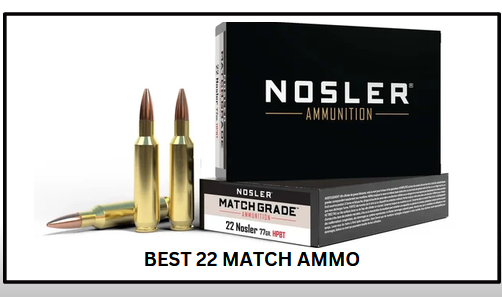
If you want to buy the best 22 match ammo, I found that the right choice depends on much more than the caliber printed on the box.
I looked at these loads with attention to the features that matter for precision-focused shooting, including bullet weight, projectile design, muzzle velocity, ballistic coefficients, brass construction, manufacturing consistency, and intended application.
These are great options because they cover different types of .22 shooting, from competition and target practice to short-barreled pistol use, hunting, and varmint applications.
In this guide, I’ll break down the key features of each load, share my top picks, explain what to look for in a buying guide, and answer common questions in the FAQs to help you find the best 22 match ammo for your shooting needs.
Our Top Picks at a Glance
- Hornady V-Match .22 ARC 62 Grain ELD-VT Brass Cased Ammunition: Best Overall
- SK Pistol Match .22 Long Rifle 40 Grain Lead Round Nose Brass Rimfire Ammunition: Best Pistol Option
- Eley Ammunition Match EPS .22 Long Rifle 40 Grain Flat Nose Brass Cased Rimfire Ammunition: Best Training Option
- Hornady Match .22 ARC 88 Grain ELD-M Brass Cased Ammunition: Best Long-Range Option
- Nosler Match Grade .22 Nosler 77 Grain Custom Competition Brass Cased Centerfire Ammunition: Best Competition Option
How We Tested the Best 22 Match Ammo
I evaluated the Best 22 Match Ammo based on the features and specifications provided for each product. I considered the following areas:
- Caliber Compatibility: I checked the cartridge designation to distinguish between .22 LR, .22 ARC, and .22 Nosler loads and their intended firearm applications.
- Bullet Weight: I compared the listed projectile weights to understand the different configurations available across the reviewed ammunition.
- Bullet Design: I examined projectile profiles such as Lead Round Nose, Flat Nose, ELD-M, ELD-VT, and Boat Tail Hollow Point designs.
- Muzzle Velocity: I compared the published velocity figures to understand the different ballistic profiles represented by the loads.
- Ballistic Characteristics: Where provided, I considered muzzle energy, ballistic coefficient, and sectional density as part of the ammunition’s published specifications.
- Case Construction: I looked at brass case construction and the manufacturer’s information about case selection and preparation.
- Manufacturing Consistency: I considered information about component selection, cartridge inspection, powder charges, bullet seating, and quality-control procedures.
- Intended Application: I assessed whether each load was designated for target shooting, competition, training, hunting, varmint use, or short-barreled firearms.
5 Best 22 Match Ammo
1) Hornady V-Match .22 ARC 62 Grain ELD-VT Brass Cased Ammunition
The Hornady V-Match .22 ARC 62 grain ammunition is designed for a mix of target shooting, match use, hunting, and varmint applications. It uses a 62 grain Extremely Low Drag Varmint-Target (ELD-VT) projectile in a brass case, with 20 rounds supplied per box.
This load has a listed muzzle velocity of 3,300 ft/s and muzzle energy of 1,499 ft-lbs. Hornady also lists a sectional density of 0.177, along with G1 and G7 ballistic coefficients of 0.395 and 0.199. These published figures provide useful information for shooters evaluating the cartridge for different target and field applications.
Hornady states that the ammunition uses carefully selected components loaded to specific standards, with an emphasis on consistency. The company also describes the components as being selected to maintain consistent performance across different temperatures.
This ammunition is best suited to .22 ARC shooters who want a factory load that can cover several precision-oriented uses, including target shooting, match activities, and varmint hunting. Its 62 grain ELD-VT projectile and published ballistic specifications make it particularly relevant to users looking for a versatile .22 ARC load.
Specifications
- Manufacturer: Hornady
- Caliber: .22 ARC
- Bullet Weight: 62 grain
- Bullet Type: ELD-VT
- Rounds: 20
- Case Material: Brass
- Muzzle Velocity: 3,300 ft/s
- Muzzle Energy: 1,499 ft-lbs
- G1 Ballistic Coefficient: 0.395
Pros
- 62 grain ELD-VT projectile
- Brass cartridge case
- Listed velocity of 3,300 ft/s
- Published G1 and G7 ballistic coefficients
- Designed for target, match, hunting, and varmint applications
- Components selected with consistency in mind
Cons
- Limited to .22 ARC chambering
2) SK Pistol Match .22 Long Rifle 40 grain Lead Round Nose (LRN) Brass Rimfire Ammunition
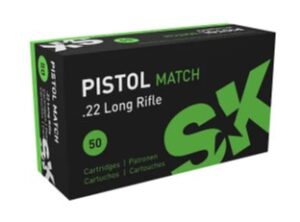
The SK Pistol Match .22 Long Rifle 40 grain ammunition is designed specifically around the requirements of short-barreled firearms. It uses a 40 grain Lead Round Nose (LRN) projectile with a brass case and rimfire priming, and each box contains 50 rounds.
SK lists this ammunition for target applications, with a published muzzle energy of 78 ft-lbs. The supplied product information also gives a 938 ft/s velocity from a 5.9-inch barrel and describes the load as subsonic. At 50 yards, the listed velocity is 879 ft/s with 69 ft-lbs of energy.
The load is configured for pistol use rather than general-purpose .22 LR shooting. Its short-barrel focus makes it suitable for shooters using .22 LR pistols for training, plinking, or competition. SK also emphasizes high manufacturing standards for its rimfire ammunition, reflecting the company’s focus on competitive shooting.
Specifications
- Manufacturer: SK
- Caliber: .22 Long Rifle
- Bullet Weight: 40 grain
- Bullet Type: Lead Round Nose
- Rounds: 50
- Case Material: Brass
- Muzzle Velocity: 922 ft/s
- Muzzle Energy: 78 ft-lbs
- Application: Target
Pros
- 40 grain LRN projectile
- Designed for short-barreled firearms
- Brass case construction
- 50-round package
- Suitable for training, plinking, and competition
- Listed as subsonic in the supplied product information
Cons
- Specifically configured around pistol and short-barrel use
3) Eley Ammunition Match EPS .22 Long Rifle 40 Grain Flat Nose Brass Cased Rimfire Ammunition
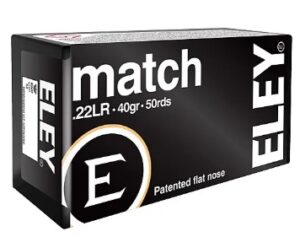
The Eley Match EPS .22 Long Rifle ammunition is a 40 grain rimfire load designed for training and competition-oriented shooting. It uses a flat nose projectile and brass cartridge case, with 50 rounds supplied per box.
The ammunition incorporates Eley’s patented flat nose profile and a cut case design. According to the supplied information, these features are intended to support consistent internal ballistic performance. The listed muzzle velocity is 1,086 ft/s, giving shooters a clear reference point when evaluating the load for their particular application.
Eley also subjects each cartridge to multiple inspection processes, including computer-controlled visual checks and calibrated measuring equipment. These production controls are intended to maintain consistency across the ammunition.
This load is best suited to .22 LR shooters involved in structured training or competitive shooting who want ammunition with a match-focused projectile design and detailed manufacturing controls. Its 40 grain flat nose configuration and 50-round package also make it suitable for regular practice sessions.
Specifications
- Manufacturer: Eley Ammunition
- Caliber: .22 Long Rifle
- Bullet Weight: 40 grain
- Bullet Type: Flat Nose
- Rounds: 50
- Case Material: Brass
- Muzzle Velocity: 1,086 ft/s
- Application: Training
- Primer Style: Rimfire
Pros
- 40 grain flat nose projectile
- Patented flat nose design
- Cut case construction
- Brass cartridge case
- Computer-controlled cartridge inspection
- Suitable for training and competition use
Cons
- Flat nose configuration may not be preferred for every .22 LR application
4) Hornady Match .22 ARC 88 Grain ELD-M Brass Cased Ammunition
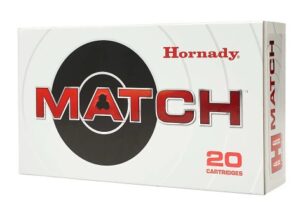
The Hornady Match .22 ARC 88 grain ammunition is designed for hunting, varmint, target, and match applications. It uses an 88 grain Extremely Low Drag Match (ELD-M) projectile loaded in a brass case, with centerfire priming.
The ELD-M bullet features Hornady’s Heat Shield tip, which is designed to maintain a consistent meplat. The load has a listed muzzle velocity of 2,820 ft/s and muzzle energy of 1,554 ft-lbs, giving shooters useful published figures for evaluating its ballistic characteristics.
Hornady also emphasizes consistency throughout the cartridge. Cases are selected according to criteria including wall thickness, internal capacity, case weight, and wall concentricity. The powder charge is matched to the specific load, while tight tolerances and quality-control procedures are used during production, including bullet seating and overall cartridge consistency.
This ammunition is best suited to .22 ARC shooters who want a match-oriented factory load for target shooting or competition, while also having a cartridge that is listed for hunting and varmint applications. It is particularly relevant to users who value carefully specified components and consistent manufacturing.
Specifications
- Manufacturer: Hornady
- Caliber: .22 ARC
- Bullet Weight: 88 grain
- Bullet Type: ELD-M
- Case Material: Brass
- Muzzle Velocity: 2,820 ft/s
- Muzzle Energy: 1,554 ft-lbs
- Application: Hunting, Varmint, Target, Match
- Primer Style: Centerfire
Pros
- 88 grain ELD-M projectile
- Heat Shield tip
- AMP bullet jacket
- Carefully selected brass cases
- Load-specific powder selection
- Tight production tolerances
- Designed for target and match applications
Cons
- Limited to .22 ARC chambering
5) Nosler Match Grade .22 Nosler 77 Grain Custom Competition Brass Cased Centerfire Ammunition
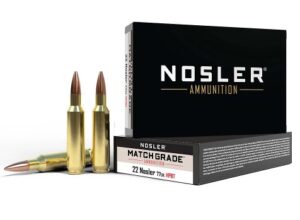
The Nosler Match Grade .22 Nosler 77 grain ammunition is designed for target shooting and match applications. It uses a 77 grain Boat Tail Hollow Point (BTHP) Custom Competition bullet loaded into a brass case, with 20 rounds supplied per box.
The Custom Competition projectile features a highly concentric jacket, precise lead alloy core, and a small meplat created by the hollow point. According to the supplied information, this design is intended to reduce drag and improve aerodynamic efficiency. The load has a listed muzzle velocity of 2,950 ft/s, muzzle energy of 1,488 ft-lbs, ballistic coefficient of 0.34, and sectional density of 0.219.
Nosler also puts considerable attention into its brass and loading process. The Custom Brass is inspected for dimensions and flash-hole alignment, then prepared for loading through processes including neck sizing, chamfering, and case preparation. Powder charges are meticulously weighed before the ammunition is assembled.
This load is best suited to .22 Nosler shooters focused on target practice, competition, and other precision-oriented range activities. It is particularly relevant to users looking for factory ammunition built around a 77 grain match projectile and carefully prepared brass components.
Specifications
- Manufacturer: Nosler
- Caliber: .22 Nosler
- Bullet Weight: 77 grain
- Bullet Type: Boat Tail Hollow Point
- Rounds: 20
- Case Material: Brass
- Muzzle Velocity: 2,950 ft/s
- Muzzle Energy: 1,488 ft-lbs
- Ballistic Coefficient: 0.34
Pros
- 77 grain Custom Competition BTHP bullet
- Highly concentric bullet jacket
- Precisely prepared brass cases
- Meticulously weighed powder charges
- Listed ballistic coefficient of 0.34
- Designed for target and match applications
Cons
- 20-round package may be limiting for high-volume practice
Why 22 Match Ammo? (Advantages)
1. Match-Focused Projectile Designs
.22 match ammunition is built around projectile designs intended for precision-oriented shooting. The products discussed use configurations such as ELD-M, ELD-VT, Lead Round Nose, and Flat Nose bullets, giving shooters different options depending on whether they are focused on target shooting, competition, training, or other applications.
2. Consistent Manufacturing
Manufacturing consistency is an important part of match ammunition. The loads discussed include examples where manufacturers emphasize carefully selected components, controlled loading processes, cartridge inspection, and tight production tolerances to maintain consistency from round to round.
3. Options for Different Shooting Applications
The ammunition covered is not limited to one type of shooting. Some loads are intended for target and match use, while others are also specified for training, hunting, or varmint applications. This gives shooters flexibility when selecting ammunition for different range or field activities.
4. Different Bullet Weight Options
The products discussed include several bullet weights, from 40 grain rimfire loads to 62, 77, and 88 grain centerfire configurations. This range gives shooters different cartridge options based on the caliber, firearm, and intended use.
5. Published Ballistic Information
Several of the loads provide useful ballistic specifications, including muzzle velocity, muzzle energy, ballistic coefficient, and sectional density. Having these figures available gives shooters measurable information when comparing ammunition characteristics for their intended application.
6. Purpose-Built Short-Barrel Options
Some .22 match ammunition is specifically configured for short-barreled firearms. This provides an option for pistol users who want ammunition designed around the characteristics of shorter barrels rather than simply using a general-purpose rifle load.
7. Quality Brass Cases
The centerfire ammunition discussed uses brass cartridge cases, with some manufacturers placing particular emphasis on case selection, dimensions, weight, wall consistency, and preparation. These details form part of the overall cartridge construction and manufacturing process.
8. Suitable for Competition and Structured Training
Match ammunition can be useful beyond casual range shooting. The products discussed include loads intended for competitive shooting, formal target work, and structured training, making them relevant to shooters who want ammunition designed around precision-focused activities.
Factors to Consider When Choosing The Best 22 Match Ammo
The first consideration is making sure the ammunition matches the firearm’s chambering. The products discussed include .22 Long Rifle, .22 ARC, and .22 Nosler, which are different cartridges and are not interchangeable. Always verify the chambering specified by the firearm manufacturer before selecting ammunition.
2. Bullet Weight
Bullet weight varies considerably across the ammunition covered, from 40 grain rimfire loads to heavier centerfire projectiles. Consider the bullet weight alongside the cartridge, firearm, and intended shooting application rather than selecting based on weight alone.
3. Bullet Design
Projectile design is another important consideration. Options include Flat Nose, Lead Round Nose, Boat Tail Hollow Point, ELD-M, and ELD-VT configurations. The appropriate design depends on the ammunition’s intended application and the characteristics the manufacturer specifies for that load.
4. Muzzle Velocity
Muzzle velocity provides a useful way to understand the ballistic profile of a particular load. The products discussed have substantially different listed velocities, so shooters should consider the published figure in relation to the cartridge, projectile weight, and intended use.
5. Ballistic Coefficient
For ammunition where ballistic coefficient is provided, it can offer additional information about the projectile’s aerodynamic characteristics. G1 and G7 values appear on some of the centerfire loads, while other ammunition may provide less ballistic data.
6. Manufacturing Consistency
Match ammunition is often selected with consistency in mind. Look for information about component selection, cartridge inspection, case preparation, powder charges, bullet seating, and quality-control procedures when evaluating how a particular load is produced.
7. Intended Application
Consider what the ammunition will actually be used for. Target shooting, competition, training, hunting, varmint applications, and pistol shooting can have different requirements, so choosing a load that matches the intended activity is important.
8. Package Size
The number of rounds per box can affect how practical a load is for regular shooting sessions. The ammunition discussed ranges from 20-round centerfire packages to 50-round rimfire boxes, so package size is worth considering based on expected range use and shooting volume.
Best 22 Match Ammo FAQs
Conclusion
Good .22 match ammunition gives a precision-focused shooter more than a box of cartridges: it provides a consistent platform for putting technique to the test.
The loads covered here span rimfire and centerfire options, with carefully designed projectiles, controlled manufacturing, and configurations suited to competition, training, target shooting, and selected field applications.
From short-barreled .22 LR pistols to higher-performance .22 centerfire rifles, there is enough variety to match different shooting disciplines.
When every shot is part of the practice, the right ammunition can make the range session more deliberate, measurable, and rewarding.
See Also:

Charles is an outdoor gear writer with a passion for exploring and reviewing outdoor equipment, optics, hunting gear, hiking essentials, and other adventure-focused products. He creates informative, practical content designed to help readers understand product features and make confident buying decisions.