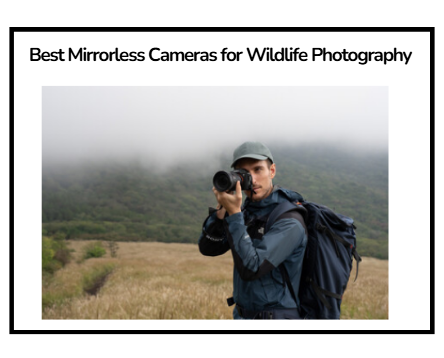
In recent years, mirrorless cameras have gained popularity among wildlife shooters due to their lightweight bodies, autofocus systems, high-resolution sensors, and advanced tracking capabilities.
The best mirrorless cameras for wildlife photography can make all the difference, whether you’re a seasoned pro upgrading your kit or an enthusiast ready to take your wildlife images to the next level.
In this guide, we’ll walk you through the top mirrorless cameras ideal for wildlife photography, highlighting key features like autofocus performance, burst shooting speed, low‑light capability, build quality, and lens ecosystem support to help you make an informed choice. Let’s dive right in.
Here is a summary of the Best Mirrorless Cameras for Wildlife Photography:
- Sony Alpha a6400 Mirrorless Camera — Best Budget Wildlife Camera – Get it on Amazon
- Sony Alpha 1 II Full-Frame Mirrorless Interchangeable Lens Camera — Best Premium/Professional Option -Get it on Amazon
- Canon EOS R6 Mark II Mirrorless Camera — Best for Fast Action & Autofocus – Get it on Amazon
- Nikon Z 9 Mirrorless Camera — Best for High-Speed Wildlife Shooting – Get it on Amazon
- Sony a7 III (ILCEM3K/B) Full-Frame Mirrorless Interchangeable-Lens Camera — Best Value Full-Frame Choice – Get it on Amazon
- Fujifilm X-T3 Mirrorless Digital Camera — Best Balance of Performance & Price- Get it on Amazon
- Nikon Z 8 Mirrorless Camera — Best All-Around Wildlife Camera – Get it on Amazon
Why Mirrorless Cameras are Ideal for Wildlife Photography
1.Faster Autofocus Systems. The best mirrorless cameras for photography use on-sensor phase detection, allowing quick and accurate tracking of moving animals.
2. Higher Continuous Shooting Speeds (FPS). Many mirrorless models can shoot 10–30 frames per second, perfect for capturing split-second wildlife action. Shorter blackout times between shots let you keep the subject in view continuously.
3. Electronic Viewfinder (EVF) Advantages. The real-time exposure, white balance, and settings preview, even before taking the shot helps photographers anticipate wildlife behavior and adjust quickly in dynamic environments.
4. Compact and Lightweight. Generally lighter than DSLRs, making them easier to carry on long hikes or safaris. This enables longer shooting sessions without fatigue, crucial for wildlife photography.
5. Silent Shooting Modes. Mirrorless cameras can shoot completely silently using an electronic shutter. As a result, they are essential for not startling shy animals, especially birds or nocturnal wildlife.
6. Better Video Capabilities. Many mirrorless cameras offer 4K or higher video, ideal for documenting animal behavior. Smooth autofocus during video makes tracking moving subjects easier.
7. Improved Low-Light Performance. Last but not least, the advanced sensors in mirrorless cameras handle dawn, dusk, and forest lighting better. The low-noise images even at high ISO settings also allows for more flexibility in natural light.
Best Mirrorless Cameras for Wildlife Photography
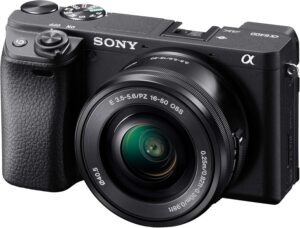
1) Sony Alpha a6400 Mirrorless Camera
Get it on Amazon
The Sony Alpha a6400 is the best mirrorless camera for wildlife photography.
Its 24.2-megapixel APS-C sensor delivers sharp, vibrant images with impressive detail, even in low-light conditions. Furthermore, the real-time Eye Autofocus and fast 425-point phase-detection autofocus system ensure the subjects remain in sharp focus whether shooting stills or video.
With a compact, lightweight body, the a6400 is highly portable and suitable for on-the-go shooting. Moreover, the fully articulating 180-degree flip screen makes it perfect for vloggers and selfie shots, while the high-resolution electronic viewfinder provides clear framing and accurate color reproduction.
In terms of video capabilities, the a6400 impresses with 4K recording at 30fps and full HD at 120fps for slow-motion footage. It offers S-Log3 and HLG picture profiles, providing flexibility for color grading in post-production.
Above all, the connectivity options like Wi-Fi, NFC, and USB-C allow seamless sharing and remote control.
Pros
- Fast and accurate autofocus with Eye AF
- Compact and lightweight design
- 24.2MP APS-C sensor delivers sharp images
- 4K video with slow-motion capability
- Fully articulating flip screen for vlogging and selfies
- High-resolution electronic viewfinder
Cons
-
No in-body image stabilization
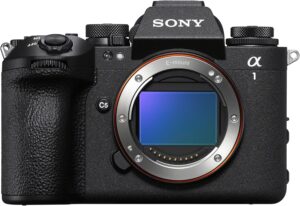
2) Sony Alpha 1 II Full-Frame Mirrorless Interchangeable Lens Camera
Get it on Amazon
The Sony Alpha 1 II is a powerhouse in the world of mirrorless cameras, designed for professional wildlife photographers and videographers who demand speed, precision, and uncompromising image quality.
Equipped with a full-frame 50.1-megapixel stacked CMOS sensor, it delivers astonishingly detailed stills with excellent dynamic range and color accuracy. Additionally, its autofocus system is lightning-fast, covering nearly the entire frame with advanced Real-Time Eye and Animal AF.
Coupled with an impressive 30 frames per second continuous shooting capability, this camera ensures that you’ll never miss a critical moment.
Furthermore, the high-resolution EVF and fully articulating touchscreen add versatility, whether shooting handheld, on a tripod, or in challenging angles.
On the video front, the Alpha 1 II shines with 8K 30p and 4K 120p recording, providing filmmakers with unmatched flexibility and professional-grade footage.
Dual card slots, fast buffer performance, and extensive connectivity options, including USB-C, Wi-Fi, and Ethernet, further make it a reliable workhorse for demanding studio or location shoots.
Pros
- Exceptional 50.1MP full-frame image quality with wide dynamic range
- Ultra-fast 30 fps continuous shooting with minimal blackout
- Advanced Real-Time Eye and Animal AF for precise focus tracking
- 8K video recording and 4K 120p for cinematic versatility
- High-resolution EVF and fully articulating touchscreen
- Robust, weather-sealed body suitable for professional use
- Dual card slots with fast data transfer
Cons
-
Sits at a high price point, limiting accessibility for hobbyists
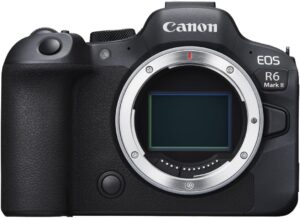
3) Canon EOS R6 Mark II Mirrorless Camera
Get it on Amazon
As one of the best mirrorless cameras for wildlife photography, the Canon EOS R6 Mark II is designed for both advanced enthusiasts and professional photographers seeking speed, versatility, and superb image quality.
Its 24.2-megapixel full-frame sensor strikes a balance between high resolution and excellent low-light performance, delivering crisp, detailed images even in challenging lighting conditions.
Furthermore, the camera’s DIGIC X processor powers an impressive continuous shooting speed of up to 12 fps with the mechanical shutter and 40 fps in electronic shutter mode, making it ideal for sports, wildlife, or fast-moving subjects.
The autofocus is enhanced with Canon’s Dual Pixel CMOS AF II, offering smooth, reliable tracking of eyes, faces, and even animals. Additionally, its fully articulated touchscreen and high-resolution EVF provide a comfortable and intuitive shooting experience, while built-in in-body image stabilization ensures sharper shots when shooting handheld.
Pros
- Excellent low-light performance and high ISO handling
- Fast continuous shooting up to 40 fps with electronic shatter
- Advanced Dual Pixel CMOS AF II with subject tracking
- In-body image stabilization
- Fully articulated touchscreen for versatile shooting angles
- High-quality 4K/60p video recording
- Durable, weather-sealed body
- Dual card slots for storage flexibility
Cons
-
The menu system can be complex for beginners
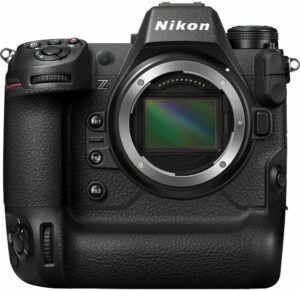
4) Nikon Z 9 Mirrorless Camera
Get it on Amazon
The Nikon Z 9 is Nikon’s flagship mirrorless camera, designed for professionals who demand speed, precision, and versatility.
Its robust full-frame sensor delivers stunning image quality with exceptional detail, even in challenging lighting conditions.
Furthermore, the autofocus system is highly advanced, offering fast and accurate subject tracking, including eye and animal detection, making it ideal for sports, wildlife, and portrait photography.
The camera’s continuous shooting capabilities are also impressive, allowing photographers to capture high-speed action without losing quality. Coupled with a solid build, extensive weather sealing, and a comfortable ergonomic design, the Z 9 is reliable for long shoots in demanding environments.
Other features it is coupled with include a powerful 8K video recording, dual card slots, comprehensive connectivity options, and an intuitive menu system that makes file management and workflow efficient.
Pros
- Exceptional full-frame image quality
- Ultra-fast and accurate autofocus system
- High-speed continuous shooting
- 8K video recording with rich dynamic range
- Durable, weather-sealed body
- Dual card slots and strong connectivity
Cons
-
High price point
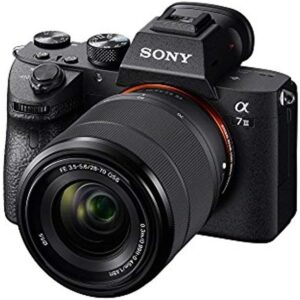
5) Sony a7 III (ILCEM3K/B) Full-frame Mirrorless Interchangeable-Lens Camera
Get it on Amazon
The Sony a7 III is another powerhouse full-frame mirrorless camera designed for both enthusiasts and professional photographers.
Its 24.2-megapixel sensor delivers exceptional image quality with impressive dynamic range and low-light performance. This makes it ideal for shooting everything from landscapes to fast-action scenes.
The included 28-70mm lens provides a versatile zoom range suitable for everyday photography. Furthermore, the camera’s 3-inch LCD screen is sharp and responsive, allowing for easy composition and review of shots, while the tilting design adds flexibility for overhead or low-angle shooting.
Combined with fast autofocus and 4K video capabilities, the a7 III handles both stills and video production with remarkable ease.
Beyond its performance, the a7 III stands out for its robust build quality and user-friendly controls. The body is solid yet comfortable in hand, and dual SD card slots are a practical feature for extended shooting sessions. Battery life is also improved over earlier models, allowing for longer shooting without frequent changes.
Pros
- Excellent low-light performance and dynamic range
- Fast and accurate autofocus system
- 4K video recording capability
- Improved battery life over previous models
- Dual SD card slots for extended shooting
- Solid, ergonomic build quality
- Versatile 28-70mm kit lens for general use
Cons
- Relatively heavy compared to other mirrorless cameras
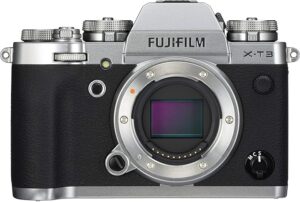
6) Fujifilm X-T3 Mirrorless Digital Camera
Get it on Amazon
If you are looking for a mirrorless camera that balances professional-level capabilities with intuitive operation, the Fujifilm X-T3 is a great option.
Its 26.1-megapixel APS-C X-Trans CMOS 4 sensor and X-Processor 4 engine deliver stunning detail, vibrant colors, and excellent dynamic range to shoot in both daylight and low-light conditions.
Furthermore, The camera’s autofocus system is fast and accurate, capable of tracking moving subjects with impressive reliability.
Paired with its high-resolution electronic viewfinder and fully articulating touchscreen, composing shots feels intuitive and responsive.
Regarding construction, the build quality is solid, with weather-sealed magnesium alloy construction that can handle rugged outdoor use without hesitation.
Video performance is another area where the X-T3 shines, offering 4K recording at up to 60fps with 10-bit 4:2:2 output. Additionally, the camera’s classic retro design, complete with physical dials for shutter speed, ISO, and exposure compensation, allows for tactile control that many photographers love.
Pros
- Exceptional image quality with vibrant colors and sharp detail
- Fast and accurate autofocus, even in low light
- 4K video at 60fps with 10-bit 4:2:2 output
- Weather-sealed, durable build
- Intuitive design with physical control dials
- Fully articulating touchscreen for versatile shooting angles
- Dual SD card slots for extra storage flexibility
Cons
-
Smaller battery life compared to some full-frame competitors
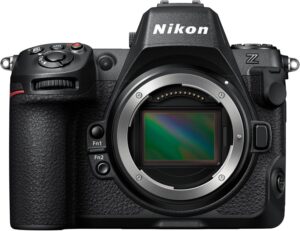
7) Nikon Z 8 Mirrorless Camera
Get it on Amazon
The Nikon Z 8 is our last recommendation for the best mirrorless cameras for wildlife photography.
As a professional full-frame mirrorless stills/video hybrid camera, its robust 45.7-megapixel sensor delivers stunningly sharp and detailed images, making it ideal for everything from commercial shoots to wildlife photography.
The camera excels in speed, offering up to 20 frames per second continuous shooting with full autofocus. Furthermore, its autofocus system is highly sophisticated, featuring advanced eye and face detection for humans, animals, and even birds.
Moreover, its build quality is exceptional, with a weather-sealed magnesium alloy body that is sturdy yet manageable for handheld use. Handling is also intuitive, thanks to its well-designed controls and high-resolution electronic viewfinder, making long sessions more comfortable and precise.
Above all, this camera supports 8K UHD recording at 30p and 4K at up to 120p, giving filmmakers enormous flexibility. It also offers 10-bit N-Log and HLG profiles, making it easy to achieve professional-grade color grading in post-production.
Pros
- Exceptional 45.7MP full-frame sensor for high-resolution stills
- Fast continuous shooting up to 20 fps
- Advanced autofocus with human, animal, and bird detection
- 8K and 4K video capabilities with professional-grade color profiles
- Dual card slots and robust connectivity options
- Solid, weather-sealed build for professional use
- Intuitive controls and comfortable ergonomics
Cons
- High price point
Next Read: 8 Best Mirrorless Cameras for Photography
Key Features to Consider when Choosing the Best Mirrorless Cameras for Wildlife Photography
When choosing the best mirrorless cameras for wildlife photography, consider the following factors:
Autofocus Performance
One of the most critical features to consider is autofocus performance. Wildlife subjects move quickly and unpredictably, so a camera with fast, accurate autofocus and advanced subject-detection, especially animal and bird eye AF. This will help you lock onto your subject and keep it sharp, even in challenging conditions.
Continuous Shooting Speed
Another essential feature is continuous shooting speed. Wildlife moments are often fleeting, and a high burst rate allows you to capture a rapid sequence of images to ensure you don’t miss the perfect wing position, leap, or expression. A generous buffer is equally important, as it lets you shoot continuously without the camera slowing down.
Sensor Resolution and Image Quality
Furthermore, sensor resolution and image quality play a major role in wildlife photography. Higher-resolution sensors allow for more cropping flexibility when subjects are far away, while good low-light performance ensures clean, detailed images during early morning or late evening shoots when wildlife is most active.
ISO Performance
The camera’s ISO performance is especially important for wildlife photographers who often work in low light or shaded environments. A mirrorless camera that handles high ISO settings well will produce less noise and better detail, allowing you to maintain fast shutter speeds without sacrificing image quality.
In-body Image Stabilization (IBIS)
Next, in-body image stabilization is another valuable feature to look for. Wildlife photography frequently involves handheld shooting with long telephoto lenses, and effective stabilization helps reduce camera shake, resulting in sharper images, particularly at slower shutter speeds.
Weather Sealing
Durability and weather sealing are crucial when photographing wildlife in the field. The best mirrorless cameras for wildlife photography should be designed to withstand dust, moisture, and varying temperatures give you the confidence to shoot in forests, wetlands, or savannahs without worrying about damaging your gear.
Power Management
More importantly, battery life and power management should not be overlooked. Wildlife shoots can last for hours, and mirrorless cameras are known to consume more power. A camera with efficient battery performance or support for battery grips ensures you can keep shooting without constant interruptions.
Lens Compatibility
Finally, lens compatibility and system support are key considerations. A strong mirrorless ecosystem with a wide range of native telephoto and super-telephoto lenses gives you the flexibility to adapt to different wildlife subjects, from small birds to large mammals, and grow your kit as your skills advance.
Accessories to Consider
When investing in a mirrorless camera for wildlife photography, having the right accessories will significantly enhance your shooting experience, improve image quality, and ensure you’re prepared for long hours in the field. Below are the primary accessories to consider:
Best Mirrorless Cameras for Wildlife Photography FAQs
- How important is animal or bird eye autofocus?
Animal and bird eye autofocus is extremely important for wildlife photography, especially for fast-moving subjects. It helps maintain sharp focus on the eyes, which is crucial for creating compelling and professional-looking wildlife images.
- What burst rate is ideal for wildlife photography?
An ideal burst rate for wildlife photography is typically 10 frames per second or higher. Faster burst rates increase your chances of capturing decisive moments such as takeoff, flight, or sudden movement.
Do I need in-body image stabilization for wildlife photography?
Yes. In-body image stabilization is highly beneficial. It helps reduce camera shake when shooting handheld with long lenses, especially in low light, and works alongside lens stabilization for even better results.
Conclusion
In wildlife photography, preparation is just as important as skill. All options mentioned above offer a powerful combination of speed, precision, and image quality, allowing photographers to confidently track fast-moving subjects in diverse lighting conditions. Whether you prioritize speed, reach, image quality, or overall versatility, there is a mirrorless camera that fits your needs and budget.

Albert, the founder of Outdoormoran, is a dedicated outdoor enthusiast with a passion for delivering the most current, accurate, and easy-to-understand information on all different outdoor gear and optics. He shares his expertise with beginners by teaching the technical aspects of outdoor gear and optics through his comprehensive collection of guides.