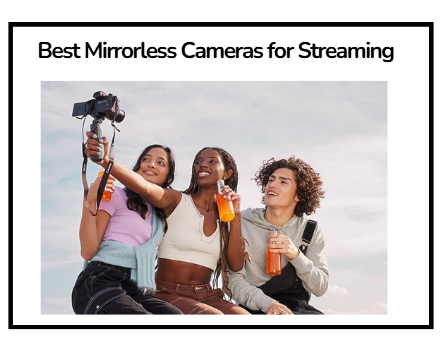
Streaming has become a major way to connect with audiences, whether you’re gaming, teaching, podcasting, or hosting live events. While many creators start with built-in laptop webcams or basic USB webcams, the best mirrorless cameras for streaming are quickly becoming the go-to choice for high-quality stream production.
This buying guide breaks down everything you need to know to choose the best mirrorless camera for streaming, from key specs and must-have features to real-world recommendations across different budgets and use cases.
Whether you’re a beginner looking to level up your stream or a seasoned creator seeking a pro-level upgrade, we’ll help you find the perfect camera to elevate your content.
Here is a summary of the Best Mirrorless Cameras for Streaming:
- Best Overall for Streaming: Sony Alpha ZV-E10 Vlog Camera — Excellent balance of video quality, streaming features, and value.- Get it on Amazon
- Best DSLR Alternative (Budget Starter): Canon EOS Rebel T7 DSLR Camera — Not mirrorless, but a solid entry option for beginners on a budget.- Get it on Amazon
- Best Canon Mirrorless All-Around: Canon EOS R50 Mirrorless Camera — Great autofocus and video quality for streaming and content creation – Get it on Amazon
- Best for Hybrid Use (Photo + Stream): Sony Alpha a6400 Mirrorless Camera — Strong AF and streaming performance in a versatile body.- Get it on Amazon
- Best Advanced Sensor Option: OM SYSTEM Olympus OM-1 Mark II Micro Four Thirds System Camera — Excellent image stabilization and robust feature set.- Get it on Amazon
- Best Compact Canon Mirrorless: Canon EOS M50 Camera — Popular choice for beginner streamers and vloggers.- Get it on Amazon
- Best Compact Vlog-Focused Camera: Sony ZV-1F Vlog Camera for Content Creators and Vloggers — Simple, solid for streaming on the go.- Get it on Amazon
What are Mirrorless Camera?
A mirrorless camera is a type of digital camera that does not use the traditional mirror mechanism found in DSLRs. Instead, it relies on a digital image sensor to capture light and generate an image. This design lets mirrorless cameras be lightweight and compact while still delivering professional-grade photo and video quality.
Why Mirrorless Cameras are Great for Streaming
Mirrorless cameras are a great choice for streaming for the following reasons:
1. Superior Image Quality. Larger sensors deliver sharper video, better color depth, and cleaner images than most webcams, especially in low light.
2. Excellent Low-Light Performance. Mirrorless cameras handle higher ISO levels with less noise, making them ideal for indoor or nighttime streaming setups.
3. Advanced Autofocus Systems. Furthermore, features like face detection and eye-tracking keep you consistently sharp and in focus, even when you move.
4. Interchangeable Lenses. The best mirrorless cameras for streaming allow you to choose wide-angle lenses for desk setups, fast prime lenses for background blur, or zoom lenses for flexibility.
5. Clean HDMI Output. Many models provide overlay-free HDMI output, enabling a professional video feed when used with a capture card.
6. USB Webcam Support. Some mirrorless cameras connect directly to a computer via USB, simplifying setup without extra hardware.
7. In-Body Image Stabilization (IBIS). This feature helps reduce shake for handheld or dynamic streaming scenarios.
8. Compact and Lightweight Design. Mirrorless cameras are easier to mount on tripods, desk arms, or small rigs without cluttering your setup.
9. Scalable for Growth. Last but not least, these cameras are suitable for beginners upgrading from webcams and professionals building high-end streaming setups.
Best Mirrorless Cameras for Streaming
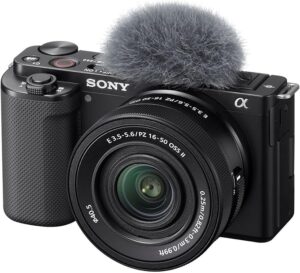
1) Sony Alpha ZV-E10 Vlog Camera
Get it on Amazon
The Sony Alpha ZV-E10 is the best mirrorless camera for streaming. It is an outstanding choice for vloggers and content creators who want a powerful, versatile camera without the complexity and bulk of traditional mirrorless systems.
From the moment you pick it up, the lightweight design and intuitive grip make it feel comfortable in hand, whether you’re shooting handheld or on a gimbal.
Furthermore, the 24.2-megapixel APS-C sensor delivers crisp, vibrant images and offers excellent low-light performance, while the flip-out touchscreen makes framing yourself effortless.
The autofocus is fast and reliable, with smooth subject tracking that keeps your focus locked on your face or subject even during movement. Additionally, Sony’s color science and image processing produce pleasing tones straight out of the camera, reducing the amount of post-production work needed.
In practice, the ZV-E10 shines as a video tool. The kit’s included lens provides a versatile focal range that suits everything from wide-angle indoor shots to tighter outdoor compositions.
Moreover, the camera captures detailed 4K footage with minimal rolling shutter, and features like product showcase and background bokeh help elevate your vlogs with professional-looking results.
Above all, the audio quality is strong for an onboard mic, and the dedicated shoe mount makes attaching external mics or accessories easy.
Pros
- Lightweight, compact body
- Fast, accurate autofocus with reliable face and eye tracking
- Flip-out touchscreen makes self-recording and framing easy
- High-quality 4K video with useful creator-focused features like background bokeh and product showcase
- Interchangeable lens system allows creative flexibility and future upgrades
- Good onboard audio and easy support for external microphones
- USB-C webcam functionality for streaming and online content creation
Cons
-
No in-body image stabilization, requiring stabilized lenses or a gimbal for smoother footage
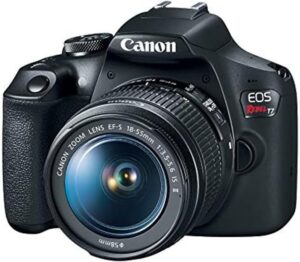
2) Canon EOS Rebel T7 DSLR Camera
Get it on Amazon
The Canon EOS Rebel T7 DSLR Camera is a beginner-friendly DSLR designed for users stepping up from smartphones or compact cameras.
It features a 24.1-megapixel APS-C CMOS sensor paired with Canon’s DIGIC 4+ image processor, delivering sharp images with natural colors, especially in good lighting.
The camera’s straightforward control layout, guided menu system, and optical viewfinder make it easy to learn traditional photography fundamentals such as exposure, depth of field, and composition.
Furthermore, the built-in Wi-Fi and NFC add convenience, allowing quick photo transfers to a smartphone or remote shooting through Canon’s Camera Connect app.
What’s more, the Rebel T7 performs reliably for everyday photography, including portraits, landscapes, family events, and casual wildlife shots. The 9-point autofocus system is simple but effective for static subjects, while Canon’s extensive EF and EF-S lens ecosystem gives users plenty of room to grow creatively.
Pros
- 24.1MP APS-C sensor delivers sharp, detailed images
- Beginner-friendly interface with guided shooting modes
- Optical viewfinder for a traditional DSLR shooting experience
- Built-in Wi-Fi and NFC for easy photo sharing
- Access to a wide range of Canon EF and EF-S lenses
- Lightweight and comfortable to hold
Cons
- The 9-point autofocus system feels basic by modern standards
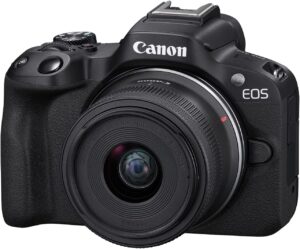
3) Canon EOS R50 Mirrorless Camera
Get it on Amazon
The Canon EOS R50 Mirrorless Camera with RF-S 18–45mm F4.5–6.3 IS STM Lens Kit is a compact, beginner-friendly mirrorless system that delivers impressive performance for its size and price.
Built around a 24.2MP APS-C sensor and Canon’s DIGIC X processor, the R50 produces sharp, vibrant images with pleasing color straight out of the camera.
Furthermore, Canon’s Dual Pixel CMOS AF II is another notable feature. It offers fast, accurate autofocus with intelligent subject detection for people, animals, and vehicles.
The lightweight body, intuitive controls, and fully articulating touchscreen make it especially appealing to newcomers stepping up from smartphones or older DSLRs.
For video creators, the EOS R50 punches above its class. It records oversampled 4K video with excellent detail and minimal rolling shutter, making it well suited for vlogging, content creation, and casual filmmaking.
Additionally, the included RF-S 18–45mm STM lens complements the camera well, providing a versatile focal range for everyday shooting while delivering smooth, quiet autofocus for video.
Pros
- Excellent 24.2MP APS-C image quality with Canon color science
- Fast and reliable Dual Pixel CMOS AF II with subject tracking
- Oversampled 4K video ideal for vlogging and content creation
- Compact, lightweight body with fully articulating touchscreen
- User-friendly interface suitable for beginners
Cons
-
No in-body image stabilization
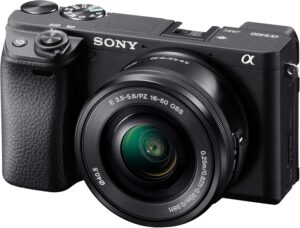
4) Sony Alpha a6400 Mirrorless Camera
Get it on Amazon
As one of the best mirrorless cameras for streaming, the Sony Alpha a6400 excels in both photography and videography.
Its 24.2-megapixel APS-C sensor delivers sharp, vibrant images with impressive detail and dynamic range, even in low-light conditions. Furthermore, the advanced autofocus system, which includes real-time Eye AF for humans and animals, ensures subjects remain sharply in focus during fast-moving scenes.
The camera also boasts a high-speed continuous shooting rate of 11 frames per second, making it ideal for capturing action shots, sports, or wildlife. Its compact and lightweight design makes it convenient for travel and everyday shooting without compromising performance.
For videographers, the a6400 offers 4K video recording with full pixel readout and no pixel binning, producing clean, high-quality footage. Moreover, the flip-up LCD screen is perfect for vlogging and selfies, while the robust build ensures durability in various shooting conditions.
Above all, connectivity features like Wi-Fi and Bluetooth allow for easy file transfer and remote control via a smartphone, streamlining workflow for creators on the go.
Pros
- Advanced Real-Time Eye AF and fast autofocus
- High-resolution 24.2MP APS-C sensor
- 4K video recording with full pixel readout
- 11 fps continuous shooting
- Compact, lightweight, and travel-friendly
- Fully articulating flip-up LCD screen
- Wi-Fi and Bluetooth connectivity
Cons
-
No in-body image stabilization
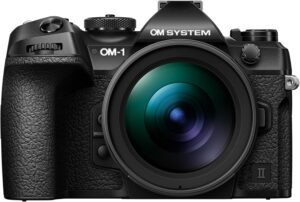
5) OM SYSTEM Olympus OM-1 Mark II Micro Four Thirds System Camera
Get it on Amazon
The OM SYSTEM Olympus OM-1 Mark II is a powerhouse for photographers and videographers seeking a compact yet versatile Micro Four Thirds system.
Its rugged, weather-sealed body ensures durability in challenging conditions, making it ideal for outdoor and travel photography.
Furthermore, the camera boasts a high-resolution 20.4MP stacked Live MOS sensor paired with the TruePic X image processor, delivering fast autofocus, excellent low-light performance, and striking image quality.
The advanced in-body image stabilization allows for sharper handheld shots, even in low-light or telephoto scenarios, while the fast burst shooting up to 120 fps in RAW mode captures action with precision.
Additionally, its intuitive menu system and customizable controls make navigating settings seamless for both beginners and professionals. The electronic viewfinder offers a bright, lag-free display, while the fully articulating touchscreen simplifies vlogging and creative angles.
Video creators will also appreciate the OM-1 Mark II’s impressive 4K 60p recording and 10-bit internal video capabilities, which produce rich, cinematic footage.
Pros
- Compact, lightweight, and weather-sealed body
- 20.4MP stacked sensor with excellent image quality
- Advanced in-body image stabilization
- Fast burst shooting up to 120 fps
- High-quality 4K 60p and 10-bit video recording
- Fully articulating touchscreen for versatile shooting angles
- Intuitive menu system with customizable controls
Cons
-
Smaller Micro Four Thirds sensor
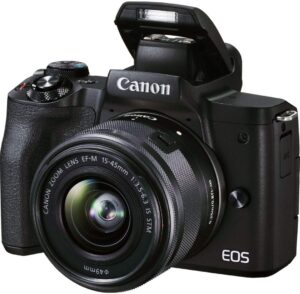
6) Canon EOS M50 Camera
Get it on Amazon
The Canon EOS M50 is a versatile mirrorless camera designed for both budding photographers and content creators who want a compact yet powerful imaging tool.
Its 24.1-megapixel APS-C sensor delivers sharp, vibrant images with excellent color reproduction, making it suitable for everything from portraits to landscapes.
Furthermore, the DIGIC 8 processor ensures fast performance, allowing quick autofocus and responsive operation, which is particularly useful for capturing fleeting moments.
The camera also boasts 4K video recording, although with a slight crop, along with Full HD at 60fps for smoother footage.
To complement the processor, its fully articulating touchscreen makes composing shots from challenging angles effortless and is ideal for vlogging or self-recording.
Moreover, the Dual Pixel autofocus system provides smooth and accurate focus tracking during both photo and video shooting, while the built-in electronic viewfinder offers a clear and detailed view.
Pros
- Compact and lightweight design
- 24.1MP APS-C sensor for sharp, detailed images
- Dual Pixel autofocus for fast and accurate focusing
- 4K video recording with Full HD at 60fps
- Fully articulating touchscreen for vlogging and selfies
- Built-in electronic viewfinder
- Easy connectivity with Wi-Fi and Bluetooth
Cons
-
Limited battery life compared to larger DSLRs
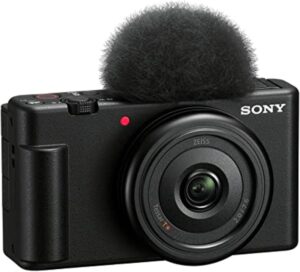
7) Sony ZV-1F Vlog Camera for Content Creators and Vloggers
Get it on Amazon
Next, we have the Sony ZV-1F Vlog Camera for Content Creators and Vloggers.
As one of the best mirrorless cameras for streaming, it features a large 20.1MP sensor that delivers sharp, vibrant images and excellent low-light performance, making it ideal for both indoor and outdoor filming.
Furthermore, the camera comes equipped with a 20mm wide-angle lens that captures expansive backgrounds, perfect for vlogging, travel videos, or lifestyle content.
For added convenience, its user-friendly interface, including a fully articulating screen and intuitive touch controls, makes framing shots, switching modes, and reviewing footage straightforward, even for beginners.
Additionally, the camera is optimized for social media content. It supports Full HD video at 60fps, providing smooth, professional-looking results. Moreover, the built-in microphone with windscreen ensures clear audio capture without the need for external accessories.
Another key advantage of the ZV-1F is its compact size and lightweight design, which makes it extremely portable for on-the-go creators. Sony also includes intelligent features such as real-time Eye Autofocus, face-priority exposure, and background defocus for cinematic-style shots with minimal effort.
Pros
- Compact and lightweight, ideal for travel and on-the-go filming
- Excellent image quality with 20.1MP sensor
- Wide-angle lens perfect for vlogging
- Fully articulating touchscreen for easy framing
- Real-time Eye Autofocus and face-priority exposure
- Vertical video support for social media platforms
- Built-in high-quality microphone with windscreen
Cons
- Limited zoom capabilities due to fixed wide-angle lens
Next Read: 6 Best 4k Mirrorless Cameras
Criteria for Choosing the Best Mirrorless Cameras for Streaming
Whether you are buying a mirrorless camera for the first time or looking for an upgrade, consider these key factors before settling for any model:
Image Quality
Firstly, the core of any streaming setup is how you look on camera. Mirrorless cameras typically offer larger sensors than webcams, giving better resolution, color depth, and low-light performance. Look for cameras with at least 1080p resolution, though 4K capability is preferable for future-proofing. High-quality image processing ensures sharp visuals and natural skin tones, which can make your stream more professional and engaging.
Autofocus Performance
Smooth and reliable autofocus is essential for maintaining a sharp image during live streams, especially if you move around. Cameras with advanced face or eye-detection autofocus make it easier to stay in focus without constant manual adjustments, improving viewer experience. Fast and accurate autofocus reduces distractions and keeps the focus on you rather than the camera.
Lens Compatibility
The best mirrorless cameras for streaming benefit from interchangeable lenses, allowing you to choose lenses suitable for your streaming environment. Wide-aperture lenses provide better low-light performance and attractive background blur, while wide-angle lenses are useful if you want to show your workspace or a larger scene. Ensure the camera supports lenses that fit your intended streaming setup.
Connectivity Options
For streaming, it’s crucial that your camera can connect to your computer or streaming software seamlessly. Cameras with clean HDMI output or USB streaming capability are ideal. Some models support direct USB webcam mode, which eliminates the need for capture cards. Reliable connectivity ensures smooth, lag-free video streams.
Battery Life and Power Options
Long streaming sessions can quickly drain camera batteries, which can interrupt your broadcast. Look for cameras with extended battery life or the ability to use continuous power via AC adapters or USB-C. This ensures uninterrupted streaming without constant battery swaps or shutdowns.
Size and Portability
The best mirrorless cameras for streaming are generally more compact than DSLRs, making them easy to set up in home studios or on desks. A lightweight and compact camera allows flexible placement and less clutter, while still delivering high-quality video. Portability also matters if you plan to stream from different locations.
Audio Support
Next, built-in microphones on most mirrorless cameras are limited, so check whether the camera has a microphone input for external mics. Good audio quality is just as important as video quality for a professional streaming experience. Cameras with headphone jacks for real-time audio monitoring are an added advantage.
Price and Value
Finally, balancing features with budget is key. High-end mirrorless cameras offer excellent video quality and features, but even mid-range models can provide outstanding streaming performance. Consider your priorities, whether it’s 4K video, low-light performance, or lens flexibility, and choose a camera that offers the best value for your streaming needs.
Settings Tips for Streaming
1.Resolution & Frame Rate. Most streaming platforms support 1080p at 60fps for smooth motion.. Some cameras offer 4K, but it may require downscaling or higher bandwidth, 1080p is usually are reliable.
2. Shutter Speed. Set your shutter speed to roughly double your frame rate (e.g., 1/120 for 60fps) to avoid motion blur.
3. ISO and Exposure. Keep ISO as low as possible to reduce noise. Use manual exposure mode to avoid sudden brightness changes during streaming.
4. White Balance. Set manually or use a preset to ensure consistent colors under your lighting.
5. Picture Profile. Standard or neutral profiles work well; avoid overly stylized profiles unless doing post-processing.
FAQs
- Do I need a 4K camera for streaming, or is 1080p enough?
While 1080p is sufficient for most streaming platforms, a 4K camera offers sharper image quality and more flexibility for cropping or zooming in post-production. However, 4K requires more bandwidth, so ensure your internet can handle it
- How important is autofocus for streaming
Very important especially if you move around during streams. Cameras with face and eye-detection autofocus keep you in focus automatically, making your streams look professional without constant adjustments.
- Is built-in audio good enough for streaming?
Built-in microphones are convenient but usually don’t match the quality of external mics. For the best audio, use a dedicated USB or XLR microphone. Cameras with mic input and headphone monitoring are ideal.
Final Words
In conclusion, choosing the best mirrorless camera for streaming involves balancing image quality, autofocus performance, lens options, connectivity, audio support, and practical considerations like battery life and size. Prioritizing the features that matter most to your streaming style. whether it’s face-focused streams, creative setups, or long gaming sessions, and choose a camera that enhances both your visuals and your viewers’ experience.

Albert, the founder of Outdoormoran, is a dedicated outdoor enthusiast with a passion for delivering the most current, accurate, and easy-to-understand information on all different outdoor gear and optics. He shares his expertise with beginners by teaching the technical aspects of outdoor gear and optics through his comprehensive collection of guides.