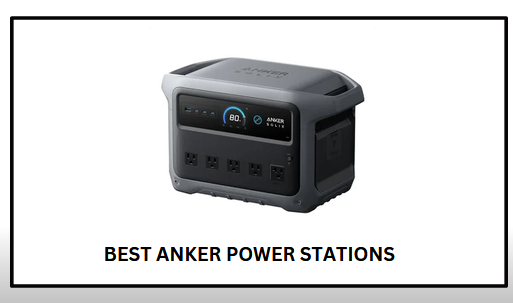
A sudden blackout, a remote campsite, or a long RV journey can quickly remind me how important dependable backup power really is. I find the Best Anker Power Stations especially useful because they combine portable designs with the capacity and features needed for a variety of situations.
Depending on the model, I can get a durable LiFePO4 battery, high continuous output, rapid AC charging, solar charging, multiple device ports, UPS protection, and app-based power management. Compact options suit travel and everyday electronics, while larger models provide more storage, RV connections, 120V/240V output, and expandable capacity for demanding backup applications.
In this guide, I’ll review the key features of the Best Anker Power Stations, reveal my top picks for different needs, explain the factors I consider before buying, and answer frequently asked questions to help you choose the right model.
Our Top Picks at a Glance
- Anker SOLIX S2000 Portable Power Station — Best for Long Runtime -Get it on Amazon
- Anker SOLIX C1000 Gen 2 Portable Power Station — Best Overall -Get it on Amazon
- Anker SOLIX C2000 Gen 2 Portable Power Station — Best for RV Use -Get it on Amazon
- Anker SOLIX C300 Portable Power Station — Best Budget Option -Get it on Amazon
- Anker SOLIX F3800 Portable Power Station — Best Premium Option – Get it on Amazon
How We Tested the Best Anker Power Stations
To evaluate the Best Anker Power Stations, I focused on the features that have the biggest effect on everyday performance. I considered battery capacity, continuous and peak output, charging speed, charging methods, available ports, portability, and overall functionality. I also looked at how well each model fits different uses, including camping, travel, RV trips, remote work, and emergency backup.
Charging performance was another important part of my assessment. I considered AC, solar, car, and alternator charging options where available. Stated recharge times and solar input limits also helped determine how practical each unit would be when power needs to be restored quickly or when operating away from the grid.
Battery performance and durability were also considered. I looked at LiFePO4 battery chemistry, cycle ratings, estimated lifespan, standby consumption, and expansion options. Since actual runtime depends on the connected devices and their power demands, I treated advertised runtime figures as estimates rather than guaranteed results.
Finally, I assessed features such as UPS functionality, app controls, noise levels, warranty coverage, weight, and physical design. These factors helped me identify the models that offer the best fit for different power requirements and usage situations.
Best Anker Power Stations
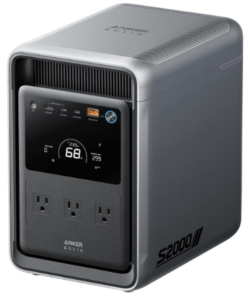
1) Anker SOLIX S2000 Portable Power Station
Get it on Amazon
The Anker SOLIX S2000 Portable Power Station offers a strong balance of battery capacity, portability, and backup performance. It provides 2,010Wh of LiFePO4 storage with 1,500W of continuous power and up to 3,000W of peak output. That combination makes it useful for home backup, emergencies, outdoor activities, and home office equipment.
The battery uses 314Ah LiFePO4 cells and can deliver up to 10,000 charge cycles while retaining 80% of its original capacity. Anker estimates a service life of around 15 years. This long cycle rating makes the S2000 suitable for users who expect to recharge and use their power station regularly.
Energy efficiency also helps extend its runtime. The unit draws about 6W while idle, and its inverter provides improved efficiency compared with typical 2kWh systems. Under Anker’s stated test conditions, the S2000 can keep a 700L refrigerator running for up to 35 hours. Your actual results will vary with the refrigerator, temperature, and power consumption.
Portability is another useful quality. The S2000 measures 8.19 × 11.1 × 12.7 inches and weighs 35.7 pounds. Its relatively compact body makes it easier to position indoors or carry when additional power is needed elsewhere. Eight outlets sit across the front and rear, helping users separate frequently used devices from appliances that remain connected.
Charging flexibility adds further convenience. You can recharge the unit from an AC outlet, solar panels, a generator, an alternator charger, or a compatible car charging setup. It also supports combined AC and solar charging. However, its maximum solar input stands at 400W, so users with larger solar arrays cannot take full advantage of their panel capacity.
Home office users can also use the S2000 as a UPS. Its transfer time of 10 milliseconds or less helps keep connected equipment powered when the electricity goes out. Wi Fi app support lets users monitor the station, manage settings, and install firmware updates. The unit also offers a Silent Mode rated at around 30dB.
For everyday appliances, the 1,500W continuous output can handle many essential electronics and moderate power loads. However, demanding appliances that require sustained high wattage may exceed its capability. The S2000 also provides 120V AC output only, lacks a 12V DC port, and does not support battery expansion.
Best For: I would recommend the Anker SOLIX S2000 to homeowners who want reliable backup power for essential appliances and electronics. It also works well for remote workers who need UPS protection for computers and networking equipment.
Campers and other outdoor users can benefit from its portable design and multiple charging options. However, users who need 240V power, expandable storage, or native 12V DC connectivity should consider these limitations before buying.
Specifications
- Battery capacity: 2,010Wh LiFePO4
- Battery cycles: Up to 10,000 cycles
- Continuous output: 1,500W
- Peak output: 3,000W
- Solar input: Up to 400W
- UPS transfer time: < 10 ms
- Output ports: 8
- Weight: 35.7 lbs
- Dimensions: 8.19 × 11.1 × 12.7 inches
Pros
- 2,010Wh LiFePO4 battery with a rating of up to 10,000 cycles
- Compact body with a weight of 35.7 pounds
- Refrigerator runtime of up to 35 hours under specified test conditions
- UPS transfer time of 10 milliseconds or less
- Several charging methods for home and off grid use
- Front and rear outlets help organize connected equipment
- Wi Fi app supports monitoring and firmware updates
- Silent Mode offers operation around 30dB
- Five-year warranty
Cons
- 1,500W continuous output limits use with high-demand appliances
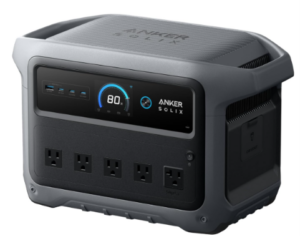
2) Anker SOLIX C1000 Gen 2 Portable Power Station
Get it on Amazon
The Anker SOLIX C1000 Gen 2 Portable Power Station is a compact power station designed for camping, emergency backup, RV trips, and remote work. It combines a 1,024Wh LiFePO4 battery with 2,000W of continuous output and 3,000W of peak power. Its portable design also makes it convenient to move between rooms, vehicles, campsites, and outdoor locations.
Fast charging makes the C1000 Gen 2 particularly convenient when you need power again quickly. HyperFlash technology allows 1,600W AC charging through the Anker app. With this feature enabled, Anker states that the unit can reach a full charge in about 49 minutes.
Solar charging gives off-grid users another useful option. The power station accepts up to 600W of solar input with a maximum 60V open-circuit voltage. Under the stated conditions, Anker estimates a full solar recharge in about 1.8 hours. Users can also recharge it through AC power, a car, a generator, and other supported charging methods.
The 1,024Wh battery uses LiFePO4 chemistry for long-term durability. Anker rates it for more than 4,000 cycles while retaining at least 80% capacity. The company estimates a service life of around 10 years, making it suitable for regular backup and recreational use.
Power output is another major strength. The C1000 Gen 2 delivers up to 2,000W continuously and 3,000W at peak demand. Its 10 output ports allow users to run several devices at once. This setup can support many everyday electronics and moderate power appliances, although high-draw devices can reduce runtime quickly.
The compact body makes transportation easier. At 24.9 pounds, the unit is practical for camping, RV travel, tailgating, and moving around the home. Its dimensions measure 15.1 × 8.2 × 9.6 inches, giving users a relatively manageable storage footprint.
For emergencies, the C1000 Gen 2 includes a UPS function with a transfer time of 10 milliseconds or less. This feature can help keep equipment such as laptops, routers, and CPAP machines running when mains power fails. Pure sine wave output also makes it suitable for sensitive electronics that require stable AC power.
The Anker app adds useful control options. Users can monitor the power station over Wi Fi, manage charging behavior, and receive firmware updates. TOU Mode also allows users to schedule power usage around time-of-use periods. However, HyperFlash charging requires activation through the app rather than operating automatically.
Best For: I would recommend the C1000 Gen 2 to campers, RV users, remote workers, and homeowners who need portable emergency power. Its fast AC charging and 600W solar input also suit users who frequently recharge away from the grid.
The 1,024Wh capacity works well for shorter backup periods, but users planning extended outages should consider their expected power consumption carefully.
Specifications
- Battery capacity: 1,024Wh LiFePO4
- Continuous output: 2,000W
- Peak output: 3,000W
- Battery life: 4,000+ cycles to 80% capacity
- AC charging: 1,600W with HyperFlash
- Solar input: Up to 600W
- Output ports: 10
- UPS transfer time: ≤10ms
- Weight: 24.9 lbs
Pros
- 1,024Wh LiFePO4 battery with a 4,000+ cycle rating
- Fast 1,600W AC charging can reach full capacity in about 49 minutes
- Up to 600W solar input for off-grid charging
- 2,000W continuous output supports many household and camping devices
- 10 output ports allow multiple devices to operate simultaneously
- Compact 24.9-pound design improves portability
- UPS function switches over in 10 milliseconds or less
- Wi Fi app provides monitoring and charging controls
- Five-year warranty
Cons
- 1,024Wh capacity may limit extended backup sessions
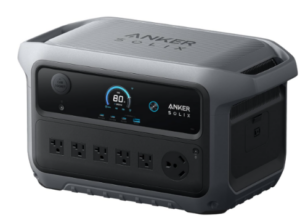
3) Anker SOLIX C2000 Gen 2 Portable Power Station
Get it on Amazon
The Anker SOLIX C2000 Gen 2 is a powerful portable power station for camping, RV travel, emergency backup, and off-grid use. It pairs a 2,048Wh LiFePO4 battery with 2,400W of continuous output and up to 4,000W of peak power. The unit also includes a dedicated 30A TT 30 RV outlet, making it useful for compatible recreational vehicles.
Fast recharging is one of the C2000 Gen 2’s most useful features. Anker states that AC and solar charging together can take the battery from empty to full in about 58 minutes. The station also supports six charging methods, giving users several ways to restore power at home, on the road, or away from the grid.
Solar charging works with up to 800W of alternator charging through the appropriate setup. The alternator option can recharge the station fully in about three hours. That feature can benefit RV users and road trippers who need to replenish the battery while traveling.
The 2,048Wh LiFePO4 battery provides substantial energy storage for essential appliances and electronics. Anker rates the battery for more than 4,000 cycles while retaining at least 80% of its capacity. OptiSave technology also keeps standby consumption around 9W, which can help reduce unnecessary battery drain.
Users can expand the C2000 Gen 2 to 4,096Wh by adding a BP2000 expansion battery. Anker states that a dual-door refrigerator can run for up to 32 hours from the main unit and up to 64 hours with the added battery under specified conditions. Actual results will vary according to the refrigerator, temperature, and power demand.
Power output reaches 2,400W during normal operation and 4,000W at peak demand. This capacity allows the station to operate multiple devices simultaneously and can support many household and RV appliances. However, high-draw equipment such as space heaters can consume the available energy quickly.
Portability remains practical despite the large battery. The C2000 Gen 2 weighs 41.7 pounds and measures 18.1 × 9.8 × 10.1 inches. Its compact dimensions make storage easier, although the unit does not include built-in wheels for moving it over longer distances.
A UPS function provides a transfer time of 10 milliseconds or less. This feature can help maintain power for connected electronics when the main electricity supply fails. The Anker app also provides Wi Fi monitoring, firmware updates, automatic charging controls, and Time of Use scheduling.
Best For: I would recommend the C2000 Gen 2 to RV owners, campers, homeowners, and off-grid users who need substantial portable energy storage. Its 30A RV outlet and alternator charging also make it suitable for road trips and recreational vehicle setups.
The expandable battery provides additional flexibility for longer backup periods. However, users who need native 240V output should note that this model supplies 120V AC power.
Specifications
- Battery capacity: 2,048Wh LiFePO4
- Continuous output: 2,400W
- Peak output: 4,000W
- Battery life: 4,000+ cycles to 80% capacity
- Solar input: Supports combined AC and solar charging
- Alternator charging: 800W
- UPS transfer time: ≤10ms
- RV outlet: 30A TT 30
- Weight: 41.7 lbs
Pros
- 2,048Wh LiFePO4 battery with a 4,000+ cycle rating
- Expandable storage up to 4,096Wh with a BP2000 battery
- Fast AC and solar charging can reach full capacity in about 58 minutes
- 2,400W continuous output with 4,000W peak power
- Dedicated 30A TT 30 outlet for compatible RV equipment
- 800W alternator charging supports mobile recharging
- UPS transfer time of 10 milliseconds or less
- Wi Fi app includes monitoring and charging management
- Five-year warranty
Cons
- No built-in wheels for easier repositioning
4) Anker SOLIX C300 Portable Power Station
Get it on Amazon
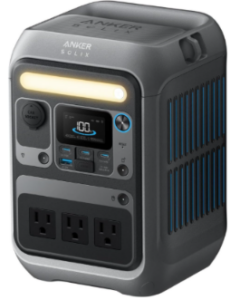
The Anker SOLIX C300 is a compact portable power station designed for camping, travel, remote work, and emergency power for smaller electronics. It combines a 288Wh LiFePO4 battery with 300W of continuous output and 600W of surge power. At just 9.09 pounds, its lightweight design also makes it easy to carry on outdoor trips.
Charging flexibility makes the C300 practical for different situations. A wall outlet can recharge the unit to 80% in about 50 minutes, while a full charge takes around 68 minutes under the stated conditions. You can also recharge it using solar power, a vehicle, or the PD 3.1 USB-C port.
The power station offers eight charging ports for everyday devices. Three AC outlets provide a combined 300W of output, while the 140W two-way USB-C ports can deliver fast charging to compatible laptops and other devices. There is also a 15W USB-C port, a 12W USB-A port, and a 120W car socket.
Solar charging adds another option for outdoor use. The C300 accepts up to 100W of solar input and works with compatible Anker solar panels. However, its solar input has an 11 to 28V open circuit voltage range. It also does not support the Anker SOLIX PS30, PS200, PS400, or other 5V 3A USB-C solar panels.
The 288Wh LiFePO4 battery is designed for regular use and long-term durability. Anker rates it for more than 3,000 cycles and estimates a lifespan of around 10 years. Smart temperature control and impact resistant construction add protection during everyday use.
Despite its small size, the C300 can handle several useful electronics. Under the stated conditions, it can run a TV and router for about 6.5 hours or support a work setup for around nine hours. It can also power a CPAP machine for one to three nights, although actual runtime depends on the connected equipment and power settings.
Quiet operation is another benefit for camping and nighttime use. The C300 produces about 25dB of noise from a distance of 3.3 feet. It also includes UPS functionality for seamless power switching when connected equipment needs continuous electricity.
Best For: I would recommend the C300 to campers, travelers, remote workers, and anyone who mainly needs portable power for smaller electronics. Its 140W USB-C charging, low weight, and quiet operation make it especially practical for laptops, phones, cameras, routers, and similar devices. However, the 288Wh capacity and 300W output limit its usefulness with high-power appliances or refrigerators.
Specifications
- Battery capacity: 288Wh LiFePO4
- Continuous output: 300W
- Surge output: 600W
- Output ports: 8
- USB-C output: Up to 140W
- Solar input: Up to 100W
- UPS: Seamless switchover
- Weight: 9.09 lbs
- Noise level: 25dB
- Battery life: 3,000+ cycles
Pros
- Lightweight 9.09-pound design for easier travel
- 288Wh LiFePO4 battery with a 3,000+ cycle rating
- Reaches 80% charge in about 50 minutes from a wall outlet
- 140W two-way USB-C charging supports compatible devices
- Eight ports provide flexible charging options
- Up to 100W solar input for off grid charging
- Quiet 25dB operation suits camping and nighttime use
- UPS function provides seamless power switching
- Five-year warranty
Cons
- 288Wh capacity is limited for larger appliances
5) Anker SOLIX F3800 Portable Power Station
Get it on Amazon
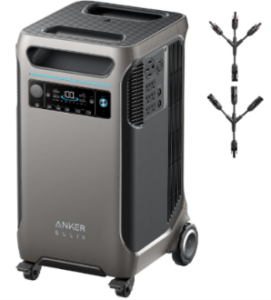
The Anker SOLIX F3800 is a high-capacity portable power station built for home backup, RV use, EV charging, and extended outages. It stores 3,840Wh of energy in an EV-class LiFePO4 battery and delivers 6,000W of continuous AC power. Its 120V and 240V output also allows it to handle a wide range of household appliances.
The F3800 can expand far beyond its base capacity. Adding up to six BP3800 battery packs increases storage to 26.9kWh. For larger backup requirements, two F3800 units with 12 battery packs can reach a combined capacity of 53.8kWh. This setup can provide substantially longer backup periods when power demands are carefully managed.
Power output makes the F3800 suitable for demanding equipment. It provides 6,000W of continuous power with up to 10,200W of starting wattage. The dual voltage design supplies both 120V and 240V power, allowing compatible appliances such as dryers, air conditioners, well pumps, refrigerators, freezers, and cooking equipment to operate from the system.
EV charging is another useful capability. The NEMA 14 50 port can deliver up to 6,000W for compatible electric vehicles using the appropriate charging cable. The unit also supports RV power through NEMA 14 50 and L14 30 connections, making it suitable for larger recreational vehicle setups.
Solar charging provides an off grid recharge option with up to 2,400W of solar input. The F3800 uses XT60 and MC4 connections, with an 11 to 60V open circuit voltage range. However, users should confirm that their solar setup matches the station’s voltage and connector requirements, especially when considering a professionally installed rooftop array.
For extended outages, the F3800 can work with the Anker Smart Generator 5500. This optional setup provides automatic start and stop operation, helping extend runtime without requiring constant manual monitoring. The power station can also function as a standby UPS, while its app provides remote monitoring and controls through Wi Fi or Bluetooth.
Despite its 132.3-pound weight, built-in casters make the F3800 easier to move across suitable surfaces. Its 34 × 34 × 34 inch dimensions require considerable storage space, so placement should be planned in advance. The system also uses durable LFP batteries, smart temperature management, and impact-resistant construction. Anker rates it for around 10 years of use and includes a five-year warranty.
Best For: I would recommend the F3800 to homeowners preparing for extended power outages, RV owners, off-grid users, and people who need high output for demanding appliances. Its 120V/240V capability and expandable battery system also suit whole-home backup setups. However, the 132.3-pound weight, large footprint, and higher purchase cost make it better suited to a planned installation than frequent portable travel.
Specifications
- Battery capacity: 3,840Wh LiFePO4
- Continuous AC output: 6,000W
- Starting wattage: 10,200W
- Voltage: 120V / 240V
- Solar input: Up to 2,400W
- Expandable capacity: Up to 53.8kWh with dual F3800 units
- EV charging: Up to 6,000W through NEMA 14 50
- UPS: Yes
- Weight: 132.3 lbs
Pros
- Large 3,840Wh battery for extended backup use
- Expandable storage up to 53.8kWh with two F3800 units and additional batteries
- 6,000W continuous output handles demanding household equipment
- 120V and 240V output supports a broad range of appliances
- Up to 2,400W solar input for off-grid recharging
- Direct EV charging through the NEMA 14 50 port
- NEMA 14 50 and L14 30 connections support compatible RV setups
- Optional Smart Generator 5500 provides automatic runtime extension
- Built in casters improve maneuverability
- Wi Fi and Bluetooth app controls
- Five year warranty and approximately 10-year battery lifespan
Cons
- 132.3-pound weight makes carrying it difficult
You may also like to read:6 Best Pecron Power Stations
Advantages of Using Anker Power Stations
Portable Power for Different Situations
Anker Power Stations are available in different capacities and power levels, giving users options for a wide range of needs. Smaller models work well for phones, laptops, cameras, routers, and other electronics. Larger units provide considerably more energy for appliances, RV equipment, and home backup. This range makes it easier to choose a power station based on actual electricity requirements.
Multiple Charging Options
Many models support more than one way to recharge the battery. AC charging provides a convenient option at home, while solar charging can help when electricity is unavailable. Some models also support vehicle or alternator charging. Having these options is useful during road trips, camping, and extended outages.
Long Lasting LiFePO4 Batteries
LiFePO4 batteries provide a durable option for repeated charging and discharging. The reviewed models offer cycle ratings in the thousands, with some designed to retain at least 80% of their capacity after thousands of cycles. Several models also have an estimated lifespan of around 10 years, making them suitable for regular use.
Wide Range of Output Ports
Different output ports allow users to power several types of equipment from one unit. Depending on the model, these can include AC outlets, USB C, USB A, car sockets, and RV connections. Higher capacity models also provide 120V and 240V output for compatible household appliances. This variety makes the power stations more versatile for different applications.
Useful Backup Power
Anker Power Stations can provide backup electricity when mains power is unavailable. Models with UPS functionality can switch to battery power quickly when an interruption occurs. This can help keep devices such as routers, computers, refrigerators, and supported medical equipment operating during short outages.
Suitable for Outdoor Use
Portable power stations provide a convenient way to take electricity beyond the home. Lightweight models are easier to carry for camping, travel, and remote work. Larger models may weigh considerably more, but built in wheels or casters can make them easier to move around a suitable surface.
Smart Monitoring and Controls
Compatible models can connect to the Anker app through Wi Fi or Bluetooth. The app allows users to monitor power levels and manage certain charging settings. Some models also include features such as Time of Use scheduling and automatic charging controls, giving users more control over how stored energy is used.
Expandable Power Capacity
Some higher capacity models allow users to add compatible battery packs. This can increase stored energy for longer outages or more demanding applications. Expansion is particularly useful for users whose electricity needs may grow over time. The maximum capacity and supported battery configuration should still be checked before purchase.
Factors to Consider When Choosing the Best Anker Power Stations
Battery Capacity
Battery capacity determines how much energy the power station can store. A smaller capacity may be enough for phones, laptops, cameras, and routers, while larger capacities provide longer runtimes for appliances and backup systems. Consider the devices you intend to run and estimate their combined energy consumption before choosing a capacity.
Continuous and Peak Output
Continuous output indicates the power a station can provide during normal operation. Peak output covers the temporary increase some appliances require when starting. Devices with motors and compressors can have higher startup demands, so checking both ratings is important. A suitable output rating ensures the power station can handle the equipment you plan to connect.
Charging Speed and Methods
Recharge speed determines how quickly the battery is ready for use again. AC charging is convenient when you have access to household electricity, while solar charging provides more flexibility away from the grid. Car and alternator charging can also be useful during travel. Choose a model with charging methods that match where and how you expect to use it.
Available Ports
The number and type of ports affect which devices you can power at the same time. Check whether you need AC outlets, USB C, USB A, a car socket, or an RV connection. High wattage USB C ports can be particularly useful for compatible laptops and other demanding electronics. The right port selection can reduce the need for additional adapters.
Weight and Portability
Portability becomes more important when you plan to move the power station frequently. Smaller units are generally easier to carry, while larger batteries can become difficult to lift. Wheels or casters can make heavier models easier to reposition. Think about your intended activities and storage location before choosing a size.
Solar Charging Capability
Solar charging can provide an alternative source of energy during camping trips and power outages. Look at the maximum solar input, supported voltage range, and connector type rather than focusing only on the wattage. Compatibility is important because a solar panel that exceeds the supported voltage range may not be suitable for the power station.
Expandability
Users who need longer backup periods may benefit from a power station that supports additional batteries. An expandable system can increase storage capacity without replacing the main unit. Keep in mind that expansion is usually restricted to compatible batteries and has a defined maximum capacity. Check these limits before purchasing if future expansion is important.
UPS, Safety, and Warranty
UPS functionality can help protect connected electronics during power interruptions, while battery management and temperature controls support safer operation. Warranty coverage is another consideration, especially for higher capacity units that represent a larger investment. App controls can also add convenience by allowing users to monitor and manage the power station remotely.
FAQs
What size Anker Power Station should I buy?
The right capacity depends on the devices you want to power and how long they need to operate. Smaller models are suitable for electronics such as phones, laptops, cameras, and routers. Larger units are better suited to refrigerators, RV equipment, and extended home backup. Calculate your expected power consumption before choosing.
Can Anker Power Stations use solar power?
Yes, compatible models can recharge through solar panels. However, solar input limits and voltage requirements vary between models. Check the maximum solar wattage, voltage range, and connector requirements before connecting a panel. This is especially important when using larger or professionally installed solar systems.
Can an Anker Power Station power a home during an outage?
Some high capacity models can provide power to selected household circuits and demanding appliances when properly connected to a home electrical system. The available runtime depends on the battery capacity and total load. High consumption appliances can drain the battery quickly, so users should calculate their expected energy needs and consider battery expansion where supported.
Conclusion
The Best Anker Power Stations combine durable LiFePO4 batteries, flexible charging options, useful output ports, portable designs, and smart power management. After considering their capacity, output, charging performance, portability, and intended uses, I recommend the Anker SOLIX C2000 Gen 2 as the best overall for its 2,048Wh capacity, 2,400W continuous output, expandable storage, fast charging, and RV friendly design. The Anker SOLIX C300 is my best budget option for users who mainly need lightweight power for camping, travel, remote work, and smaller electronics. For demanding home backup and high power applications, the Anker SOLIX F3800 is my best premium option, offering 3,840Wh of storage, 6,000W output, 120V/240V capability, EV charging, and extensive expansion potential. Ultimately, the best model depends on your power requirements, expected runtime, charging needs, and how portable you need the system to be.

Moran is an outdoor gear reviewer with a passion for testing and evaluating equipment that enhances real-world adventures. With a focus on accuracy, durability, and performance, Moran provides honest insights to help readers choose the right gear for their needs. From optics and hunting equipment to everyday outdoor essentials, each review is built on careful research and practical understanding. Moran’s goal is to simplify buying decisions by delivering clear, reliable, and experience-driven recommendations.