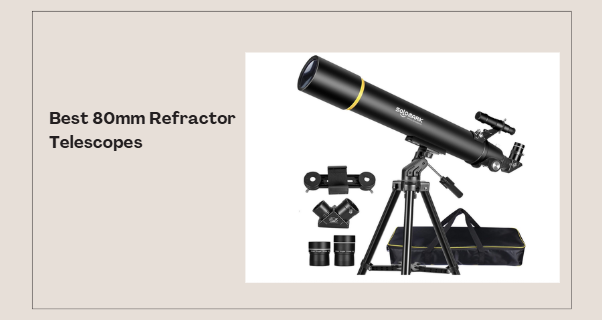
Discovering the wonders of the night sky is a thrilling experience, and choosing the right telescope makes it even more enjoyable. The best 80mm refractor telescopes are a popular choice for stargazers, offering a great mix of portability, ease of use, and impressive optical clarity for beginners and hobbyists looking to observe the Moon, planets, and some brighter deep-sky objects with crisp, detailed views.
In this guide, we will walk you through the best models available and help you understand the key factors to consider. Additionally, we will ensure you get all the insights you need to pick a telescope that fits your needs, budget, and stargazing goals.
What is a Refractor Telescope?
A refractor telescope is a type of optical telescope that uses lenses to gather and focus light, allowing you to view distant objects clearly. Unlike reflecting telescopes, which use mirrors, refractors rely on a large objective lens at the front of the tube to bend, or “refract,” incoming light to a focal point at the eyepiece.
This design produces sharp, high-contrast images with minimal maintenance, making refractor telescopes ideal for observing the Moon, planets, and bright stars. Their sealed tube also protects the optics from dust and misalignment, ensuring consistent performance over time.
What to Look for in an 80mm Refractor Telescope
With multiple refractor telescopes available today, here’s what to look for in the best 80mm refractor telescopes:
- Clear Optics. Firstly, ensure the telescope has high-quality lenses, especially fully coated or multi-coated ones, to improve light transmission and reduce glare.
- Focal Length. This determines how much magnification you can achieve and the field of view. Longer focal lengths are better for planets, while shorter ones are better for wider star clusters.
- Stable Mount. A solid mount prevents shaking, making it easier to track objects as they move across the sky. Both alt-azimuth and equatorial mounts have their advantages depending on your needs.
- Portability. Consider weight and size if you plan to move the telescope frequently or take it outdoors. A lighter design is easier to carry without compromising stability.
- Eyepieces & Accessories. Additional eyepieces, Barlow lenses, and finderscopes expand your viewing options and enhance your stargazing experience.
- Easy to Use. Simple setup, smooth focusing, and intuitive controls make observing more enjoyable, especially for beginners who are still learning the night sky.
- Good Value. Lastly, look for a telescope that balances quality, features, and price to ensure you get the most out of your investment.
Best 80mm Refractor Telescopes
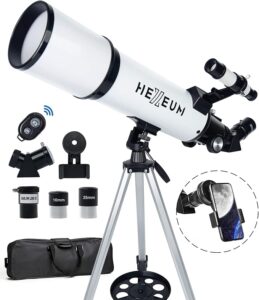
1) HEXEUM 80mm Astronomical Portable Refracting Telescope
Get it on Amazon
The HEXEUM 80mm Aperture 600mm Refracting Telescope is the best 80mm refractor telescope.
Designed for both beginners and casual stargazers, its 80mm aperture allows for bright and clear views of the moon, planets, and some deep-sky objects, while the 600mm focal length provides good magnification without making the setup overly bulky.
Furthermore, the telescope features fully multi-coated high-transmission optics, which enhance light gathering and produce sharp, detailed images.
The included AZ mount is user-friendly, allowing for smooth manual tracking of celestial objects. Moreover, the sturdy tripod provides a stable platform for both night and daytime observations.
Another feature is the smartphone adapter. Paired with the wireless control, it makes it easy to capture photos and share your observations with friends or on social media.
Above all, this telescope is straightforward to set up and portable enough for taking on trips or using in your backyard.
Pros
- Bright 80mm aperture with clear optics
- Fully multi-coated lenses for high light transmission
- Portable and easy to set up
- User-friendly AZ mount with stable tripod
- Smartphone adapter and wireless control for photos
Cons
-
Limited deep-sky observation compared to larger telescopes
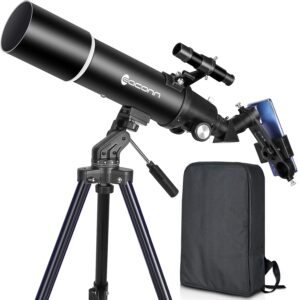
2) EACONN 80mm Aperture Refractor Telescope
Get it on Amazon
The EACONN 80mm Aperture Refractor Telescope is an impressive option for beginner and intermediate stargazers, offering a balance of clarity and portability.
The telescope’s refractor design ensures minimal maintenance, as there are no mirrors to align, and the included fully coated optics help reduce glare and enhance contrast. Furthermore, its 80mm aperture allows for bright, sharp views of the moon, planets, and some deep-sky objects like star clusters.
With a lightweight build and compact frame, it’s easy to transport and set up for both backyard stargazing and casual outdoor excursions. The telescope also comes with a variety of eyepieces and a basic mount, providing versatility for exploring different magnifications without requiring additional purchases.
Overall, its user-friendly design, combined with decent optical quality, makes it a reliable choice for those eager to explore the night sky.
Pros
- Bright 80mm aperture for clear views of celestial objects
- Lightweight and portable design
- Refractor design requires minimal maintenance
- Fully coated optics improve contrast and reduce glare
- Comes with multiple eyepieces for versatile magnification
Cons
-
Limited performance for very distant deep-sky objects
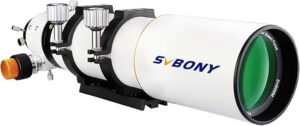
3) SVBONY SV50 80 mm F7 Achromatic Refractor Telescope
Get it on Amazon
The SVBONY SV503 Refractor Telescope is a versatile optical tube that impresses with its 80mm aperture and F7 focal ratio, designed to deliver crisp and clear views of the night sky.
Its extra-low dispersion achromatic lens reduces chromatic aberration, producing sharper and more color-accurate images of planets, the Moon, and brighter deep-sky objects.
Moreover, the dual-speed focuser allows for both coarse and fine adjustments, making it easier to achieve precise focus for high-magnification observing. The optical tube is also lightweight yet solidly built, making it portable for backyard stargazing or casual astrophotography.
Another impressive feature is its smooth dual-speed focuser. It enhances the viewing experience by allowing precise adjustments without introducing vibration. This telescope also pairs well with a variety of mounts, offering flexibility for different observing setups.
Pros
- Crisp, sharp images with reduced chromatic aberration
- Dual-speed focuser for precise focusing
- Lightweight and portable design
- High-quality achromatic lens suitable for planetary and deep-sky viewing
- Versatile OTA that works with multiple mounts
Cons
-
Mount and tripod not included
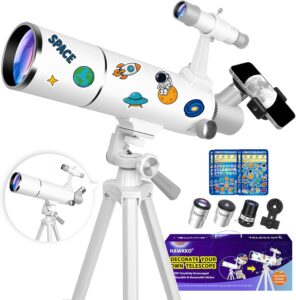
4) Hawkko 80mm Refractor Telescope
Get it on Amazon
As one of the best 80mm refractor telescopes for kids, the Hawkko Telescope excels in ease of use and versatility.
Its 80mm aperture provides a solid balance between light-gathering ability and portability, allowing for clear views of the moon, planets, and some brighter deep-sky objects.
Furthermore, the telescope comes with multiple eyepieces, offering different magnification levels, which makes it easy for users to experiment and find their preferred view.
Setup is straightforward, and the included adjustable tripod ensures stable viewing even on uneven surfaces. The telescope’s design is also lightweight, making it convenient for outdoor use and family stargazing nights, while still maintaining a durable build that can withstand frequent handling.
Above all, the telescope offers excellent value for beginners and younger users, combining ease of use with a satisfying viewing experience.
Pros
- Good light-gathering with 80mm aperture
- Multiple eyepieces for varying magnifications
- Lightweight and portable design
- Stable tripod for outdoor viewing
- Easy setup for beginners and kids
Cons
-
The focuser is slightly stiff and tricky to adjust
5) SOLOMARK 80mm Refractor Telescope for Kids & Beginners
Get it on Amazon
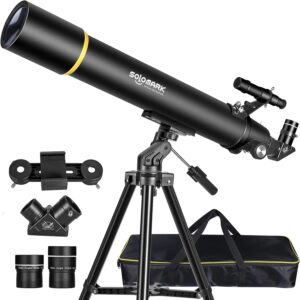
The SOLOMARK 80mm Refractor Telescope for Kids & Beginners is a solid entry-level telescope designed to spark curiosity in young stargazers and beginners alike.
Featuring a large 80mm aperture, it provides clear and bright views of the moon, planets, and some deep-sky objects. This makes it versatile enough for casual night sky observation.
Furthermore, the telescope features a fully adjustable tripod that ensures stable viewing, even on uneven surfaces. Its lightweight design makes it easy for kids to handle and transport, and the included eyepieces offer varying magnifications, allowing users to explore different celestial objects in greater detail.
In practice, the telescope performs well for casual observation, delivering crisp images of the moon’s craters and major planetary features like Jupiter’s bands or Saturn’s rings under clear skies. The included finderscope helps users quickly locate objects, which is especially helpful for beginners.
Pros
- Bright 80mm aperture for clear lunar and planetary views
- Lightweight and portable design
- Beginner-friendly setup and adjustable tripod
- Multiple eyepieces for varying magnifications
- Finderscope aids in locating celestial objects
Cons
-
Not suitable for professional or advanced astrophotography
6) Celestron Travel Scope 80 Portable Refractor Telescope
Get it on Amazon
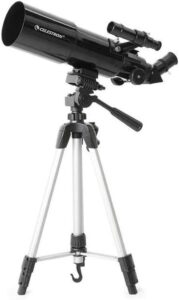
The Celestron Travel Scope 80 is one of the best 80mm refractor telescopes for family use. It is designed for adults and kids to enjoy together and sets up in minutes to deliver rewarding views with no prior experience required.
Optically, the fully-coated glass optics deliver bright and clear images, making celestial observation accessible even for beginners. Furthermore, the telescope’s compact and portable design is ideal for travel, camping, or backyard astronomy, allowing users to set up quickly without cumbersome equipment.
The included altazimuth mount provides smooth and intuitive movement. This makes it easy to track planets, the moon, and other celestial objects.
Moreover, its sturdy construction ensures reliable performance, while the included accessories, such as eyepieces and a backpack, enhance the overall user experience.
Pros
- Lightweight and portable design, easy to travel with
- Fully-coated glass optics provide bright and clear images
- Smooth altazimuth mount for easy tracking
- Includes useful accessories like eyepieces and a carrying backpack
- Quick and simple setup for beginners
Cons
-
Limited magnification for advanced deep-sky viewing
7) HUGERSTAR 80mm Refractor Telescope for Astronomy Beginners
Get it on Amazon
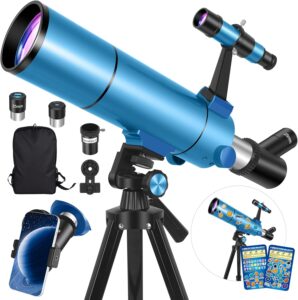
Last but not least, we have the HUGERSTAR Telescope for Adults & Kids. This is a versatile and user-friendly refractor telescope designed for both beginners and young astronomy enthusiasts.
With an 80mm aperture and a 500mm focal length, it delivers bright, clear images of the moon, planets, and nearby celestial objects.
Moreover, the telescope offers adjustable magnification from 20X up to 150X, allowing users to explore a range of details in the night sky. Its professional-grade optics provide crisp visuals, while the included eyepieces and finderscope make locating and focusing on celestial targets straightforward.
Regarding handling, the telescope is lightweight and portable. This makes it easy to set up in your backyard or take along on stargazing trips, and its sturdy tripod ensures stable viewing even at higher magnifications.
To top it all off, the design is family-friendly, providing a smooth learning curve for beginners without compromising on quality. This telescope also comes with a smartphone adapter, enabling users to capture and share astronomical images effortlessly.
Pros
- Bright 80mm aperture for clear views of the moon and planets
- Magnification range of 20X–150X for versatile viewing
- Lightweight and portable design
- Sturdy tripod for stable viewing
- Easy assembly suitable for beginners and kids
- Smartphone adapter for astrophotography
Cons
- Basic eyepieces for advanced users
Next Read: 5 Best 90mm Refractor Telescopes
Key Factors to Consider when Choosing the Best 80mm Refractor Telescopes
Choosing the right 80mm refractor telescope requires careful consideration of these factors to ensure the best stargazing experience.
Optical Quality
Firstly, optical quality is paramount, as it determines the clarity and sharpness of the images you see. Look for telescopes with well-coated lenses and precise glass elements, as these reduce glare, improve light transmission, and enhance contrast for viewing celestial objects. Even small differences in optical quality can significantly affect how detailed planets, the moon, and deep-sky objects appear.
Focal Length and Focal Ratio
These features impact how magnified your views will be and the field of view you can achieve. A longer focal length provides higher magnification, which is ideal for viewing the moon and planets, whereas a shorter focal length gives a wider field of view, perfect for scanning star clusters or galaxies. Consider the types of celestial objects you enjoy most to decide which combination suits your stargazing style.
Mount Stability
Next, mount type and stability are crucial, as even the best optics will produce shaky images on an unstable mount. Refractors commonly come with altazimuth or equatorial mounts, each offering different advantages. Altazimuth mounts are simple to use and ideal for beginners, while equatorial mounts are better for tracking celestial objects smoothly, especially if you plan to photograph the night sky.
Portability and Weight
Furthermore, consider weight and portability. The best 80mm refractor telescopes vary from a lightweight, compact design suitable for travel, to a bulkier model that remains mostly stationary. Consider how often you will transport the telescope and the locations you intend to observe from, balancing convenience with stability and build quality.
Accessories and Expandability
To enhance your observing experience, consider the accessories included and expandability. High-quality eyepieces, finderscopes, and Barlow lenses expand the range of views and detail you can achieve. Some of the best 80mm refractor telescopes allow for camera attachments or smartphone adapters for astrophotography, so evaluating the included and optional accessories helps you maximize the telescope’s versatility without needing to purchase additional gear immediately.
Budget and Value
Finally, budget and value should guide your decision. While it can be tempting to choose the cheapest option, investing in a telescope with better optics, a sturdy mount, and useful accessories can provide a more enjoyable and lasting experience. Balancing quality, features, and price ensures you get the most satisfaction from your 80mm refractor telescope without overspending.
Best 80m Refractor Telescopes Pros and Cons
Pros:
- Sharp and crisp images. Refractors offer excellent clarity with minimal optical distortion.
- Low maintenance. No mirrors to clean or collimate, making them beginner-friendly.
- Portable and lightweight. This makes them easy to carry for backyard or travel stargazing.
- Good for planets and moons. High contrast makes details on planets and the lunar surface clear.
- Durable and reliable. Fully enclosed optics are less affected by dust and alignment issues.
- Quiet operation. Typically smooth and stable mounts without complex motors.
- Versatile with accessories. The best 80mm refractor telescopes work well with Barlow lenses, eyepieces, and even basic astrophotography setups.
- Immediate usability. With minimal setup required, these telescopes are ideal for beginners.
Cons:
- Limited light-gathering. Not ideal for very faint deep-sky objects like distant galaxies.
- More expensive per inch of aperture. Refractors tend to cost more than reflectors for the same aperture.
- Heavier than small reflectors of similar light-gathering. Some compact designs may still be bulky when combined with a mount.
FAQs
What can I see with an 80mm refractor telescope?
An 80mm refractor is great for observing the moon, planets like Jupiter and Saturn, bright star clusters, and some nebulae. While it won’t reveal the faintest deep-sky galaxies, it offers impressive views for beginners and casual stargazers.
Do I need an equatorial mount for an 80mm refractor?
Not necessarily. Altazimuth mounts are simpler and sufficient for casual observing. Equatorial mounts are better if you want to track objects smoothly or try astrophotography.
Can I use an 80mm refractor for astrophotography?
Yes, especially for wide-field shots of the moon, planets, and bright star clusters. A sturdy mount and proper camera adapter are essential for clear images.
Conclusion
To wrap it up, selecting the best 80mm refractor telescope involves balancing optics, mount stability, portability, and budget to match your stargazing goals. These telescopes offer sharp, high-contrast views of the moon, planets, and bright star clusters, making them ideal for beginners and casual observers. By considering factors like focal length, mount type, and included accessories, you should find a model that provides both immediate enjoyment and long-term value.
What is a Refractor Telescope?

Albert, the founder of Outdoormoran, is a dedicated outdoor enthusiast with a passion for delivering the most current, accurate, and easy-to-understand information on all different outdoor gear and optics. He shares his expertise with beginners by teaching the technical aspects of outdoor gear and optics through his comprehensive collection of guides.