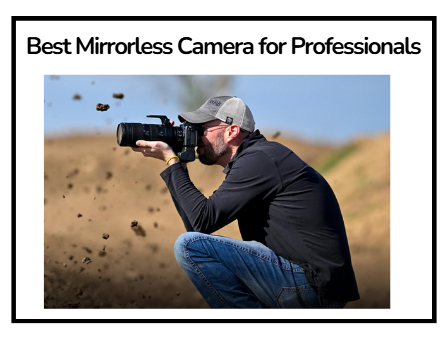
Looking for the best mirrorless camera for professionals? If yes, you are in the right place. Read on; this comprehensive guide is for you.
Mirrorless cameras have revolutionized the photography and videography world by offering high-end performance in a compact, lightweight design.
This guide will walk you through the key features, specifications, and factors to consider when buying a mirrorless camera and ensuring you find a model that meets the demands of your professional workflow.
Why Choose a Mirrorless Camera?
Mirrorless cameras have revolutionized professional photography and videography, offering numerous advantages to professionals. These benefits include:
-
Compact and lightweight. Without the mirror and optical viewfinder of a DSLR, mirrorless cameras are easier to carry, making them ideal for travel, events, and long shooting sessions.
-
Electronic Viewfinder (EVF). This feature provides a real-time preview of your exposure, white balance, and depth of field, so you can see exactly how your final image will look.
-
Faster and more accurate autofocus. The On-sensor phase-detection allows for precise focus tracking, including eye and animal detection, which is especially useful for portraits, wildlife, and sports.
-
High-speed continuous shooting. Many mirrorless cameras offer high FPS rates with deep buffers, perfect for capturing fast action and fleeting moments.
-
Advanced video capabilities. Furthermore, the best mirrorless camera for professional supports high-resolution video (4K, 6K, or 8K), high frame rates, and professional codecs for hybrid shooters who need both photo and video performance
-
Customizable controls and ergonomics. The buttons, dials, and menus can be tailored to your workflow, saving time and improving efficiency during shoots.
-
Growing lens ecosystem. Moreover, modern mirrorless systems offer a wide range of native lenses and adapters for older lenses, giving professionals flexibility for any type of photography or videography.
-
Reduced shutter noise and vibration. The electronic shutters allow for silent shooting, reducing disturbances in events, wildlife, and studio environments.
-
Future-proof technology. Last but not least, mirrorless systems are at the forefront of camera innovations, including autofocus improvements, in-body stabilization, and electronic enhancements.
Best Mirrorless Cameras for Professionals
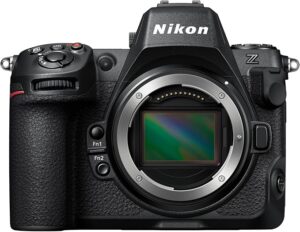
1) Nikon Z 8 Professional full-frame Mirrorless Camera
Get it on Amazon
The Nikon Z 8 is the best mirrorless camera for professionals. It is a powerhouse camera that brings flagship-level performance into a more compact and accessible body.
Built around a 45.7MP stacked CMOS sensor and Nikon’s EXPEED 7 processor, the Z 8 delivers exceptional image quality with outstanding detail, dynamic range, and color accuracy. Its fast readout virtually eliminates rolling shutter, making it highly reliable for action, wildlife, and sports photography.
Furthermore, the camera’s subject-detection autofocus, capable of recognizing people, animals, birds, and vehicles. It locks on quickly and tracks confidently, even in challenging lighting. Additionally, the Z 8 maintains a well-balanced, weather-sealed body that feels robust without being overly bulky.
On the video side, the Nikon Z 8 is equally impressive, offering internal 8K and oversampled 4K recording with advanced codecs and professional monitoring tools. It also supports high frame rates, N-Log, and 12-bit RAW video, making it suitable for serious filmmakers and hybrid creators.
To top it all off, the lack of a mechanical shutter reduces wear and tear while enabling silent shooting, which is ideal for events and wildlife work.
Pros
- 45.7MP stacked sensor with excellent dynamic range
- Extremely fast and accurate subject-detection autofocus
- 8K and high-quality 4K video recording with professional features
- No mechanical shutter for silent shooting and durability
- Robust weather-sealed build in a relatively compact body
- High-resolution EVF and intuitive controls
Cons
- Large files require fast cards and powerful editing hardware
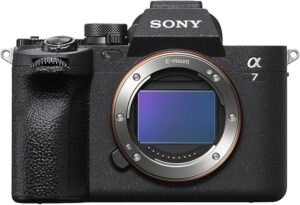
2) Sony Alpha 7 IV Full-frame Mirrorless Interchangeable Lens Camera
Get it on Amazon
The Sony Alpha 7 IV Full-Frame Mirrorless Interchangeable Lens Camera impresses as a true all-around powerhouse that bridges the gap between still photography and video creation.
Its ergonomics feel thoughtfully refined compared to its predecessors, with a more substantial grip and intuitive control layout that make long shooting sessions comfortable.
Furthermore, the sensor produces beautifully detailed images with a pleasing balance of dynamic range and color depth, and the autofocus system is fast and reliable whether you’re tracking moving subjects or focusing on delicate portrait work.
Video performance is equally strong, offering flexible recording formats and clean, usable footage straight out of the camera. This makes it a compelling choice for hybrid shooters who demand high quality without switching gear for different tasks.
In addition to everything else, the battery life is respectable but can be limiting during extended video shoots or travel days, so carrying spares becomes almost mandatory.
Pros
- Excellent image quality with rich detail and wide dynamic range
- Fast, dependable autofocus for both stills and video
- Strong hybrid performance great for photographers and videographers
- Solid build quality with refined ergonomics
- Flexible video features and recording formats
Cons
-
Some advanced features require digging through setting to optimized
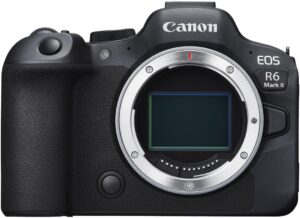
3) Canon EOS R6 Mark II Mirrorless Camera
Get it on Amazon
The Canon EOS R6 Mark II is a powerful full-frame mirrorless camera that builds on the strengths of its predecessor while delivering meaningful upgrades for both photographers and hybrid creators.
At its core is a new 24.2MP full-frame CMOS sensor paired with Canon’s advanced DIGIC X processor. It produces excellent image quality with improved dynamic range and noticeably cleaner high-ISO performance.
Autofocus is another feature. With an enhanced Dual Pixel CMOS AF II system, it offers fast, accurate subject detection for people, animals, birds, vehicles, and even aircraft. Furthermore, the continuous shooting speeds reach up to 40 fps with the electronic shutter, making it an outstanding choice for sports, wildlife, and action photography.
For video creators, the EOS R6 Mark II is a highly capable hybrid camera that addresses many limitations of the original R6. It records oversampled 4K video at up to 60p without severe overheating concerns, along with Full HD at up to 180p for smooth slow-motion footage.
The camera also benefits from in-body image stabilization rated up to 8 stops, allowing for sharp handheld shooting in challenging lighting conditions.
Additionally, features such as 10-bit recording, Canon Log 3, and clean HDMI output make it suitable for professional workflows, livestreaming, and content creation.
Pros
- Excellent 24.2MP full-frame image quality with strong low-light performance
- Fast and highly reliable Dual Pixel CMOS AF II with advanced subject tracking
- Up to 40 fps burst shooting with electronic shutter
- Oversampled 4K video with improved heat management
- In-body image stabilization up to 8 stops
- Solid build quality with weather sealing and ergonomic design
Cons
-
No 6K or 8K video recording options
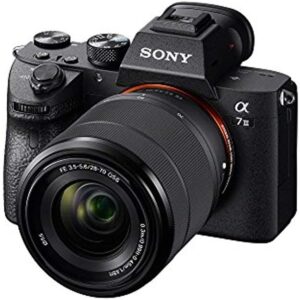
4) Sony a7 III (ILCEM3K/B) Full-frame Mirrorless Interchangeable-Lens Camera
Get it on Amazon
The Sony a7 III (ILCEM3K/B) is a versatile camera that delivers outstanding results for enthusiasts and working professionals alike.
Widely regarded as one of the most balanced full-frame mirrorless cameras ever released, it features a 24.2MP back-illuminated full-frame sensor that produces excellent dynamic range, accurate color, and strong low-light performance.
Image quality remains impressive across a wide ISO range, making it well suited for everything from landscapes and portraits to weddings and travel photography. Furthermore, Sony’s 5-axis in-body image stabilization further enhances handheld shooting, helping users achieve sharper images and smoother video even in challenging lighting conditions.
The a7 III video function is equally capable, recording oversampled 4K footage with rich detail and minimal rolling shutter. Its hybrid autofocus system, with fast phase-detection and reliable Eye AF for both humans and animals, performs exceptionally well for both stills and video tracking.
Above all, the dual SD card slots, a robust magnesium alloy body, and excellent battery life using the NP-FZ100 battery make it dependable for long shoots and professional workflows.
Pros
- Excellent 24.2MP full-frame image quality with wide dynamic range
- Fast, accurate autofocus with reliable Eye AF
- Strong 4K video performance with oversampling
- 5-axis in-body image stabilization
- Long battery life compared to many mirrorless rivals
- Dual SD card slots for backup and workflow flexibility
- Solid, weather-resistant build quality
Cons
-
Menu system is slightly complex and unintuitive
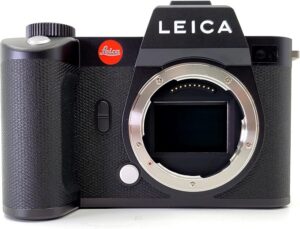
5) Leica SL2 Mirrorless Camera
Get it on Amazon
The Leica SL2 is the best mirrorless camera for professional looking to take their photograph and videography a notch higher.
The camera impresses with its solid, weather-sealed magnesium alloy body that feels both weighty and reassuring in the hand. The ergonomics are intuitive, with a deep grip and thoughtfully placed dials that make extended shooting sessions comfortable.
Furthermore, its 47.3-megapixel full-frame sensor delivers exceptionally rich, detailed stills with a broad tonal range, and colors that feel natural yet vibrant.
In addition, the Maestro III processor ensures smooth performance across the board, from rapid autofocus acquisition to high-resolution electronic viewfinder refresh rates. Video shooters will also appreciate its robust 5K/4K capabilities, clean logs, and versatile codec support, transforming the SL2 into a powerful hybrid platform without compromise.
Pros
- Exceptional build quality and weather sealing
- High-resolution sensor with outstanding image quality
- Fast, accurate autofocus performance
- Excellent electronic viewfinder and intuitive controls
- Strong video features and hybrid capabilities
Cons
-
Steep price point for body and lenses
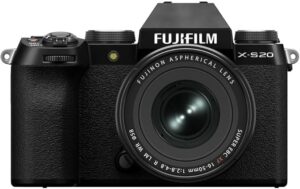
6) Fujifilm X-S20 Mirrorless Digital Camera XF16-50mmF2.8-4.8 R LM WR
Get it on Amazon
Next, we have the Fujifilm X-S20 with the XF16-50mmF2.8-4.8 R LM WR kit lens. It strikes a compelling balance between stills and video performance in a lightweight, enthusiast-friendly mirrorless package.
The 26.1 MP APS-C X-Trans sensor delivers rich, detailed images with vibrant color reproduction straight out of camera, and the lineup of Fujifilm’s beloved Film Simulation modes lets photographers achieve distinctive looks without heavy post-processing.
On the video side, the camera offers serious capabilities, including internal 6.2K capture and 4K up to 60 fps with 10-bit output, all wrapped in a body that’s comfortable to hold for extended shoots and travel.
Furthermore, the responsive autofocus and improved in-body stabilization make handheld shooting more reliable across a range of scenarios, from street photography to casual vlogging.
This camera also brings to the table a vari-angle touchscreen that simplifies framing unconventional angles and selfie-style shots.
Pros
- Excellent overall image quality with vibrant colors and detail
- Strong video performance (up to 6.2K and 4K 60 fps with 10-bit)
- Improved autofocus and reliable in-body image stabilization
- Comfortable, lightweight body with a fully articulated touchscreen
- Beginner-friendly modes (including dedicated vlog settings) and good battery life
Cons
-
No comprehensive weather sealing on the camera body
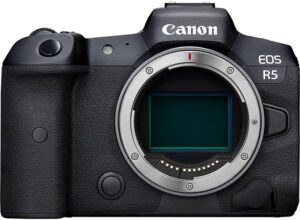
7) Canon EOS R5 Mirrorless Camera
Get it on Amazon
The Canon EOS R5 Mirrorless Camera is designed for professionals and serious enthusiasts who demand top-tier performance in both stills and video.
At its core is a 45-megapixel full-frame sensor paired with Canon’s DIGIC X processor, delivering exceptional detail, wide dynamic range, and impressive low-light performance.
Furthermore, the camera’s in-body image stabilization works in tandem with compatible RF lenses to provide up to 8 stops of stabilization, making handheld shooting far more reliable.
Canon’s Dual Pixel CMOS AF II system is fast, intelligent, and remarkably accurate, with advanced subject detection that locks onto eyes, faces, animals, and vehicles with confidence across nearly the entire frame.
Regarding video, the EOS R5 pushes boundaries with internal 8K recording and high-quality 4K options, giving creators immense flexibility for cropping, reframing, and future-proofing their content.
The camera also excels in speed, offering up to 12 fps with the mechanical shutter and 20 fps electronically. This makes it well suited for wildlife, sports, and action photography.
In addition to everything else, its robust magnesium-alloy body feels solid and weather-sealed, while the high-resolution EVF and fully articulating touchscreen enhance both shooting and review.
Pros
- 45MP full-frame sensor with excellent detail and dynamic range
- Advanced Dual Pixel CMOS AF II with reliable subject tracking
- In-body image stabilization up to 8 stops
- High-end video capabilities, including 8K and oversampled 4K
- Fast burst rates ideal for action and wildlife
- Solid, weather-sealed professional build quality
Cons
-
Premium price, especially as a body-only purchase
8) Sony Alpha 1 Full-frame Interchangeable Lens Mirrorless Camera
Get it on Amazon
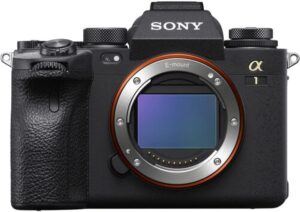
The Sony Alpha 1 is our last recommendation for the best mirrorless camera for professionals.
Built around a 50.1MP full-frame stacked CMOS sensor and the BIONZ XR processor, the Alpha 1 delivers exceptional image quality with impressive dynamic range, color depth, and low-noise performance across a wide ISO range.
Its ability to shoot up to 30 frames per second with full AF/AE tracking makes it uniquely versatile, equally capable of capturing fast-moving sports, wildlife, and high-resolution commercial or landscape work.
Furthermore, the electronic shutter operates with minimal rolling shutter, while the blackout-free 9.44-million-dot EVF offers one of the clearest and most immersive viewing experiences.
The Alpha 1 is equally formidable on video functionality. It supports 8K 30p and 4K up to 120p with advanced color profiles such as S-Cinetone and S-Log3. Moreover, its AI-driven autofocus system excels at real-time tracking for humans, animals, and birds, delivering outstanding accuracy for both stills and video.
Pros
- Exceptional 50.1MP full-frame image quality
- Up to 30 fps continuous shooting with advanced autofocus
- Industry-leading EVF with high resolution and clarity
- 8K and high-frame-rate 4K video capabilities
- Reliable subject detection for humans, animals, and birds
- Solid, weather-sealed professional build
Cons
-
Sits at a high price point
Next Read
Key Factors to Consider when Choosing the Best Mirrorless Camera for Professionals
Sensor Size and Resolution
Firstly, the sensor size of a camera plays a critical role in image quality, depth of field control, and low-light performance. Full-frame sensors are the top choice for most pros because they deliver superior dynamic range, better noise control at high ISOs, and more flexibility in post-processing.
Resolution also matters depending on your specialty. High-megapixel sensors benefit commercial, fashion, and landscape photographers, while moderate resolutions offer faster workflows for sports and event shooters.
Autofocus Performance and Accuracy
Reliable autofocus is essential in professional environments where missed shots are costly. Look for mirrorless cameras with advanced phase-detection systems, wide AF coverage, and intelligent subject detection such as eye, face, animal, or vehicle tracking. Fast, sticky autofocus ensures sharp results in challenging situations like fast-moving subjects, low light, or shallow depth-of-field shooting.
Image Quality and Dynamic Range
Beyond resolution, professionals should evaluate overall image quality, including color science, tonal gradation, and dynamic range. The best mirrorless camera for professionals should have a wide dynamic range that preserves highlight and shadow detail, giving more flexibility during editing. This is especially important for wedding, landscape, and documentary work where lighting conditions are often unpredictable.
Video Capabilities and Codecs
Many professionals need strong hybrid performance, making video features a major consideration. Look for mirrorless cameras that support high-resolution recording (such as 4K or higher), professional codecs, high bit rates, and advanced profiles like log or RAW output. The best mirrorless camera for professionals should also have features such as in-body stabilization, clean HDMI output, and reliable continuous autofocus are also crucial for professional video production.
Build Quality and Weather Sealing
Professional cameras must withstand demanding environments. A durable magnesium-alloy body, strong weather sealing, and robust ports ensure reliability in rain, dust, heat, or cold. Solid build quality is also important for travel, wildlife, and outdoor professionals who frequently shoot in challenging conditions.
Lens Ecosystem and System Compatibility
A strong lens lineup is just as important as the camera body itself. Professionals should consider the availability of native lenses, including fast primes, professional zooms, and specialty lenses. Adaptability to third-party lenses or legacy glass is also important as it adds flexibility and reduces long-term system costs when building a complete professional kit.
Ergonomics, Controls, and Workflow
Furthermore, comfort and efficiency should be consider when choosing the best mirrorless camera for professionals. A professional mirrorless camera should offer intuitive button layouts, customizable controls, responsive touchscreens, and high-resolution electronic viewfinders. Features like dual memory card slots, fast buffer performance, and seamless file transfer options help streamline professional workflows.
Battery Life and Connectivity
Lastly, the best mirrorless camera for professionals should have improved battery performance, but professionals still need reliable power for extended shoots. Cameras that support USB-C charging, battery grips, or long-lasting batteries are a major advantage. Strong connectivity options such as Wi-Fi, Bluetooth, and wired transfer enable fast delivery, remote control, and backup, essential in fast-paced professional environments.
Care and Maintenance Tips
- Keep lenses clean: Use a microfiber cloth or lens cleaning solution to remove dust and smudges
- Avoid touching the sensor: Never touch the camera’s sensor; use a blower to remove dust
- Use a protective filter: Consider using UV or clear filters to protect the lens glass
- Store properly: Keep the camera in a padded bag or case when not in use
- Avoid extreme conditions: Protect the camera from excessive heat, cold, humidity, and direct sunlight
- Remove batteries when storing long-term: This prevents leakage and corrosion
- Use a lens cap: Always cover lenses when not shooting to prevent scratches and dust
- Clean the camera body: Wipe gently with a soft, dry cloth; avoid harsh chemicals
- Check and format memory cards regularly: Helps prevent file corruption
- Update firmware: Keep camera software up to date for optimal performance
- Handle with care: When using the camera, avoid drops, bumps, and rough handling
Best Mirrorless Camera for Professionals FAQs
What megapixel count is best for professional work?
The ideal megapixel count depends on your field. Commercial, studio, and landscape photographers often benefit from high-resolution sensors of 40MP or more, while wedding, event, and sports professionals typically prefer 20–30MP cameras for faster processing and manageable file sizes without compromising quality.
How important is in-body image stabilization (IBIS) for professionals?
IBIS is extremely valuable, especially for handheld shooting in low light or when recording video. It allows professionals to shoot at slower shutter speeds without a tripod and helps produce smoother footage, making it a highly desirable feature in modern mirrorless systems..
Are mirrorless cameras better than DSLRs for professional video work?
In most cases, yes. Mirrorless cameras typically offer superior video features such as advanced autofocus, higher frame rates, log profiles, and compact form factors. This makes them the preferred choice for hybrid shooters and professionals who prioritize both photography and video.
Conclusion
To wrap it up, investing in a professional mirrorless camera is a decision that shapes the quality, efficiency, and versatility of your work. The best choice balances performance, reliability, and adaptability to your specific shooting needs. Carefully consider sensor performance, autofocus, image quality, video features, lens options, durability, and workflow-friendly design to ensure that you choose the gear that handles both everyday shoots and challenging assignments.

Albert, the founder of Outdoormoran, is a dedicated outdoor enthusiast with a passion for delivering the most current, accurate, and easy-to-understand information on all different outdoor gear and optics. He shares his expertise with beginners by teaching the technical aspects of outdoor gear and optics through his comprehensive collection of guides.