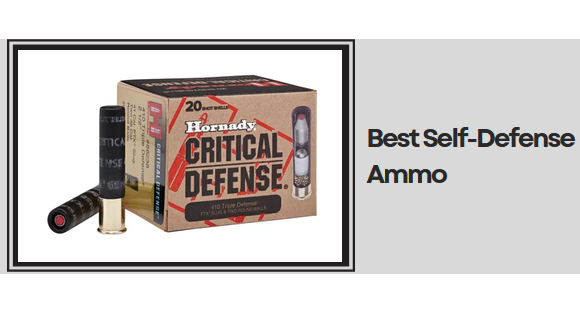
Do you want to buy the best self-defense ammo for your firearm? Choosing the right ammunition can make a significant difference in reliability, consistency, and performance when personal safety matters.
I’ve reviewed six options across different calibers and firearm types, examining features such as bullet construction, projectile weight, muzzle velocity, case material, and manufacturer-stated design benefits.
My goal is to help you understand what each load offers, where its limitations may lie, and which characteristics deserve closer attention before making a purchase.
Below, I’ll introduce my top picks, discuss their key features, explain the advantages of self-defense ammunition, and cover the essential factors to consider in my buying guide.
I’ll also answer frequently asked questions to help you make a more informed decision based on firearm compatibility, credible performance testing, and responsible use.
Our Top Picks at a Glance
- Hornady Critical Defense 12 Gauge 8 Pellet 2.75 in Buckshot Shotgun Ammunition: Best Shotgun Defense Option
- Winchester USA 5.56x45mm NATO 62 Grain Green Tip M855 FMJBT Ammunition: Best M855 Rifle Ammunition Option
- G9 Defense 9mm +P 80 Grain External Hollow Point Ammunition: Best Specialized 9mm Option
- Freedom Munitions .380 ACP 100 Grain Round Nose Flat Point Ammunition: Best General-Purpose .380 ACP Option
- SinterFire Special Duty .40 S&W 125 Grain Hollow Point Frangible Ammunition: Best Frangible Ammunition Option
- Hornady Critical Defense 9mm Luger 100 Grain Flex Tip eXpanding Ammunition: Best Concealed-Carry Ammunition Option
How We Tested the Best Self Defense Ammo
To evaluate the best self-defense ammo, we reviewed the available product specifications, manufacturer descriptions, and stated design features of each load. Our assessment focused on the information buyers need to compare defensive ammunition responsibly, without treating manufacturer claims as independently verified results.
- Bullet Design: We examined the listed projectile types, including hollow point, frangible, and full metal jacket designs, noting their intended applications.
- Caliber and Compatibility: We considered the stated calibers and the importance of matching ammunition to a firearm’s specifications.
- Bullet Weight and Velocity: We compared published bullet weights and muzzle velocities where this information was available.
- Muzzle Energy: We recorded manufacturer-listed energy figures when provided, recognizing that these figures alone do not establish defensive effectiveness.
- Case Construction: We reviewed case materials and protective finishes, including brass cases and nickel plating.
- Reliability Claims: We noted manufacturer statements about quality control, corrosion resistance, and reliable function without presenting unverified claims as test results.
- Specialized Features: We considered features such as Flex Tip technology, external hollow point designs, frangible construction, and propellants intended to reduce muzzle flash.
- Available Evidence: We identified gaps in the supplied product information and considered the importance of independent testing, firearm compatibility, and safe handling when evaluating suitability for personal protection.
6 Best Self Defense Ammo
1) Hornady Critical Defense 12 Gauge 8 Pellet 2.75 in Buckshot Shotgun Ammunition for Personal Defense
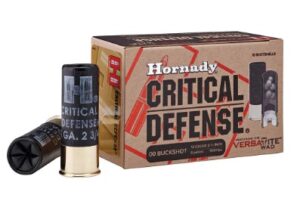
The Hornady Critical Defense 12 Gauge 8 Pellet Buckshot ammunition is designed for personal defense and comes in a standard 2.75-inch shell. It uses eight 00 buckshot pellets with a listed muzzle velocity of 1,600 feet per second, providing defined ballistic specifications for users evaluating defensive shotgun ammunition.
Hornady uses its Versatite wad technology, which is designed to produce consistent, tight shot patterns without requiring modifications to the shotgun. According to the manufacturer, the ammunition is also loaded for reliable functioning in compatible pump-action and semi-automatic shotguns.
Each shell contains a 1.5-ounce lead shot payload and uses a plastic and brass cartridge case. The box contains 10 rounds, making it a relatively small package for users who want to evaluate this defensive load or maintain a limited supply.
This ammunition is best suited to shotgun owners seeking a purpose-designed personal-defense load. Users should confirm that the 12-gauge, 2.75-inch shells are compatible with their shotgun and understand the significant penetration risks associated with buckshot.
Specifications
- Manufacturer: Hornady
- Gauge: 12
- Shell Length: 2.75 inches
- Number of Rounds: 10
- Shot Type: 00 Buckshot
- Pellet Count: 8
- Shot Weight: 1.5 oz
- Muzzle Velocity: 1,600 fps
- Case Material: Plastic and brass
Pros
- Designed for personal defense
- Eight-pellet 00 buckshot load
- Listed muzzle velocity of 1,600 fps
- Versatite wad technology designed for consistent patterns
- Developed for compatible pump-action and semi-automatic shotguns
- Standard 2.75-inch shell format
Cons
- Contains lead shot and is not lead-free
2) Winchester USA 5.56x45mm NATO 62 grain Green Tip M855 Full Metal Jacket Boat Tail FMJBT Brass Centerfire Rifle Ammunition for Self-Defense
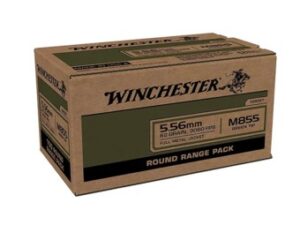
The Winchester USA 5.56x45mm NATO 62 Grain Green Tip M855 ammunition features a full metal jacket boat-tail bullet and a brass cartridge case. Designed for target shooting and other listed applications, this load uses a 62-grain projectile with a stated muzzle velocity of 3,060 feet per second.
The M855 bullet has a green tip and a steel insert beneath its jacket. Winchester also specifies a heat-treated cartridge case, with the ammunition built around a conventional centerfire primer. These features define its construction and distinguish it from standard full metal jacket loads without a steel insert.
This ammunition may suit owners of compatible 5.56 NATO firearms who need factory-loaded cartridges for target shooting and training. Although self-defense appears among the listed applications, M855 is not specifically an expanding defensive bullet, and its penetration characteristics can create risks beyond the intended target. Users should confirm firearm compatibility and understand local laws before selecting ammunition for any purpose.
Specifications
- Manufacturer: Winchester
- Caliber: 5.56x45mm NATO
- Bullet Type: Full Metal Jacket Boat Tail
- Bullet Weight: 62 grains
- Muzzle Velocity: 3,060 fps
- Case Material: Brass
- Primer: Centerfire
- Tip Design: Green tip with steel insert
- Lead-Free: No
Pros
- 62-grain M855 bullet design
- Brass cartridge case
- Heat-treated case construction
- Published muzzle velocity of 3,060 fps
- Suitable for target shooting with compatible firearms
- Conventional centerfire cartridge format
Cons
- Full metal jacket design is not an expanding bullet
3) G9 Defense 9mm +P 80 Grain External Hollow Point Brass Cased Pistol Ammunition E-9MMP-80A for Self-Defense
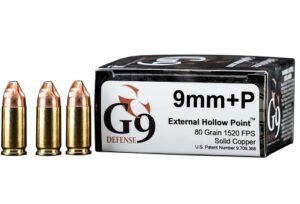
The G9 Defense 9mm +P 80 Grain External Hollow Point ammunition is designed for personal protection and features a lightweight, solid copper projectile. Its external hollow point (EHP) design uses shaped channels that G9 Defense describes as Shape Charge Technology, intended to influence how the projectile behaves on impact.
The ammunition has an 80-grain bullet and a listed muzzle velocity of 1,480 fps, with another specification listing 1,520 fps. Its stated muzzle energy is 410 ft-lbs. The +P designation indicates higher-pressure 9mm ammunition, so users should verify that their specific firearm is rated for this load before use.
G9 Defense also describes the EHP design as intended to provide consistent penetration and performance through common barriers. The manufacturer reports testing in ballistic gel and claims reduced felt recoil due to the projectile’s lighter weight. These are manufacturer-provided claims, and actual results can vary with firearm, test conditions, and the barriers encountered.
This ammunition may suit experienced firearm owners looking for factory-loaded 9mm +P cartridges specifically marketed for personal defense. Before choosing it for everyday carry, confirm firearm compatibility, check applicable laws, and review independent testing where available. The box contains 20 rounds, and the ammunition is listed as lead-free.
Specifications
- Manufacturer: G9 Defense
- Caliber: 9mm Luger +P
- Bullet Type: External Hollow Point
- Bullet Weight: 80 grains
- Muzzle Velocity: 1,480 fps, with another listing of 1,520 fps
- Muzzle Energy: 410 ft-lbs
- Case Material: Brass
- Primer: Centerfire
- Package Quantity: 20 rounds
Pros
- Lightweight, solid copper projectile design
- External hollow point construction
- Listed for personal and self-defense use
- Lead-free bullet construction
- Waterproofing is stated by the manufacturer
- Compact 20-round package
Cons
- Published muzzle velocity figures are inconsistent
4) Freedom Munitions .380 ACP 100 Grain Round Nose Flat Point Brass Pistol Ammunition
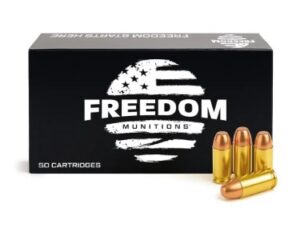
Freedom Munitions .380 ACP 100 Grain Round Nose Flat Point ammunition is a factory-loaded cartridge listed for target shooting, general use, and self-defense. It features a 100-grain RNFP bullet, combining a rounded nose profile with a flat point, and uses a brass cartridge case.
The manufacturer lists a muzzle velocity of 960 feet per second. The ammunition uses a conventional centerfire primer and is not lead-free. While the product is marketed for several applications, the supplied information does not include detailed ballistic testing or evidence of its terminal performance in defensive situations.
This ammunition may appeal to .380 ACP owners looking for factory-loaded cartridges for range practice or general shooting. Those considering it for personal defense should assess independent performance testing and confirm that the load functions reliably in their specific firearm. As with any ammunition, verify caliber compatibility before use.
Specifications
- Manufacturer: Freedom Munitions
- Caliber: .380 ACP
- Bullet Type: Round Nose Flat Point (RNFP)
- Bullet Weight: 100 grains
- Muzzle Velocity: 960 fps
- Case Material: Brass
- Primer: Centerfire
- Lead-Free: No
Pros
- 100-grain bullet
- Brass cartridge case
- Published muzzle velocity of 960 fps
- Listed for target shooting and general use
- Also marketed for self-defense
Cons
- Not lead-free
5) SinterFire Special Duty Self-Defense .40 S&W 125 Grain Hollow Point Frangible Brass Cased Pistol Ammunition
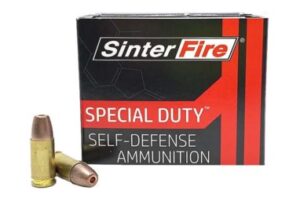
SinterFire Special Duty .40 S&W ammunition is designed for personal defense and features a 125-grain hollow point frangible (HPF) bullet. It combines this projectile design with a brass cartridge case and a centerfire primer. The ammunition is also listed as lead-free, which may be an important consideration for buyers evaluating its specifications.
The ammunition has a published muzzle velocity of 1,350 feet per second. Its frangible bullet construction is a defining feature, although the supplied product information does not include independent test results to verify claims about accuracy, consistency, or terminal performance.
Packaged in a box of 20 rounds, this ammunition is intended for handgun use. It may interest .40 S&W owners evaluating factory-loaded cartridges for personal protection. Before choosing it for defensive use, confirm compatibility with your specific handgun and review reliable testing of its performance under relevant conditions.
Specifications
- Manufacturer: SinterFire
- Caliber: .40 S&W
- Bullet Type: Hollow Point Frangible (HPF)
- Bullet Weight: 125 grains
- Muzzle Velocity: 1,350 fps
- Case Material: Brass
- Primer: Centerfire
- Lead-Free: Yes
- Package Quantity: 20 rounds
Pros
- Frangible hollow point bullet design
- Lead-free ammunition
- Brass cartridge case
- Published muzzle velocity of 1,350 fps
- Designed for personal defense
- Convenient 20-round box
Cons
- Compatibility should be confirmed for the specific handgun
6) Hornady Critical Defense 9 mm Luger 100 Grain Flex Tip eXpanding Centerfire Pistol Ammunition
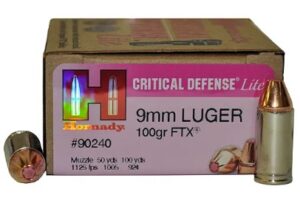
Hornady Critical Defense 9mm Luger 100 Grain ammunition is designed for personal protection, particularly for users who carry a compatible handgun for concealed carry. It features Hornady’s Flex Tip technology, which is intended to support bullet expansion while helping prevent the projectile’s cavity from becoming clogged by clothing.
The cartridge has a 100-grain bullet and a listed muzzle velocity of 1,125 feet per second, producing a stated muzzle energy of 281 ft-lbs. Hornady also uses nickel-plated cartridge cases to help resist corrosion and make the ammunition easier to distinguish during visual checks in reduced lighting.
According to the manufacturer, each round is individually inspected, while the propellant formulation is designed to reduce muzzle flash and help manage recoil. These features may appeal to concealed-carry users looking for factory-loaded defensive ammunition. As with any defensive load, confirm that it is suitable for your specific firearm and test its feeding and function safely according to the manufacturer’s guidance.
Specifications
- Manufacturer: Hornady
- Caliber: 9mm Luger
- Bullet Weight: 100 grains
- Bullet Type: Listed as Spitzer
- Muzzle Velocity: 1,125 fps
- Muzzle Energy: 281 ft-lbs
- Case Material: Brass, nickel-plated finish
- Primer: Centerfire
- Package Quantity: 25 rounds
Pros
- Flex Tip technology designed to support expansion
- Bullet design intended to reduce clogging from clothing
- Nickel-plated cases help resist corrosion
- Propellant designed to limit muzzle flash
- Each round is individually inspected, according to Hornady
- Convenient 25-round package
Cons
- Actual performance can vary with firearm and test conditions
Why Self Defense Ammo? (Advantages)
1. Designed for Personal Protection
Self-defense ammunition is developed for situations where protecting yourself or others may be necessary. Depending on its design, it may offer specific performance characteristics intended for defensive use. Choosing a suitable load requires considering firearm compatibility, reliable function, and independent performance testing rather than relying on marketing claims alone.
2. Purpose-Built Bullet Design
Some defensive cartridges use hollow point or other specialized bullet designs intended to expand on impact. Expansion can affect the projectile’s penetration and the amount of energy transferred to a target. Actual results vary according to ammunition construction, impact conditions, and other factors, so published claims should be assessed against credible test results.
3. Consistent Performance
Consistency matters when selecting ammunition for personal protection. Manufacturers may use quality-control procedures, inspect individual rounds, and maintain production standards to reduce defects. However, ammunition should also be tested for reliable feeding and function in the specific firearm in which it will be used.
4. Corrosion Resistance
Some defensive ammunition uses nickel-plated cases or other corrosion-resistant finishes. These features can help protect cartridge surfaces during storage and handling, particularly when ammunition is exposed to moisture. Proper storage conditions remain important because a protective coating does not make ammunition immune to deterioration.
5. Reduced Muzzle Flash
Certain defensive loads use propellants formulated to limit visible muzzle flash. This feature may be relevant in low-light conditions, when a bright flash can temporarily affect visibility. Actual flash levels depend on the ammunition, firearm, barrel length, and surrounding environment.
6. Manageable Recoil
Ammunition characteristics, including bullet weight and propellant selection, can influence perceived recoil. A load that a shooter can control comfortably may support more consistent practice and firearm handling. Individual experience varies, so users should evaluate recoil and function safely rather than assuming a particular cartridge will feel the same in every handgun.
7. Options for Different Firearms
Defensive ammunition is available in multiple calibers, bullet weights, and projectile designs. This variety allows firearm owners to evaluate loads suitable for their particular handgun or other compatible firearm. The correct caliber and pressure rating must always match the firearm manufacturer’s specifications.
8. Convenient Storage and Carry
Defensive ammunition is commonly sold in compact boxes suitable for organized storage. Some lightweight projectile designs may also reduce cartridge weight, depending on the specific load. Safe storage, appropriate packaging, and compliance with applicable laws remain essential considerations.
Factors to Consider When Choosing The Best Self Defense Ammo
1. Caliber Compatibility
The first consideration is whether the ammunition matches the chambering specified by the firearm manufacturer. Cartridges that appear similar are not necessarily interchangeable, and using the wrong ammunition can create serious safety risks. Always check the firearm’s markings and owner’s manual before purchasing or loading a cartridge.
2. Bullet Design
Bullet construction influences how ammunition behaves on impact. Hollow point designs are commonly intended to expand, while full metal jacket and frangible projectiles have different construction characteristics. Evaluate the intended application and look for credible test results rather than assuming that one bullet design performs best in every situation.
3. Bullet Weight
Bullet weight, usually measured in grains, is one factor affecting a cartridge’s ballistic behavior. Different weights may produce different velocities, recoil characteristics, and penetration results. Consider the complete ammunition specification and independent testing instead of judging suitability by bullet weight alone.
4. Muzzle Velocity and Energy
Muzzle velocity measures how quickly a projectile leaves the barrel, while muzzle energy describes its kinetic energy at that point. Both figures can help when comparing ammunition specifications, but neither independently establishes defensive effectiveness. Results can also differ between firearms because of barrel length and testing conditions.
5. Reliable Function
A defensive load needs to function consistently in the firearm for which it is intended. Differences in cartridge dimensions, bullet profiles, and firearm design can affect feeding and cycling. Consult the firearm manufacturer and follow safe range-testing procedures to confirm compatibility and function.
6. Penetration and Expansion Testing
Independent ballistic testing can help buyers understand how a cartridge behaves under controlled conditions. For defensive ammunition, useful evaluations may examine penetration depth, projectile expansion, and performance through standardized barriers. Test results should be interpreted carefully because laboratory conditions cannot reproduce every real-world situation.
7. Case Construction and Corrosion Resistance
Cartridge cases may be made from brass, steel, or other materials, while some ammunition uses additional protective plating. Case construction can influence corrosion resistance, handling, and compatibility with a firearm. Store ammunition in a cool, dry place and follow the manufacturer’s storage recommendations.
8. Price, Availability, and Storage Life
Cost and availability matter when choosing ammunition for regular practice and personal protection. Buyers should consider the package quantity, the ability to obtain the same load consistently, and the cost of verifying reliable function. Store ammunition properly and follow manufacturer guidance on inspection and replacement rather than assuming that all cartridges have the same usable lifespan.
Best Self Defense Ammo FAQs
1. What Is the Difference Between Self-Defense Ammunition and Regular Target Ammunition?
Self-defense ammunition is generally designed around specific defensive performance goals, such as controlled expansion or a particular penetration profile. Target ammunition is primarily intended for practice or competition and may use different projectile designs. Neither label alone guarantees performance, so examine the specifications and reliable testing for the particular load.
2. Is Hollow Point Ammunition Always the Best Choice for Self-Defense?
No. Hollow point ammunition is designed to expand under suitable conditions, but its performance depends on projectile construction, impact velocity, and other variables. Other designs have different characteristics and limitations. Choose ammunition compatible with your firearm and base your decision on credible testing, relevant laws, and professional guidance where appropriate.
3. How Should Self-Defense Ammunition Be Stored?
Keep ammunition in its original packaging or another suitable, clearly labeled container in a cool, dry environment. Avoid excessive heat, moisture, and exposure to corrosive substances. Store it securely away from children and unauthorized users, inspect it for visible damage or corrosion, and follow the manufacturer’s instructions for handling and storage.
Conclusion
Buying the best self-defense ammunition is about more than finding a cartridge with impressive numbers on the box. It means selecting a dependable load that suits your firearm, performs consistently, and gives you confidence in your equipment without relying on marketing promises.
From specialized bullet designs to corrosion-resistant cases and carefully developed propellants, today’s defensive ammunition offers different features for different needs. The smartest choice is one backed by credible performance testing, verified firearm compatibility, and responsible handling.
When personal safety matters, informed decisions and regular practice are far more valuable than bold claims printed on a package.
See Also:

Charles is an outdoor gear writer with a passion for exploring and reviewing outdoor equipment, optics, hunting gear, hiking essentials, and other adventure-focused products. He creates informative, practical content designed to help readers understand product features and make confident buying decisions.