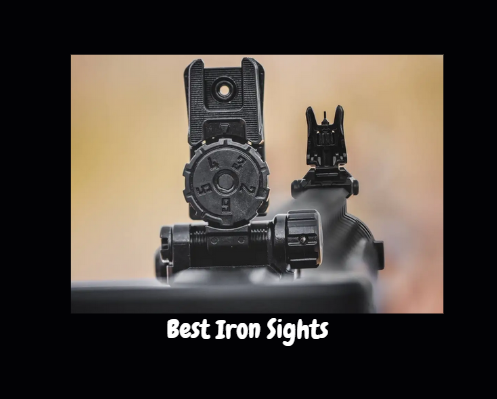
In this guide on the best iron sights, I’ll walk you through why they are still a must-have, highlight the key features that matter most, share some top picks to consider, and provide a buying guide to help you make the right choice.
I’ll also answer some of the most common FAQs so you’ll have a complete picture of what to look for and how to get the most out of your iron sights.
When it comes to reliable aiming systems, I believe iron sights deserve just as much attention as modern optics.
Iron sights offer unmatched simplicity, durability, and consistency, making them an essential option whether you rely on them as your primary sight or as a backup in case your optic fails.
Must-Have Features for the Best Iron Sights
The best iron sights share a set of must-have features that balance durability, precision, and ease of use.
First, rugged construction is essential, with steel or aircraft-grade aluminum and protective finishes like hard coat anodizing or Melonite to resist corrosion and wear.
A low-profile design that folds or stays snag-free ensures compatibility with optics and prevents interference with other accessories. Positive detents or locking systems are critical so the sights stay secure in both the up and down positions.
Tool-free windage and elevation adjustments, ideally with precise MOA click values, make zeroing faster and more reliable. Standard AR sight height for rifles, or clear, high-contrast dots for pistols, guarantees intuitive target acquisition and co-witnessing with optics.
Finally, ambidextrous operation and broad compatibility with Picatinny rails or specific handgun models expand versatility, while options like tritium or fiber-optic inserts enhance performance in low-light conditions.
Together, these features define what makes an iron sight both dependable and effective across a variety of shooting scenarios.
Why Iron Sights?
Iron sights remain an essential part of shooting because they offer simplicity, reliability, and durability that optics alone cannot always guarantee.
Unlike red dots or scopes, iron sights do not rely on batteries, glass, or electronics, which means they will function in virtually any condition.
They provide a consistent and proven aiming method that works at close and medium ranges, making them a dependable backup if an optic fails or gets damaged.
Iron sights also encourage shooters to develop strong fundamental skills in sight alignment and trigger control, which translates into better accuracy overall.
For many, they serve as both a primary and backup aiming system, ensuring that no matter the environment, the shooter always has a reliable way to stay on target.
Best Iron Sights
1) Magpul Industries MBUS Pro LR Top Mounted Deployable Iron Sight
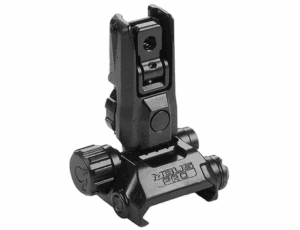
The Magpul MBUS Pro LR rear sight is one of the best iron sights.It is a rear, top-mounted, deployable iron sight designed to pair cleanly with modern AR platform builds.
The sight’s all-steel construction and case-hardened finish set a solid expectation for long service life, and the Melonite treatment adds a high level of resistance to wear and corrosion that keeps the finish looking and performing like new through harsh use.
The MBUS Pro LR keeps things simple and rugged. The sight mounts to any MIL-STD-1913 Picatinny or STANAG 4694 rail and deploys to standard AR sight height, so co-witnessing with optics is straightforward. Windage is adjustable via a low-profile knob that needs no tools, which makes field adjustments fast and reliable.
Elevation is handled by a tactile wheel calibrated for 200 to 600 meter engagements in 50 meter increments, giving the shooter predictable clicks for longer range work without guessing.
The mechanical design emphasizes positive engagement and user confidence. Positive detents hold the sight securely in both the up and down positions so the sight does not drift when stowed or in use.
Ambidextrous geometry and the top-mounted, rear position make it compatible with a wide range of shooters and mounting schemes. For builds that combine magnified optics or a red dot plus magnifier, the MBUS Pro LR provides a robust, precision backup that matches the form and function of higher-end components.
This sight is perfect for buyers who want a military grade backup sight with true elevation indexing and tool-free windage will appreciate the MBUS Pro LR. It is especially suited to AR users who expect to engage at extended distances or who want an iron sight that blends seamlessly with modern optics.
The sight’s steel construction and Melonite finish make it an excellent choice for heavy use, duty carry, or harsh environments.
Pros
- All steel construction for strength and longevity
- Case hardened finish with Melonite for superior wear and corrosion resistance
- Tool-free windage adjustment via a low-profile knob
- Elevation wheel indexed for 200 to 600 meter adjustments in 50 meter increments
- Positive detents hold the sight securely in both up and down positions
- Mounts to MIL-STD-1913 Picatinny and STANAG 4694 rails for broad compatibility
- Standard AR sight height when deployed for easy co-witnessing with optics
- Ambidextrous design suitable for right or left-handed shooters
Cons
- Top-mounted rear configuration requires a compatible rail layout and may interfere with some highly accessorized upper receivers
2) Magpul Industries MBUS Generation II Front & Rear Sight Set
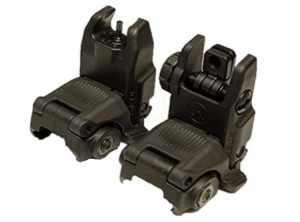
The Magpul MBUS Generation II front and rear sight set is a no-nonsense backup iron sight solution that balances durability, low weight, and quick deployment. Designed to serve as reliable backup sights for modern sporting rifles, the set uses impact-resistant polymer construction to keep weight down while resisting operational abuse in the field.
The clean, utilitarian look pairs well with a wide range of builds and gives shooters a dependable alternative when optics fail or are not desired.
Deployment and use are simple and intuitive. Each sight is spring loaded so it flips up easily from either side or by pressing on the top; this makes one-handed activation straightforward in dynamic situations.
Detent and spring pressure keep the sights erect for accurate aiming but also allow them to fold flat if they take an impact, preventing damage and avoiding unwanted interference when stowed.
The sights provide a standard sight height when deployed, which makes aligning with most optics and magnifiers uncomplicated.
Mounting and compatibility were designed for modern rails. The set clamps to any MIL STD 1913 Picatinny or STANAG 4694 receiver rail for rock-solid attachment and repeatable zero.
Because these are intended as rail-mounted sights they are not suitable for railed gas blocks, so users with that configuration should plan mounting accordingly. The overall simplicity of the design reduces snag points and makes the set low maintenance for daily carry or range use.
Practical takeaways and who will like this: shooters who want a lightweight, robust, and fast-deploying backup sight set that will survive hard use will appreciate the MBUS Gen II pair.
It is especially attractive for AR platform owners who prefer polymer components to reduce weight and who need a reliable mechanical backup that folds unobtrusively when not in use.
Pros
- Impact resistant polymer construction for low weight and rugged durability
- Spring loaded flip up action allows easy deployment from either side or by pressing the top
- Detent and spring pressure hold the sight erect while permitting unobstructed folding under impact
- Clamps to any MIL STD 1913 Picatinny or STANAG 4694 rail for secure mounting and repeatable zero
- Standard sight height when deployed for easy alignment with common optics and magnifiers
- Low maintenance design with reduced snag profile for carry and tactical use
Cons
- Not compatible with railed gas block mounting options
3) Midwest Industries Combat Rifle Top Mounted Deployable Iron Sight
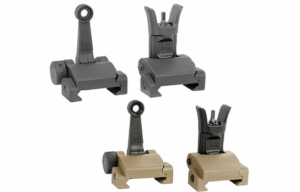
The Midwest Industries Combat Rifle folding front and rear sight set is a purpose-built backup iron sight package for AR platform rifles. Designed to mount to any Picatinny rail, the set keeps a very low profile when folded and flips up to Mil-Spec sight height for reliable co-witnessing with most optics. Deployment is crisp and repeatable, and the geometry of the sights supports both rapid close-range aiming and more deliberate precision work.
Build quality mixes weight savings with battlefield-grade durability. Both sights use a hard-coated 6061 aluminum base to reduce mass, while the working components are made from ordnance-grade, phosphate-finished steel for toughness and wear resistance.
Dual locking detent springs provide a positive, tactile feel when moving between stowed and deployed positions, and the folding mechanism’s low folded heights — .437 inch for the front and .388 inch for the rear — mean the sights clear most optics and accessories when not in use.
Adjustment and sighting features are generous for a flip-up set. The front sight accepts a standard A2 post and works with common A2 tools, while the rear sight offers an intermediate aperture that balances precision at range with fast target acquisition up close.
Click values are tight and shooter-friendly: the front uses 1.5 MOA per click, and the rear provides rifle .5 MOA and carbine .65 MOA click adjustments for fine zeroing. Midwest Industries also supplies a precision A2 front sight tool machined from stress proof steel with a knurled handle for secure, repeatable adjustments in the field.
This sight set is ideal for shooters building a serviceable, optic-forward rifle who want steel-on-steel durability without adding excessive weight. It suits patrol, duty, range, and serious recreational use where a robust mechanical back up is preferred.
Users with railed gas blocks or unusual rail geometry should verify fit, but most standard Picatinny-equipped ARs will accept the set without modification.
Pros
- Low profile when folded which clears most optics and rail accessories
- Flips up to Mil-Spec sight height for easy co-witnessing with common optics
- Ordnance-grade steel components with phosphate finish for durability
- Hardcoated 6061 aluminum base for weight savings
- Dual locking detent springs for crisp, reliable positioning every deployment
- Front uses standard A2 post and includes a precision A2 tool for adjustments
- Rear intermediate aperture balances long-range precision with rapid close-range engagement
- Precise click values for fine zeroing across rifle and carbine settings
Cons
- Steel components add durability but increase weight compared with all polymer alternatives
4) Troy Iron Sight
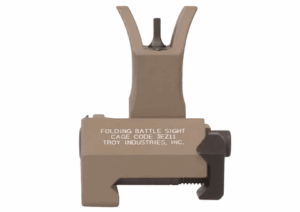
The Troy folding front BattleSight is a proven upgrade for AR platform shooters who want a rugged, precision front sight that plays well with modern optics. Machined from hardened aircraft aluminum with stainless steel components and finished in MILSPEC hardcoat anodizing, the sight balances toughness with low weight.
Its machined construction and corrosion-resistant finishes make it a natural choice for shooters who expect repeated use under demanding conditions.
The operation is simple and fast. A push of the button folds the sight securely out of the way until it is needed again, and a stainless steel cross-locking system keeps the sight upright and zeroed even under hard use.
The design avoids fiddly levers and exposed springs so deployment feels positive and reliable when timing matters. The sight installs on any Picatinny rail and can be moved or removed without permanent modification to the firearm, which makes it convenient for users who swap accessories or use multiple uppers.
Adjustment and compatibility are shooter friendly. The sight uses a zero canting attachment system to ensure alignment on installation and each click adjusts by .50 MOA for tight, repeatable windage or elevation changes.
The geometry and height are intended to cowitness with common red dot optics and the sight works well either alone or paired with a rear backup. Ambidextrous use and a simple post shape keep acquisition intuitive for most shooters.
Who will like this sight and why: tactical users, competition shooters, and everyday owners who value repeatable performance with low fuss will appreciate the Troy front BattleSight.
It is particularly well suited for builds that rely primarily on optics but need a dependable mechanical front sight ready to work without adjustment or compromise.
Pros
- Machined from hardened aircraft aluminum with stainless steel components for long term durability
- MILSPEC hardcoat anodize finish for corrosion and wear resistance
- Push button folding with a stainless steel cross locking system for secure deployment and retention
- Mounts on Picatinny rails and can be removed or relocated without permanent firearm modification
- Zero canting attachment system simplifies correct alignment during installation
- Each click adjusts .50 MOA for precise, repeatable tuning
- Designed to cowitness with red dot optics and works well alone or with a rear backup
- No levers or springs to fumble with during installation or deployment
Cons
- Installation requires a Picatinny rail and may not suit non-standard mounting systems
5) Sig Sauer XRAY3 Sight Set
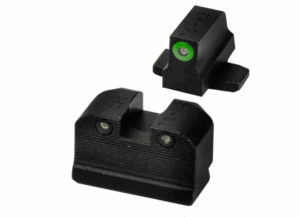
The Sig Sauer XRAY3 sight set is a polished iron sight package designed for fast, intuitive target acquisition across a wide range of light conditions. The XRAY3 combines a blacked-out rear with a high contrast front to create a clear sight picture that naturally draws the eye to the front dot.
That visual clarity translates to quicker alignment and more confident shooting, whether you are on patrol, running drills at the range, or out hunting at dawn or dusk.
The sighting system uses a three dot arrangement with a bright, long lasting illumination that performs well in low light and remains visible in daylight. The oversized fluorescent polymer front dot is chemical resistant so it tolerates routine cleaning solvents and exposure to the elements without degrading.
Surrounding steel components protect the luminous elements from recoil and impact while also resisting abrasive wear, giving the sights a lifespan measured in years, not months.
Installation and fit are straightforward for many popular SIG platforms. XRAY3 sets are sized and shaped to work with common SIG frames, including P320, P938, P238, P229, P226, P220, P227, and P225 models.
The sights are available in standard SIG sizes and in square or round rear notch options so you can choose the geometry that best suits your shooting style and optic compatibility. The chemical-resistant materials and rugged construction make these sights a low-maintenance choice that stays bright and reliable through extended service.
Who will benefit most from these sights: duty and concealment carriers who need a sight that performs day and night without swapping components, recreational shooters who want a visible front reference for fast acquisition, and anyone who prefers robust steel protection around luminous sight elements.
The XRAY3 aims to be a one-set solution for mixed light environments rather than a sight that needs seasonal or role dependent changes.
Pros
- High contrast front and blacked out rear for rapid, intuitive target acquisition
- Three dot illumination that is bright in low light and remains visible in daylight
- Oversized fluorescent polymer front dot that resists chemicals and field wear
- Steel surrounds protect luminous elements from recoil and cleaning solvents
- Available in standard SIG sizes and rear notch shapes to fit many SIG models
- Low maintenance design built for long term visibility and reliability
Cons
- Compatibility limited to specified SIG platforms so other handgun owners will need a different model
6) Daniel Defense A1.5 Top Mounted Fixed Iron Sight
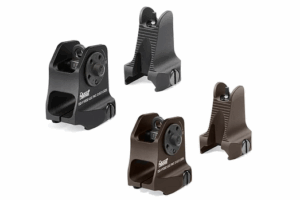
The Daniel Defense A1.5 fixed iron sight set is a purpose-built solution for shooters who want a permanent, low-profile backup sighting system that demands little maintenance. Both front and rear sights are machined from 6061-T6 aircraft grade aluminum and finished with Military Specification Type III hard coat anodizing for excellent corrosion resistance and long service life.
Because the sights are fixed, they remove the mechanical complexity of folding systems while offering a rock-solid sight plane that stays zeroed through heavy use.
Mounting and retention use Daniel Defense’s patented Rock & Lock attachment technology which makes installation quick and secure on any Picatinny rail. The rail-mounted configuration keeps the front sight snag-free and compatible with compact weapon lights, a benefit for shooters who want to run an illumination device without compromising a reliable aiming point.
The unobtrusive profile of the A1.5 set keeps the sighting geometry simple and predictable, and the standard AR sight height makes co-witnessing with many optics straightforward.
Performance focuses on repeatability and reliability. Fixed sights eliminate play and moving parts, so the shooter gets an unchanging sight picture and predictable point of impact over time.
The ambidextrous layout suits a wide range of users and mounting positions. Because these are non-illuminated sights they perform like traditional iron sights in all lighting conditions without batteries or luminous elements that can fail, making them a solid choice for duty, training, and serious recreational use.
Who will appreciate this sight set: owners of AR platform rifles who prefer a permanent, maintenance light backup that will not require re-zeroing after hard use, and users who run weapon lights and need a snag-free front sight that clears attachments.
The A1.5 is especially appropriate where durability, minimalism, and a reliable mechanical sighting plane are priorities.
Pros
- Constructed from 6061-T6 aircraft-grade aluminum for a strong but lightweight setup
- Military Specification Type III hard coat anodized finish for long-term corrosion resistance
- Patented Rock & Lock attachment technology for fast, secure mounting on Picatinny rails
- Fixed front and rear design provides a consistent sight plane with no moving parts to loosen or fail
- Rail-mounted front sight reduces snag risk and works with compact weapon mounted lights
- Ambidextrous geometry fits a wide range of shooters and mounting preferences
- Unobtrusive profile that co-witnesses at standard AR sight height
Cons
- Permanent mounting means changing setups or switching optics may require removal and reinstallation
Next Read: 6 Best Red Dot Magnifiers
Which is better, red dot or iron sights?
Red dots and iron sights both have their place, and the better option depends on how you intend to use your firearm. A red dot offers faster target acquisition, especially in close to mid-range shooting, since the illuminated reticle allows you to aim with both eyes open and quickly align on target, making it popular for tactical, defensive, and competition use.
Iron sights, on the other hand, are more rugged, never run out of batteries, and provide a reliable backup if an optic fails, which is why many shooters keep them as a secondary option. In general, red dots excel in speed and ease of use, while iron sights win in simplicity, durability, and reliability under all conditions.
Factors to Consider when Choosing the Best Iron Sights
When choosing the best iron sights, several important factors should be considered to ensure they meet your shooting needs and perform reliably in different environments.
Here are the key factors with explanations:
Durability
One of the most critical factors in selecting iron sights is durability. Since these sights are often used in demanding conditions, they need to withstand recoil, rough handling, and exposure to the elements.
Materials like aircraft-grade aluminum or steel with protective finishes ensure the sights last for years without bending, corroding, or losing zero. A durable set of sights provides peace of mind, especially in situations where optics may fail.
Visibility and Sight Picture
The best iron sights should provide a clear and consistent sight picture in varying light conditions. High-contrast designs, whether through blacked-out rears, bright front posts, or tritium inserts, allow for quick target acquisition both in daylight and low-light scenarios.
A sight system that enhances visibility reduces the time it takes to align and fire accurately, which is crucial in both defensive and sporting applications.
Mounting Compatibility
Compatibility with your firearm’s platform is another key factor. Iron sights must match the mounting system, such as Picatinny or dovetail, to ensure a secure fit.
Additionally, the design should allow for smooth integration with other accessories, such as weapon lights or optics, without snagging or interfering. Choosing sights that align properly with your firearm ensures reliable performance and ease of installation.
Adjustability
Iron sights that allow windage and elevation adjustments give shooters greater control over accuracy. While fixed sights are often simple and rugged, adjustable models allow for fine-tuning based on ammunition type, shooting distance, and personal preferences.
This feature is especially valuable for those who want precision at varying ranges without relying solely on optics.
Ergonomics and Usability
The best iron sights are designed to be user-friendly and intuitive. Features such as snag-free profiles, easy-to-see dots, or smooth transitions between front and rear sights improve the overall shooting experience.
Sights should feel natural to use, whether for quick target transitions in a defensive situation or slow, precise aiming at the range.
Non-Dependence on Electronics
A major advantage of iron sights is that they do not rely on batteries or electronics. When choosing a set, consider how they function as a dependable backup system to optics.
The best designs provide consistent performance without maintenance beyond basic cleaning, making them a fail-safe aiming solution in any condition.
Best Iron Sights FAQs
Are iron sights still necessary if I use a red dot or scope?
Yes, iron sights remain an important backup even if you rely on a red dot or scope. Electronics can fail due to battery loss, damage, or environmental conditions, and iron sights provide a dependable aiming solution in those moments. Many shooters keep them as a fail-safe option to ensure accuracy when optics are unavailable.
What is the difference between fixed and flip-up iron sights?
Fixed iron sights are always deployed, offering constant readiness and rugged durability. Flip-up iron sights, on the other hand, can be folded down when not in use and quickly deployed when needed.
The choice between the two depends on whether you want a streamlined profile for optics use or prefer the simplicity of a permanently ready sight.
Do iron sights work well in low-light conditions?
Traditional iron sights can be harder to use in low light, but modern designs often include high-contrast front posts or tritium inserts that glow in the dark.
These features improve visibility, allowing for faster target acquisition in dim environments. For shooters who expect to use their firearm in varying light conditions, sights with enhanced visibility are a strong option.
Final Thoughts
In conclusion, iron sights remain one of the most dependable and versatile aiming solutions for shooters of all levels. Their rugged construction, ease of use, and independence from batteries or electronics make them a trustworthy option in any environment.
The best iron sights combine durability, precise adjustments, and compatibility with modern optics setups, giving you confidence whether you’re using them as your primary system or as a backup.
For a well-rounded option that balances performance and reliability, the Midwest Industries Combat Rifle Iron Sight Set is the best overall choice. If you want a cost-effective yet capable solution, the Sig Sauer XRAY3 Sight Set delivers excellent visibility and durability at a budget-friendly level.
For those who want a premium fixed sight built for ultimate strength and consistency, the Daniel Defense A1.5 Top Mounted Fixed Iron Sight is hard to beat. No matter which category fits your needs, investing in quality iron sights ensures you’ll always have a dependable aiming system at your disposal.

Albert, the founder of Outdoormoran, is a dedicated outdoor enthusiast with a passion for delivering the most current, accurate, and easy-to-understand information on all different outdoor gear and optics. He shares his expertise with beginners by teaching the technical aspects of outdoor gear and optics through his comprehensive collection of guides.