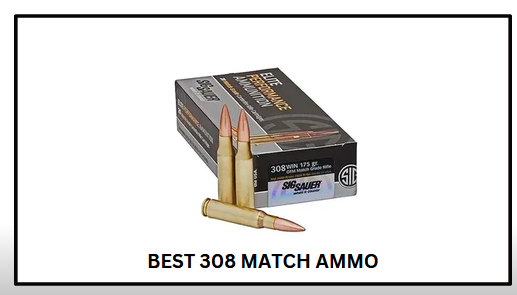
Do you want to buy the best 308 match ammo for competition, precision target shooting, and demanding range sessions?
I have reviewed these .308 Winchester match loads with a focus on the features that matter when consistency is the priority, including bullet weight, match projectile design, ballistic coefficient, muzzle velocity, brass case construction, propellant selection, and manufacturing quality.
These loads are great choices to consider when you want factory ammunition built specifically around target and competition shooting rather than general-purpose use.
In this guide, I’ll cover the key features of each load, share my top picks, explain what to look for in a buying guide, and answer common questions in the FAQs so you can narrow down the best 308 match ammo for your shooting needs.
Our Top Picks at a Glance
- SIG SAUER Elite Match Grade .308 Winchester Open Tip Brass Cased Centerfire Rifle Ammunition: Best Overall
- Hornady Match .308 Winchester BTHP Centerfire Rifle Ammunition: Best Competition Option
- Hornady Superformance .308 Winchester Extremely Low Drag Match Centerfire Rifle Ammunition: Best Long-Range Option
- Barnes Precision Match .308 Winchester OTM BT Rifle Ammunition: Best Value Option
- PPU Match .308 Winchester Hollow Point Boat Tail Brass Cased Rifle Ammunition: Best Budget Option
How We Tested the Best 308 Match Ammo
I evaluated the Best 308 Match Ammo based on the features and specifications provided for each product. I considered the following areas:
- Bullet Weight: I compared the available bullet weights, including 168, 175, and 178 grain configurations, to understand the range of match-oriented options.
- Bullet Design: I examined projectile configurations such as Open Tip Match, Boat Tail Hollow Point, and Extremely Low Drag designs because bullet shape is an important part of match ammunition.
- Ballistic Coefficient: I reviewed the published G1 and G7 ballistic coefficients to assess the aerodynamic characteristics specified for each load.
- Muzzle Velocity: I compared the listed velocities to understand the different performance specifications across the ammunition reviewed.
- Case Construction: I considered the use of brass cases and the manufacturers’ attention to case consistency and quality.
- Propellant Selection: I looked at how manufacturers selected or developed propellants for their respective loads, particularly where consistency and long-range efficiency were emphasized.
- Manufacturing Quality: I considered production procedures, component selection, dimensional consistency, and quality-control measures described for each ammunition option.
- Intended Application: I evaluated whether each load was specifically suited to target shooting, match use, competition, or precision-focused range sessions.
5 Best 308 Match Ammo
1) SIG SAUER Elite Match Grade .308 Winchester Open Tip Brass Cased Centerfire Rifle Ammunition
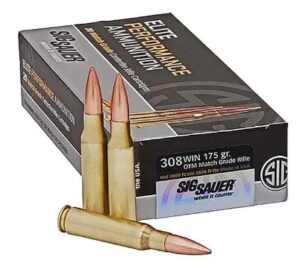
The SIG SAUER Elite Match Grade .308 Winchester is a 175 grain Open Tip Match load designed for precision-oriented shooting with both bolt-action rifles and modern autoloading platforms. It uses a brass case and centerfire primer, with 20 rounds included per box.
The ammunition is built around a Sierra MatchKing projectile, with the 175 grain OTM bullet selected for match applications. SIG SAUER specifies consistent bullet weight retention and controlled velocity variation as part of the load’s design.
The cartridges are precision loaded with electromechanical monitoring to maintain geometric conformity. Temperature-stable propellants are also used, while the case metallurgy and premium primers are intended to support consistency across the ammunition.
This load is best suited to shooters looking for .308 Winchester ammunition for match shooting, precision range work, and other applications where consistency is an important consideration. It can be used in compatible bolt-action or autoloading rifles.
Specifications
- Manufacturer: SIG SAUER
- Caliber: .308 Winchester
- Bullet Weight: 175 grain
- Bullet Type: Open Tip Match
- Capacity: 20 rounds
- Case Material: Brass
- Muzzle Velocity: 2,600 ft/s
- Application: Match
- Projectile: Sierra MatchKing
Pros
- 175 grain OTM projectile
- Sierra MatchKing bullet
- Brass cases
- Temperature-stable propellants
- Designed for consistent velocity
- Precision-loaded for geometric conformity
- Intended for bolt-action and autoloading platforms
Cons
- Primarily intended for match and precision applications
2) Hornady Match .308 Winchester BTHP Centerfire Rifle Ammunition
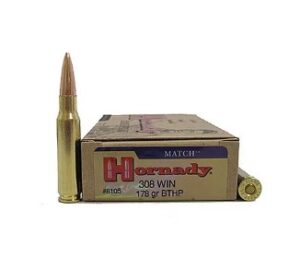
The Hornady Match .308 Winchester 178 grain load is designed for target and match shooting, combining a 178 grain projectile with a brass case and a listed muzzle velocity of 2,600 ft/s. It comes in a 20-round box and is built around Hornady’s match ammunition design for shooters who place emphasis on consistency.
The load uses a boat-tail hollow point match configuration, with Hornady’s ELD Match design incorporating a Heat Shield tip. The tip is intended to maintain a consistent bullet shape and meplat, while the boat-tail profile is designed to reduce drag during flight.
Hornady also pays attention to case and powder selection. The cases are chosen for consistent wall thickness, internal capacity, weight, and concentricity, while the powder charge is matched to the specific load. The ammunition is produced under tight quality-control tolerances to promote consistency between lots.
With a listed G1 ballistic coefficient of 0.53 and sectional density of 0.268, this load is suited to shooters using compatible .308 Winchester rifles for target practice, precision range sessions, and match-oriented shooting. It is best for users who want ammunition built around carefully selected components rather than a general-purpose hunting load.
Specifications
- Manufacturer: Hornady
- Caliber: .308 Winchester
- Bullet Weight: 178 grain
- Bullet Type: BTHP Match / ELD Match
- Capacity: 20 rounds
- Case Material: Brass
- Muzzle Velocity: 2,600 ft/s
- Muzzle Energy: 2,672 ft-lbs
- G1 Ballistic Coefficient: 0.53
Pros
- 178 grain match projectile
- ELD Match Heat Shield tip
- Boat-tail design
- Carefully selected brass cases
- Load-specific powder selection
- Listed G1 BC of 0.53
- Tight manufacturing tolerances
- Intended for target and match shooting
Cons
- Not lead-free
3) Hornady Superformance .308 Winchester Extremely Low Drag Match Centerfire Rifle Ammunition
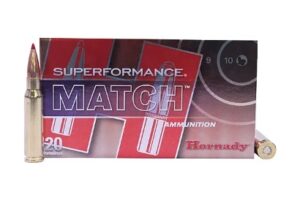
The Hornady Superformance .308 Winchester 168 grain ELD Match is a target-shooting load built around a spitzer boat-tail projectile and Hornady’s Superformance propellant system. It comes in a 20-round box with brass cases and a listed muzzle velocity of 2,840 ft/s, giving this load a different performance profile from conventional .308 Winchester match ammunition.
The 168 grain bullet uses an extremely low drag design intended to maintain efficient flight. Hornady lists a G1 ballistic coefficient of 0.523 and a G7 ballistic coefficient of 0.263, along with a sectional density of 0.253. These specifications make the load particularly relevant to shooters evaluating ammunition for precision-oriented target work.
Superformance ammunition uses progressive propellants developed specifically for the load. Hornady also specifies high-quality cases and primers, with consistent components intended to support consistent shooting performance. The ammunition is loaded with match-grade bullets and is listed specifically for target shooting.
This load is best suited to shooters using compatible .308 Winchester rifles for target practice and precision-focused range sessions. It may appeal to users looking for a relatively high listed muzzle velocity combined with a match-oriented bullet and carefully specified components.
Specifications
- Manufacturer: Hornady
- Caliber: .308 Winchester
- Bullet Weight: 168 grain
- Bullet Type: Spitzer Boat Tail
- Capacity: 20 rounds
- Case Material: Brass
- Muzzle Velocity: 2,840 ft/s
- Muzzle Energy: 3,009 ft-lbs
- G1 Ballistic Coefficient: 0.523
Pros
- 168 grain match bullet
- Extremely low drag design
- Listed 2,840 ft/s muzzle velocity
- G1 ballistic coefficient of 0.523
- G7 ballistic coefficient of 0.263
- Brass cases and quality primers
- Superformance progressive propellant system
- Designed for target shooting
Cons
- Intended primarily for target shooting
4) Barnes Precision Match .308 Winchester OTM BT Rifle Ammunition
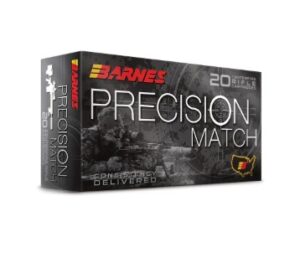
The Barnes Precision Match .308 Winchester 175 grain load is built for competitive and target shooting, using a Match Burner Open Tip Match boat-tail projectile and a brass cartridge case. Each box contains 20 rounds, with a listed muzzle velocity of 2,600 ft/s and muzzle energy of 2,626 ft-lbs.
Barnes developed this load around a specific combination of projectile and propellant after extensive testing. The goal is to provide a consistent cartridge for shooters who want repeatable performance during match and long-range target sessions.
The 175 grain Match Burner OTM BT bullet has a listed G1 ballistic coefficient of 0.521 and G7 ballistic coefficient of 0.255. Barnes pairs the projectile with a propellant selected for long-range efficiency, giving the ammunition a configuration suited to precision-focused shooting.
This load is best suited to competitive shooters and target shooters using compatible .308 Winchester rifles, particularly those looking for match ammunition for longer-range range sessions while keeping ammunition cost in consideration.
Specifications
- Manufacturer: Barnes
- Caliber: .308 Winchester
- Bullet Weight: 175 grain
- Bullet Type: Match Burner OTM Boat-Tail
- Capacity: 20 rounds
- Case Material: Brass
- Muzzle Velocity: 2,600 ft/s
- Muzzle Energy: 2,626 ft-lbs
- G1 Ballistic Coefficient: 0.521
Pros
- 175 grain match projectile
- Open tip match boat-tail design
- Listed G1 BC of 0.521
- Listed G7 BC of 0.255
- Brass cases
- Propellant selected for long-range efficiency
- Intended for competition and match shooting
Cons
- Lead projectile, not lead-free
5) PPU Match .308 Winchester Hollow Point Boat Tail Brass Cased Rifle Ammunition
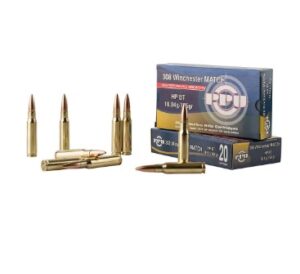
The PPU Match .308 Winchester 168 grain ammunition is built for target shooting, combining a boat-tail hollow point projectile with a brass case. Each box contains 20 rounds, with a listed muzzle velocity of 2,610 ft/s and muzzle energy of 2,541 ft-lbs.
PPU uses controlled production procedures to maintain consistent dimensions and specifications throughout the loading process. The ammunition also uses primers selected for uniform quality and powders chosen for consistent ballistic characteristics.
Each finished batch undergoes inspection before leaving the manufacturer. The 168 grain BTHP bullet has a listed G1 ballistic coefficient of 0.45, giving this load specifications suited to shooters evaluating ammunition for target and match-oriented applications.
This ammunition is best suited to target shooters and competitors using compatible .308 Winchester rifles. It can be a practical choice for range sessions at both shorter and longer distances where consistent ammunition characteristics are important.
Specifications
- Manufacturer: PPU
- Caliber: .308 Winchester
- Bullet Weight: 168 grain
- Bullet Type: Boat Tail Hollow Point
- Capacity: 20 rounds
- Case Material: Brass
- Muzzle Velocity: 2,610 ft/s
- Muzzle Energy: 2,541 ft-lbs
- G1 Ballistic Coefficient: 0.45
Pros
- 168 grain BTHP projectile
- Boat-tail bullet design
- Brass cartridge cases
- Primers selected for uniform quality
- Powders chosen for consistent ballistics
- Controlled production procedures
- Finished ammunition undergoes inspection
- Suitable for target shooting
Cons
- 168 grain configuration may not suit every shooter’s preference
Why 308 Match Ammo? (Advantages)
1. Consistent Manufacturing Standards
Match ammunition is produced with close attention to dimensions, components, and loading consistency. The products discussed use carefully selected bullets, primers, powders, and brass cases, with manufacturers applying quality-control and inspection procedures to promote uniformity between cartridges.
2. Match-Oriented Bullet Designs
The ammunition covered uses projectile designs such as Open Tip Match, Boat Tail Hollow Point, and other precision-focused configurations. These designs are commonly used in target and competition ammunition where bullet shape and consistency are important considerations.
3. Useful Ballistic Characteristics
Several of the loads provide published ballistic coefficient figures, including both G1 and G7 values. These specifications give shooters useful information about the aerodynamic characteristics of the bullets, particularly when evaluating ammunition for longer-range target shooting.
4. Multiple Bullet Weight Options
The reviewed ammunition includes 168, 175, and 178 grain projectiles. Having different bullet weights gives shooters several factory-loaded configurations to consider based on their rifle, shooting distance, and preferred ammunition characteristics.
5. Carefully Selected Propellants
The ammunition discussed uses powders selected or developed for specific loads. Manufacturers place emphasis on consistent ballistic characteristics, while some loads use propellant systems developed specifically around the projectile and cartridge combination.
6. Quality Brass Cases
Brass cases are used across the reviewed ammunition, with some manufacturers paying particular attention to case weight, wall thickness, internal capacity, and dimensional consistency. These characteristics are relevant when evaluating factory match ammunition for uniformity.
7. Suitable for Competition and Target Shooting
Several of the loads are specifically listed for match, competition, or target applications. This makes .308 match ammunition relevant to shooters participating in organized shooting as well as those spending time on precision-focused range sessions.
8. Variety of Factory Match Loads
The range of available .308 match ammunition provides different combinations of bullet weight, projectile design, velocity, ballistic coefficient, and case construction. This gives shooters more configurations to evaluate when selecting ammunition for their particular rifle and shooting application.
Factors to Consider When Choosing The Best 308 Match Ammo
1. Bullet Weight
The ammunition discussed includes 168, 175, and 178 grain options. Bullet weight affects the overall ballistic characteristics of a load, so consider the rifle being used, intended shooting distance, and the characteristics you want from the ammunition.
2. Bullet Design
Projectile configuration is another important consideration. Options such as Open Tip Match, Boat Tail Hollow Point, and spitzer boat-tail designs have different profiles and aerodynamic characteristics, making bullet design relevant when selecting ammunition for precision-oriented shooting.
3. Ballistic Coefficient
Published ballistic coefficient figures can help when comparing the aerodynamic characteristics of different loads. Some ammunition provides both G1 and G7 values, giving shooters additional information when evaluating bullets for longer-range applications.
4. Muzzle Velocity
Muzzle velocity provides a useful reference when comparing ammunition specifications. However, the published figure is not necessarily the velocity every rifle will produce, since actual results can vary with the firearm and shooting conditions.
5. Case Construction
Brass case quality is worth examining when choosing factory match ammunition. Information about case weight, wall thickness, internal capacity, and dimensional uniformity can provide useful insight into the manufacturer’s approach to cartridge consistency.
6. Propellant Selection
The propellant is another component to consider because manufacturers may select powders specifically for a particular bullet and load. Consistent ballistic characteristics can be an important part of ammunition intended for target and competition use.
7. Manufacturing and Quality Control
Look at how the manufacturer handles production and inspection. Attention to component selection, dimensional tolerances, cartridge uniformity, and finished-product inspection can provide useful information about how the ammunition is produced.
8. Intended Application
Consider whether the ammunition is specifically listed for target shooting, match use, or competition. Matching the ammunition’s intended application with your own shooting activity can help narrow down the available .308 Winchester options.
Best 308 Match Ammo FAQs
1. What bullet weights are available in .308 match ammunition?
The ammunition reviewed includes 168, 175, and 178 grain options. These provide several configurations for shooters to consider, with the appropriate choice depending on the rifle, intended distance, and individual shooting requirements.
2. Is .308 match ammunition suitable for long-range target shooting?
Many .308 match loads are well suited to precision-oriented target shooting at longer distances. Several of the reviewed cartridges use boat-tail projectile designs and provide published ballistic coefficient values that are relevant when evaluating their aerodynamic characteristics.
3. Is muzzle velocity the most important specification when choosing .308 match ammunition?
No. Muzzle velocity is only one part of the specification. Bullet weight, projectile design, ballistic coefficient, case construction, propellant selection, and manufacturing consistency can also be important when evaluating match ammunition.
Conclusion
Good match ammunition should make the rifle feel predictable rather than leave the shooter wondering what happened between shots.
The .308 loads covered here bring together carefully specified projectiles, consistent components, controlled production, and match-focused performance for shooters who take target work seriously.
They offer the kind of factory ammunition that can fit everything from structured competition to demanding range sessions, without turning the selection into a search for marketing promises.
When the goal is to spend more time reading groups and less time questioning the ammunition, quality .308 match ammo gives shooters a solid place to start.
See Also:

Charles is an outdoor gear writer with a passion for exploring and reviewing outdoor equipment, optics, hunting gear, hiking essentials, and other adventure-focused products. He creates informative, practical content designed to help readers understand product features and make confident buying decisions.