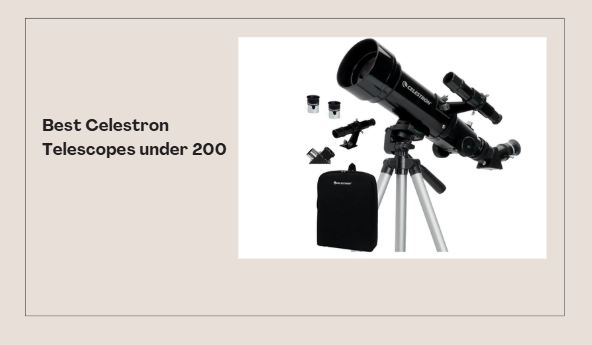
Exploring the night sky doesn’t have to cost a fortune, and this is where the best Celestron telescopes under 200 truly shine.
Known for producing reliable and beginner-friendly optics, Celestron offers a range of budget-friendly telescopes designed to make astronomy accessible to everyone, from beginners to enthusiasts.
In this buying guide, you’ll discover how to choose the best Celestron telescope under $200 by understanding the top options available and what features matter most at this price range.
Why Choose a Celestron Telescope?
Celestron is a well-established name in astronomy, known for producing reliable and high-quality telescopes for decades. These telescopes feature:
-
Beginner-Friendly Designs. Many Celestron telescopes are designed with simplicity in mind, making them easy to set up and use, even for first-time users.
-
Good Optical Performance. Despite being affordable, Celestron telescopes offer clear and sharp views of the moon, planets, and some deep-sky objects.
-
Wide Range of Options. Furthermore, Celestron provides various telescope types from refractors to reflectors and compound models to suit different viewing needs and preferences.
-
Affordable Pricing. The brand also offers excellent value for money, especially in the under $200 category, making astronomy accessible without a large investment.
-
Portable and Lightweight Models. Moreover, many of the best Celestron telescopes under 200 are compact and easy to carry, ideal for backyard stargazing or travel.
-
Included Accessories. Most models come with useful extras like eyepieces, finderscopes, and tripods, so you can start observing right away.
-
Educational Support. Last but not least, Celestron often includes guides, apps, or software to help beginners learn more about astronomy and locate celestial objects easily.
Best Celestron Telescopes under 200
1) Celestron Travel Scope 70 Portable Refractor Telescope
Get it on Amazon
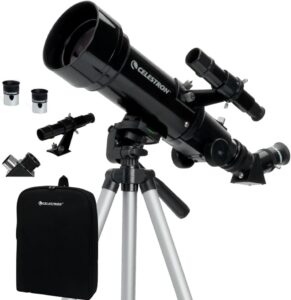
The Travel Scope 70 Portable Refractor Telescope is the best Celestron Telescope under 200. This is a compact and beginner-friendly instrument designed for casual stargazing and daytime observation.
With its 70mm aperture and fully-coated glass optics, it delivers bright and reasonably sharp views of the Moon, planets like Jupiter and Saturn, and even some brighter deep-sky objects.
Furthermore, the lightweight construction makes it easy to carry on trips, hikes, or camping adventures, while the simple alt-azimuth mount allows for intuitive up-and-down and side-to-side movements.
Setup is also quick and straightforward, making it especially appealing for newcomers who want a hassle-free introduction to astronomy without dealing with complicated adjustments.
In terms of performance, this telescope excels in portability and convenience rather than high-end optical power. Additionally, the included accessories, such as eyepieces and a finderscope, provide a complete starter kit, although more experienced users may eventually want to upgrade them for better clarity and magnification control.
Pros
- Lightweight and highly portable design
- Easy and quick setup, ideal for beginners
- Fully-coated optics improve brightness and clarity
- Versatile for both terrestrial and astronomical viewing
- Affordable entry-level option
Cons
-
Limited aperture reduces deep-sky performance
2) Celestron – AstroMaster 70AZ Telescope
Get it on Amazon
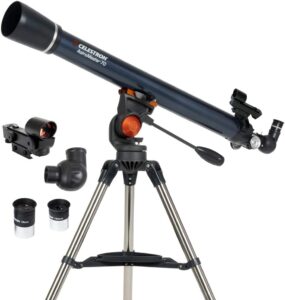
The Celestron AstroMaster 70AZ Telescope is a beginner-friendly refractor designed to make stargazing simple, enjoyable, and accessible right out of the box.
Its 70mm aperture provides clear and bright views of the Moon, planets, and some brighter deep-sky objects, making it a solid entry point for newcomers to astronomy.
Optically, the fully-coated glass optics help improve light transmission and image clarity. Furthermore, the simple alt-azimuth mount allows smooth up-and-down and side-to-side movement for intuitive tracking.
For added convenience, setup is quick and straightforward, and the adjustable-height tripod adds flexibility for users of different heights, though it feels more suited for casual observing than precision work.
In actual use, the AstroMaster 70AZ performs best when observing the Moon and nearby planets like Jupiter and Saturn, where it reveals basic details such as lunar craters and planetary bands. On top of that, its lightweight design makes it highly portable, ideal for backyard observing or quick trips outside the city.
Pros
- Easy to set up and use
- Lightweight and portable design
- Fully-coated optics for improved image clarity
- Smooth manual alt-azimuth mount for simple tracking
- Adjustable-height tripod accommodates different users
Cons
-
The basic mount lacks slow-motion controls
3) Celestron – PowerSeeker 70EQ Telescope
Get it on Amazon
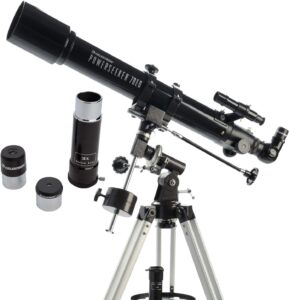
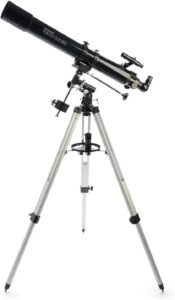
As one of the best Celestron telescopes under 200, the PowerSeeker 70EQ Telescope is an easy-to-use and powerful telescope ideal for both kids and adults.
This 70mm refractor telescope offers enough light-gathering ability to see planets, the Moon’s craters, distant stars, the Orion Nebula, and more. It is mounted on a manual German equatorial mount, which, while initially a bit challenging to learn, provides smoother and more precise tracking of objects once properly aligned.
Moreover, the included optical accessories, such as multiple eyepieces and a Barlow lens, offer flexibility in magnification, allowing users to experiment and find the best views for different targets.
5) Celestron Travel Scope 60DX Portable Refractor Telescope
Get it on Amazon
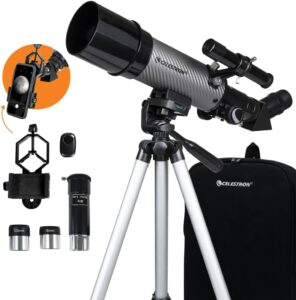
Next, we have the Travel Scope 60DX Portable Refractor Telescope. Unlike many beginner telescopes, this quality refractor features fully coated glass lenses and a 60mm aperture for crisp, clear views of the Moon, planets, and daytime scenery, all in a lightweight, travel-ready design.
The fully-coated glass optics enhance light transmission and image clarity, helping reduce glare and improve contrast during observations.
Additionally, its lightweight build and included backpack make it especially convenient for travel, camping, or quick backyard sessions, while the simple alt-azimuth mount allows smooth, intuitive movement for users who may be new to telescopes.
In terms of performance, the Travel Scope 60DX offers decent optical quality for its size and price range, though it’s best suited for low to moderate magnification. The included eyepieces provide a good starting range, and the smartphone adapter adds a modern touch for capturing basic astrophotography shots.
Overall, this telescope strikes a good balance between affordability, portability, and usability, making it a versatile choice for beginners, students, or anyone looking for a hassle-free introduction to astronomy.
Pros
- Lightweight and highly portable design
- Comes with a convenient travel backpack
- Fully-coated optics for improved brightness and clarity
- Easy to set up and beginner-friendly
- Includes smartphone adapter for basic photography
- Smooth alt-azimuth mount for simple tracking
Cons
- Limited aperture restricts deep-sky viewing performance
6) Celestron – AstroMaster 114EQ Newtonian Telescope
Get it on Amazon
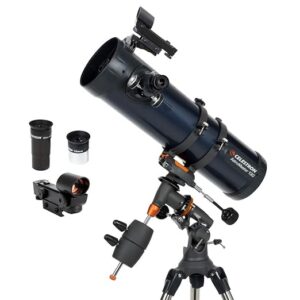
The AstroMaster 114EQ is a powerful telescope for astronomy beginners. It delivers sharp optics, a stable equatorial mount, and smooth manual controls, making it the top choice for beginners ready to explore the night sky.
The 114mm aperture gathers a respectable amount of light, making it suitable for viewing the Moon, planets like Jupiter and Saturn, and even some brighter deep-sky objects such as star clusters and nebulae.
The telescope’s optical performance is generally sharp, with good contrast for planetary viewing, and the included accessories provide enough versatility for users to get started right away. Furthermore, the equatorial mount allows for smoother tracking of celestial objects once properly aligned, which enhances the overall observing experience.
This telescope is also built with ease of use in mind. You can effortlessly aim and center your target using the two slow-motion control knobs for right ascension and declination, whether you’re observing planets or deep-sky objects.
Pros
- Good 114mm aperture for brighter and clearer views
- An equatorial mount allows for smoother object tracking
- Suitable for both planetary and some deep-sky observations
- Comes with useful starter accessories
- Affordable for a beginner’s telescope
Cons
- Setup and alignment take time
7) Celestron Travel Scope 80 Portable Refractor Telescope
Get it on Amazon
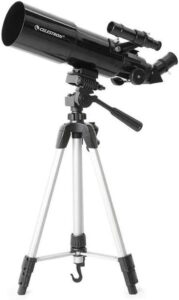
Lastly, we have the Celestron Travel Scope 80 Portable Refractor Telescope. This telescope is designed with portability and simplicity in mind, making it an appealing option for beginners and casual stargazers who want a grab-and-go setup.
As one of the best Celestron telescopes under 200, the 80mm aperture provides a noticeable step up in light-gathering ability compared to smaller entry-level scopes. This enables users to observe the Moon in sharp detail, pick out brighter planets like Jupiter and Saturn, and even catch glimpses of star clusters and some deep-sky objects under dark skies.
Furthermore, the fully-coated glass optics help improve image brightness and contrast, while the lightweight construction and included backpack make it especially convenient for travel, camping, or quick backyard sessions.
Regarding overall performance, this telescope strikes a balance between affordability and usability. The included accessories, such as eyepieces, a finderscope, and a diagonal, provide a complete starter kit right out of the box, so users can begin observing immediately without additional purchases.
In addition to everything else, setup is straightforward, with a simple mount and intuitive controls that don’t overwhelm first-time users.
Pros
- Lightweight and highly portable design
- 80mm aperture offers good brightness for beginner-level astronomy
- Fully-coated optics improve clarity and contrast
- Easy and quick setup, ideal for beginners
- Comes with useful accessories for immediate use
- Includes a backpack for convenient transport
Cons
- The basic mount included limited precision tracking
Next Read: 8 Best Celestron Telescope for Beginners
Criteria for Choosing the Best Celestron Telescopes under 200
Here are the key factors to consider when buying a Celestron telescope under 200.
Aperture Size (Light‑Gathering Ability)
The most important factor in any telescope is its aperture, which is the diameter of the main lens or mirror. A larger aperture lets in more light, which means you’ll see fainter stars, brighter planets, and more details on objects like the Moon. For telescopes under $200, you’ll often find apertures between 70 mm and 114 mm. While you can’t compare these to large observatory telescopes, a bigger aperture in this price range still makes a noticeable difference in what you’ll be able to observe.
Magnification and Eyepieces
Next, magnification tells you how much closer an object appears, but more isn’t always better. A telescope’s magnification depends on the eyepiece you use and the telescope’s focal length. Good beginner telescopes usually come with a couple of eyepieces offering low and medium power, which are more useful than super high magnification, which just makes images blurry. Look for models that include at least two quality eyepieces so you have flexibility when viewing different objects.
Optical Design (Refractor vs. Reflector)
Celestron telescopes in this price range typically use either refractor (lens‑based) or reflector (mirror‑based) designs. Refractors are usually easier to use and require less maintenance, while reflectors often offer larger apertures for the price. Your choice depends on what you want to see and how much tinkering you’re willing to do. Refractors are simple and steady; reflectors give you brighter views of deep‑sky objects.
Mount Stability
A common mistake beginners make is overlooking the mount. Even a great telescope won’t give good views if the mount wobbles. With the best Celestron telescopes under 200, you’ll see either an alt‑azimuth mount (moves up/down and left/right like a camera tripod) or a simple equatorial mount (tracks stars). Ensure the mount feels solid and smooth in movement. A shaky mount leads to frustrating star jumps every time you try to focus.
Ease of Setup and Use
Furthermore, consider ease of setup and use. A telescope that’s quick and intuitive to set up matters a lot. Celestron models with clear instructions, minimal assembly parts, and simple alignment steps save you time and frustration. If the setup feels complicated or requires extra tools right out of the box, you might end up using it less often.
Portability and Weight
A telescope under $200 that’s also lightweight and portable means you can take it outside or to darker skies more easily. If a telescope is too heavy or bulky, you might avoid using it after a few tries. Think about where you’ll store it and how often you’ll carry it. A portable design invites stargazing rather than discourages it.
Build Quality and Durability
Even inexpensive telescopes should be built to last. Look for solid materials, sturdy connections, and parts that feel well‑aligned. Cheap plastics or wobbly knobs can make focusing difficult and wear out quickly. A Celestron telescope with better build quality will deliver sharper views and last longer as you learn and grow in your astronomy hobby.
Included Accessories
Lastly, look at the included accessories. The best Celestron telescopes under 200 include helpful accessories like a finderscope, a Barlow lens that increases magnification, instructional guides, and software. These extras add a lot of value, especially when you’re just starting out and don’t yet own eyepieces or star‑hunting tools. Check what comes in the box so you don’t have to spend extra money soon after buying.
FAQs
- Can a telescope under $200 show planets clearly?
Yes, you can see planets like Jupiter, Saturn, and Mars, but the level of detail will be limited compared to higher-end models. Telescopes in this range are best for bright objects like the Moon, planets, and some star clusters.
- Should I choose a refractor or reflector telescope?
It depends on your skills and use case. For beginners, refractors are usually easier to handle and require less maintenance. Reflectors may offer slightly better views of deep-sky objects at the same price but require occasional alignment (collimation).
- How portable are Celestron telescopes?
Most Celestron telescopes under $200 are lightweight and easy to carry, making them convenient for backyard stargazing or taking to darker skies.
Final Words
Choosing the best Celestron telescope under 200 comes down to balancing aperture, optical design, mount stability, and ease of use. While budget-friendly models won’t offer the high-end details of expensive telescopes, they are perfect for beginners looking to explore the Moon, planets, and brighter deep-sky objects. Pay attention to portability, included accessories, and build quality to ensure a satisfying stargazing experience.