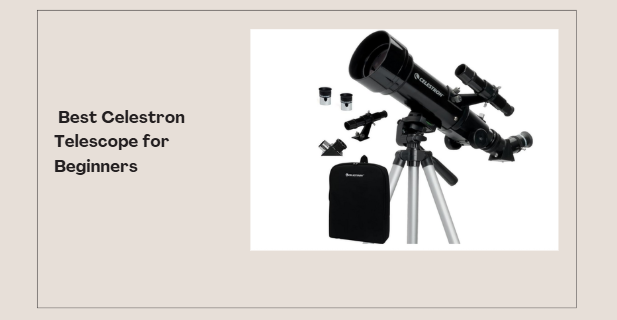
If you’re new to astronomy, Celestron is widely known for producing beginner-friendly telescopes that combine reliable optics, simple setup, and user-focused features. From observing the Moon’s surface to spotting bright planets and star clusters, the best Celestron telescope for beginners will help you explore the night sky with ease.
In this guide, we review the best Celestron telescopes for beginners, highlighting models that offer great performance, ease of use, and excellent value for first-time stargazers. Whether you want a compact starter telescope or a more advanced option, these picks are ideal to begin your astronomy journey with confidence.
Why Choose a Celestron Telescope?
Celestron has been a leading name in amateur astronomy for decades, known for producing reliable and well-engineered telescopes. As a beginner, choosing a telescope from this brand comes with numerous benefits that include:
-
Beginner-Friendly Designs. Many Celestron telescopes are designed with simple controls and quick setup, making them ideal for first-time users.
-
High-Quality Optics. The telescopes are built with quality lenses and mirrors that provide clear and sharp views of the Moon, planets, and other celestial objects.
-
Wide Range of Options. Furthermore, Celestron offers telescopes for different skill levels and budgets, from basic starter models to more advanced computerized systems.
-
Innovative Technology. Some models include helpful features such as smartphone-assisted sky navigation and automated object tracking.
-
Great Value for Money. The best Celestron telescopes often provide strong performance and durable construction at competitive price points.
-
Good Availability of Accessories. The brand offers a variety of compatible accessories such as eyepieces, mounts, and filters that help improve your viewing experience.
Best Celestron Telescopes for Beginners
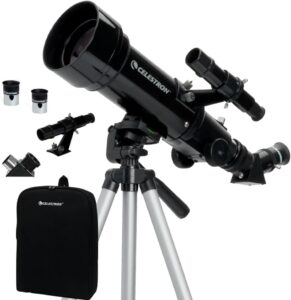
1) Celestron Travel Scope 70 Portable Refractor Telescope
Get it on Amazon
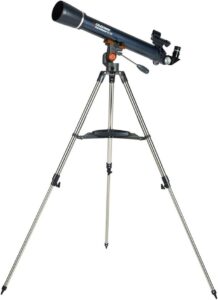
5) Celestron StarSense Explorer DX 130AZ App-Enabled Telescope
Get it on Amazon
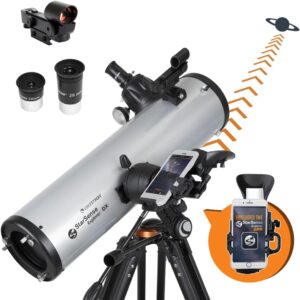
Next, we have the Celestron StarSense Explorer DX 130AZ App-Enabled Telescope. This is a robust Newtonian reflector designed for both beginner and intermediate stargazers who want a more interactive and guided astronomy experience.
With its 130mm aperture, it collects plenty of light, allowing for clear views of the Moon, planets, star clusters, and brighter deep-sky objects.
The smartphone dock and StarSense app integration take the guessing out of navigating the night sky, automatically aligning the telescope with your location and pointing out celestial objects. Furthermore, the setup is straightforward, and the alt-azimuth mount provides smooth, manual movement.
While it is designed with ease-of-use in mind, the telescope still offers serious observational power for its class. The StarSense app adds an educational layer, helping users identify stars, planets, and other objects while making the experience engaging for families or solo astronomers.
Above all, its sturdy tripod and lightweight design make it portable and convenient for backyard astronomy or short excursions.
Pros
- Large 130mm aperture for bright, detailed views
- Smartphone dock with StarSense app simplifies sky navigation
- Easy setup and intuitive alt-azimuth mount
- Portable and lightweight design
- Great educational tool for beginners and families
Cons
- App-based guidance relies heavily on smartphone battery and GPS accuracy
6) Celestron StarSense Explorer DX 102AZ App-Enabled Telescope
Get it on Amazon
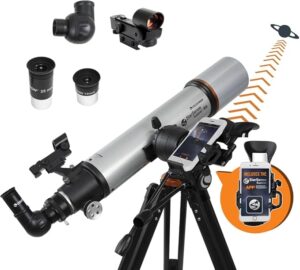
The StarSense Explorer DX 102AZ App-Enabled Telescope combines simplicity, technology, and performance, making it a great choice for those eager to explore the night sky with minimal learning curve.
What sets this telescope apart is the StarSense technology, which pairs the telescope with a smartphone via the StarSense app. This feature automatically aligns the telescope, helping users locate thousands of stars, planets, and deep-sky objects without complex calculations or prior astronomy experience.
Its 102mm refractor lens delivers clear and bright images of the Moon, planets, and brighter deep-sky objects, making celestial observation enjoyable and accessible. Additionally, the included alt-azimuth mount is stable and easy to maneuver, allowing smooth tracking of celestial objects.
In terms of portability and setup, the telescope is lightweight, and the assembly process is straightforward. This makes it convenient for backyard observing or trips to darker skies. Its build quality is also solid, with durable materials that withstand regular handling.
Pros
- Clear and bright 102mm optics for a range of celestial objects
- The StarSense app simplifies alignment and object location
- User-friendly alt-azimuth mount with smooth movement
- Lightweight and portable for easy setup and transport
- Educational app content enhances learning
Cons
-
Limited high-magnification capability for detailed planetary views
7) Celestron – AstroMaster 130EQ Newtonian Telescope
Get it on Amazon
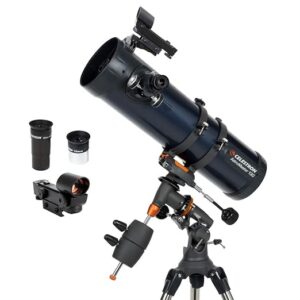
Next, we have the Celestron AstroMaster 130EQ Newtonian Telescope. This is a solid choice for amateur astronomers seeking a versatile and affordable way to explore the night sky.
The telescope’s equatorial mount provides smooth tracking of celestial bodies as they move across the sky, which is especially helpful for beginners learning to align and follow objects.
Furthermore, setup is straightforward, and the included accessories, such as eyepieces and a finderscope, enhance the observing experience.
Moreover, its 130mm aperture allows for impressive light-gathering ability, making celestial objects like the Moon, Jupiter, Saturn, and distant star clusters appear bright and detailed.
Overall, for anyone looking to dive into astronomy without a huge investment, the AstroMaster 130EQ delivers excellent value and a rewarding viewing experience.
Pros
- Large 130mm aperture for bright and detailed views
- An equatorial mount allows tracking of celestial objects
- Comes with useful accessories, including eyepieces and a finderscope
- Affordable and beginner-friendly
- Suitable for both planetary and deep-sky observation
Cons
-
Slightly bulky and less portable
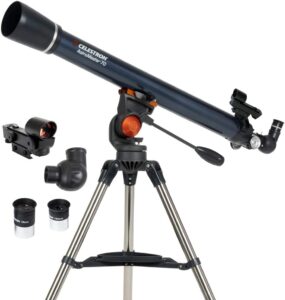
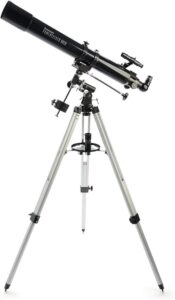
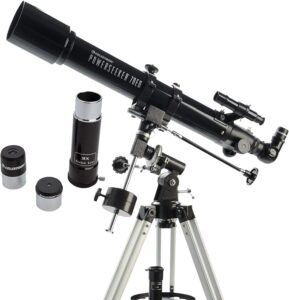
8) Celestron – PowerSeeker 70EQ Telescope
Get it on Amazon
The PowerSeeker 70EQ Telescope is our last recommendation for the best Celestron telescope for beginners.
Its compact and portable design makes it easy to set up in your backyard or take on a camping trip, while the manual German equatorial mount provides a hands-on experience for learning the fundamentals of celestial tracking.
Furthermore, the 70mm aperture allows for clear views of the Moon’s craters, planetary details, and brighter deep-sky objects, making it a versatile starter telescope. While it requires manual adjustment, this feature enhances your understanding of astronomy by teaching you how to locate and follow celestial objects accurately.
To top it all off, the included eyepieces and adjustable tripod make it a convenient all-in-one package for newcomers.
Pros
- Compact and portable design
- Beginner-friendly German equatorial mount
- Clear views of the Moon, planets, and bright deep-sky objects
- Includes adjustable tripod and multiple eyepieces
- Affordable entry-level telescope
Cons
- A limited aperture restricts the visibility of faint objects
Next Read: 8 Best Celestron Telescopes for Planets
Key Factors to Consider when Choosing the Best Celestron Telescope for Beginners
When choosing a Celestron telescope as a beginner, consider these key factors:
Type of Telescope
One of the first factors to consider is the type of telescope. Celestron offers different models like refractor, reflector, and compound (Schmidt-Cassegrain) telescopes, each with unique advantages. Refractors are often easier to use and require less maintenance, while reflectors provide larger apertures for deep-sky viewing. Compound telescopes are versatile but can be more expensive, so understanding your observing goals helps narrow the choice.
Aperture Size
Another important factor is the aperture size. The aperture, which is the diameter of the telescope’s main lens or mirror, directly affects how much light the telescope can gather. Larger apertures reveal fainter objects and finer details in planets, stars, and galaxies. For beginners, a moderate aperture, large enough to see planets clearly but still manageable in size, is usually ideal.
Mount type and Stability
Next, stability and the type of mount play a crucial role in the observing experience. Telescopes come with alt-azimuth mounts, which move up/down and left/right, or equatorial mounts, which align with Earth’s rotation for easier tracking of celestial objects. A stable, smooth-moving mount is essential, as shaky mounts can make viewing frustrating, especially at higher magnifications.
Portability and Size
The portability and size of the telescope are other key considerations. Beginners may prefer telescopes that are lightweight and easy to transport, especially if they plan to take their telescope to dark-sky locations. Compact designs are also important as they make setup and storage easier without compromising too much on viewing quality.
Ease of Use
Ease of use and automation are also significant for newcomers. The best Celestron telescope for beginners comes with computerized mounts and GoTo technology that automatically locates and tracks objects in the night sky. For beginners, these features save time and make stargazing more enjoyable, though fully manual telescopes provide more hands-on learning.
Price
Budget and price considerations should not be overlooked. While it’s tempting to go for the most powerful telescope, beginners often benefit from starting with an affordable, mid-range model that offers good performance without overwhelming complexity. Remember to factor in the cost of accessories like eyepieces, filters, and carrying cases.
Expandability
Finally, consider expandability and accessory support. The best Celestron telescope for beginners allows upgrades or additional accessories to grow with your skills. Interchangeable eyepieces, camera adapters, and planetary filters enhance the experience over time, ensuring your telescope remains useful as you learn more about astronomy.
FAQs
- Which telescope type is best for beginners?
Refractor telescopes are easier to use and maintain, while reflectors offer more aperture for viewing deep-sky objects. Compound telescopes are versatile but more expensive.
- How big should the aperture be?
For beginners, an aperture between 70mm and 150mm provides clear views of planets and the moon while remaining manageable.
- Do I need a computerized mount?
Not necessarily, but GoTo mounts can help beginners find and track objects quickly. Manual mounts are great for learning celestial navigation.
Beginner Tips for Using a Telescope
- Always start with low magnification eyepieces to locate objects easily
- Set up your telescope on a stable, level surface to avoid shaking
- Allow your telescope to cool to the outdoor temperature for sharper images
- Use a star map or astronomy app to plan what you want to observe
- Keep lenses and mirrors clean, but avoid harsh chemicals
Conclusion
Choosing the best Celestron telescope for beginners doesn’t have to be overwhelming. By prioritizing factors like ease of use, aperture, mount stability, portability, and budget, you should find a telescope that delivers clear views and sparks your curiosity.
Hopefully, this buying guide has helped you select a model that not only makes your first stargazing experiences enjoyable but also provides room to grow, ensuring that your journey into astronomy remains exciting for years to come.
Checkout: Celestron Astronomy Glossary of Terms