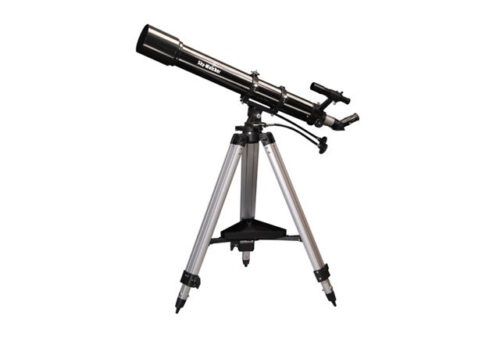
Looking for the best 90mm refractor telescopes to explore the sky at night? If your answer is yes, these telescopes combine clear, sharp views with a lightweight, hassle-free setup, making it simple to explore the Moon, planets, and brighter stars.
In this guide, we’ll walk you through the top models that are compact enough to take on trips yet powerful enough to reveal the beauty of the night sky. Additionally, we have included key features, pros and cons of refractor telescopes, and tips for getting the most out of your stargazing experience.
Understanding the 90mm Refractor Telescopes
A 90 mm refractor telescope is a popular type of optical telescope that uses lenses rather than mirrors to gather and focus light. The 90 mm refers to the diameter of the main objective lens, which determines how much light the telescope can collect.
The large 90mm objective lens matters for:
- Light‑Gathering Power. It gathers significantly more light than smaller models (like 60 mm or 70 mm), making it better for seeing fainter objects. This helps when looking at galaxies, star clusters, nebulae, and even finer details on planets and the Moon.
- Improved Resolution. Larger apertures improve clarity and detail. With a 90 mm refractor, you’ll see sharper images compared to smaller beginner scopes, especially on planets and the Moon.
How Refractor Telescopes Work
Refractor telescopes use a set of lenses at the front (objective lens) to bend/refract incoming light and bring it into focus. Unlike reflectors, which use mirrors:
- No mirror alignment (collimation) is needed.
- They’re generally sealed, so dust and debris don’t get inside.
- They’re often low–maintenance, easy to use, and great for beginners and casual stargazers.
What You Can See with a 90 mm Refractor
A 90 mm refractor is versatile for viewing many celestial targets:
- The Moon: Craters, mountains, and maria in great detail.
- Planets: Jupiter’s cloud bands and Jupiter’s moons, Saturn’s rings, and Mars’ polar caps in favorable lighting conditions
- Bright Deep‑Sky Objects: Star clusters and some brighter nebulae.
Best 90mm Refractor Telescopes
1) Gskyer Telescope 600x90mm AZ Astronomical Refractor Telescope
Get it on Amazon
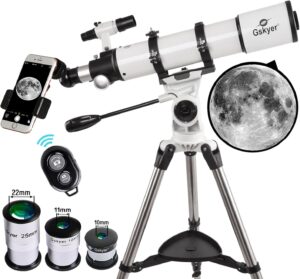
The Gskyer Telescope 600x90mm AZ is the best 90mm refractor telescope. It is designed for adult astronomy enthusiasts who want a high-magnification viewing experience without the complexity of advanced setups.
With a 90mm aperture and up to 600x magnification, this telescope offers clear, detailed views of the moon, planets, and even some brighter deep-sky objects.
Furthermore, the refractor design ensures crisp images with minimal chromatic aberration, making it easier to distinguish planetary features or the craters on the moon.
The included alt-azimuth mount allows for smooth manual adjustments, which is ideal for beginners and casual stargazers who prefer simplicity and portability. Additionally, the telescope comes with multiple eyepieces, a Barlow lens, and a smartphone adapter, making it versatile for both visual observation and basic astrophotography.
Above all, the mount is user-friendly, so this telescope remains a strong option for hobbyists seeking a balance between performance, portability, and affordability.
Pros
- High 600x magnification potential for detailed views
- Crisp, clear optics with minimal chromatic aberration
- Includes multiple eyepieces, a Barlow lens, and a smartphone adapter
- User-friendly alt-azimuth mount
- Portable and lightweight design
Cons
- The mount is slightly unstable at high zoom
2) SVBONY SV48P Telescope
Get it on Amazon
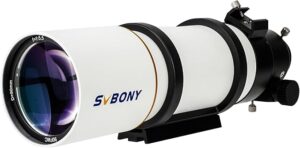
The SVBONY SV48P Telescope, 90mm Aperture F5.5 Refractor OTA is an impressive entry-level telescope that combines solid optics with a user-friendly design.
Its 90mm aperture gathers a significant amount of light, offering clear and bright views of the moon, planets, and some deep-sky objects like star clusters.
Moreover, the F5.5 focal ratio provides a wide field of view, which is particularly helpful for scanning the night sky and tracking celestial objects without constantly adjusting the scope.
The optical tube assembly (OTA) is lightweight and portable, making it easy to set up and carry, whether for backyard astronomy or short trips to darker skies. The build quality is also sturdy, and the smooth focusing mechanism allows for precise adjustments, helping users achieve sharp, detailed images without frustration.
Another notable feature of the SVBONY SV48P is its versatility and ease of use. The refractor design requires minimal maintenance, eliminating the need for frequent collimation, which is perfect for beginners who want to focus on observing rather than complex setup.
Above all, the telescope excels for planetary and lunar observation, and it is compatible with various mounts and accessories, allowing hobbyists to upgrade or customize their setup over time.
Pros
- Large 90 mm aperture gathers good light for the price
- Solid, beginner‑friendly optical tube assembly
- Smooth focusing system that’s easy to use
- Great starter choice for lunar, planetary, and some deep‑sky viewing
Cons
-
OTA only; mount and tripod not included
3) EACONN 90mm Refractor Telescope for Kids and Beginners
Get it on Amazon
4) Opaita 90mm Refractor High Powered Telescope
Get it on Amazon
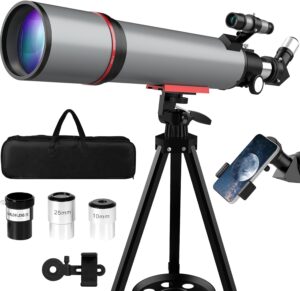
Next, we have the Opaita 90mm Refractor High Powered Telescope, which is an impressive tool for both beginner and intermediate stargazers.
As a budget refractor telescope, its 90mm aperture allows for bright, detailed views of celestial objects, from the craters of the moon to the rings of Saturn, and even some of the brighter deep-sky objects.
Furthermore, the telescope comes with smooth-focus controls and a stable mount, making it easy to adjust and track objects as they move across the sky.
Its compact design and lightweight build also make it convenient for outdoor trips, whether it’s a backyard observation or a camping adventure under a dark sky. Users also appreciate the combination of affordability and performance, making it a solid entry-level choice without compromising on optical quality.
Pros
- Bright and clear images of celestial objects
- Smooth focus and easy tracking
- Lightweight and portable for outdoor use
- Affordable for beginners and hobbyists
- Compact design ideal for travel
Cons
- Limited astrophotography capabilities without extra equipment
5) MEEZAA 90mm Refractor Telescope
Get it on Amazon
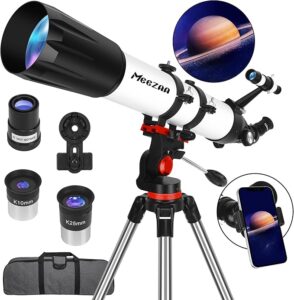
If you are interested in astronomy or like to explore the night sky, the MEEZAA astronomical telescope is for you. It is a perfect telescope for adult astronomy beginners to explore nature and the universe.
This astronomy telescope has an 800mm(f/8.88) focal length and 90mm aperture. The 90mm aperture captures more light, and fully multi-coated optical glass lenses with high transmission coating improve image brightness and clarity
Furthermore, this high-powered telescope for adults is equipped with two eyepieces(10 mm and 25 mm) and a 3X Barlow lens. The 3X Barlow lens triples the magnification of each eyepiece, allowing us to observe unprecedented lunar details
It also includes an adjustable stainless steel tripod (28 to 46 inches) for flexible viewing. All accessories fit neatly into the carry bag. Use the phone adapter to capture photos and videos, sharing moments during backyard astronomy, camping nights, and outdoor star parties.
Portability is another strong point, as the telescope is lightweight and easy to set up, perfect for outdoor stargazing sessions or even casual backyard astronomy.
Pros
- Bright and clear 90mm aperture for Moon, planet, and some deep-sky viewing
- Stable, adjustable tripod for steady observations
- Smooth focusing system for easy adjustments
- Lightweight and portable for backyard or outdoor use
- Good starter telescope for beginners
Cons
-
Limited deep-sky viewing compared to higher-end models
Next Read: 7 Best 80mm Refractor Telescopes
Criteria for Choosing the Best 90mm Refractor Telescopes
Whether you are buying your first telescope or looking for an upgrade, consider these factors to ensure you find a model matches your needs.
Optical Quality
First, optical quality is paramount. High-quality glass and precise lens coatings enhance light transmission, providing sharper, brighter images of celestial objects like planets and star clusters. A poor optical setup can make even the most expensive telescope underperform.
Focal Length and Ratio
Next, consider the focal length and ratio. Longer focal lengths provide higher magnification and narrower fields of view, which are ideal for observing planets. Shorter focal lengths offer wider fields, better for star clusters and nebulae. Matching the focal ratio with your observing goals ensures optimal performance.
Mount Type
Mount type and stability are also essential. An unstable or wobbly mount will ruin your viewing experience, even with excellent optics. Equatorial mounts are great for tracking celestial objects as they move across the sky, while alt-azimuth mounts are simpler and easier for beginners to handle.
Portability
The portability and weight of the best 90mm refractor telescopes can’t be overlooked. A 90mm refractor can be lightweight, but bulky models may require extra effort to transport and set up. Consider where you’ll use the telescope most often and how easy it is to carry.
Eyepiece Compatibility
Fifth, eyepiece compatibility and included accessories matter. Many of the best 90mm refractor telescopes come with one or two eyepieces, but having the option to swap in additional eyepieces allows for varying magnifications. Accessories like finderscopes, Barlow lenses, and diagonal mirrors can significantly enhance your viewing experience.
Build Quality
Moreover, build quality and durability are important for long-term use. A well-built telescope can withstand frequent use and minor bumps without losing alignment or performance. Materials like aluminum or reinforced plastic frames usually offer a good balance of durability and weight.
Ease of Setup
Furthermore, ease of assembly and setup is crucial, especially for beginners. Telescopes that are overly complicated or require frequent adjustments can frustrate users and reduce enjoyment. Quick-setup models with intuitive controls encourage longer, more frequent stargazing sessions.
Budget and Value for Money
Finally, budget and value for money should guide your decision. While it’s tempting to go for the cheapest option, investing a bit more often ensures better optics, durability, and overall performance. Compare features, warranties, and included accessories to find a telescope that provides the best value for your investment.
Best 90mm Refractor Telescopes Pros and Cons
Pros:
- Great for astrophotography beginners. Their stable lenses and simple setup make them good entry-level options for basic astrophotography of the Moon and brighter planets.
- Low maintenance alignment. Refractors typically hold their alignment (collimation) longer than reflectors, so you spend more time observing and less time adjusting.
- Quiet operation. Unlike telescopes with motors or fans, refractors are generally very quiet, providing a peaceful viewing experience.
- No central obstruction. Because refractors don’t have a secondary mirror blocking light, they often show higher contrast images than some reflector designs.
- Good for daytime use. Many refractors double as terrestrial spotting scopes, so you can use them for birdwatching or landscape viewing during the day.
- Consistent performance. Once focused, the best 90mm refractor telescopes provide steady, reliable views under a wide range of conditions.
- Ideal for learning astronomy basics: Their straightforward design helps beginners learn how telescopes work and how to navigate the night sky without overwhelming complexity.
Cons:
-
Limited deep-sky performance. May not show very faint galaxies or nebulae in detail.
-
Higher cost per inch of aperture. Most models are slightly more expensive than similar-sized reflectors.
FAQs
- What can I see with a 90mm refractor telescope?
A 90mm telescope can provide clear views of the Moon, planets like Jupiter and Saturn, and brighter star clusters. Some nebulae and galaxies may be visible, but faint deep-sky objects will appear less detailed.
- Are 90mm refractors good for beginners?
Yes. They are easy to use, require minimal maintenance, and provide high-quality views without the complexity of larger telescopes.
- Do I need extra accessories for a 90mm refractor?
While basic models come with one or two eyepieces, adding a Barlow lens, a diagonal mirror, or extra eyepieces improves magnification options and viewing comfort.
Conclusion
A 90mm refractor telescope is an excellent choice for both beginners and intermediate stargazers. Its combination of sharp optics, manageable size, and ease of use makes it ideal for exploring the Moon, planets, and brighter deep-sky objects.
By taking into account aspects like lens quality, mount steadiness, ease of transport, eyepiece options, and overall value, you should find a telescope that fits both your stargazing needs and budget.
In the end, the ideal 90mm refractor inspires you to gaze at the stars, explore celestial wonders, and enjoy the night sky.