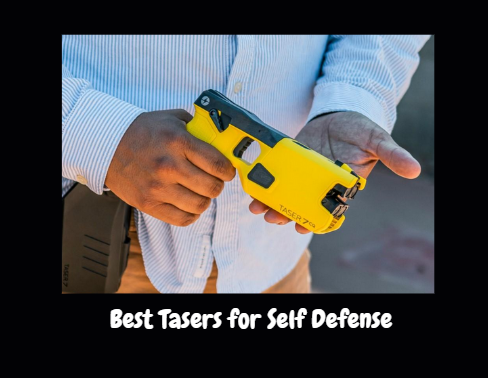
When it comes to personal safety, I believe having the right tool can make all the difference, and that’s why I’ve taken a closer look at the best Tasers for self-defense.
These devices are great because they give you a safe way to protect yourself by providing distance, reliability, and effective stopping power without being lethal.
In this guide, I’ll walk you through their key features, share my top picks, and provide a buying guide to help you choose the right option for your needs.
I’ll also answer some of the most common FAQs so that by the end, you’ll feel confident about which TASER fits your lifestyle and offers the best peace of mind.
Is a TASER illegal to carry around?
In the United States most states allow civilian possession of Tasers and similar electroshock devices but there are important state and local exceptions, age limits, and rules about carrying and use , manufacturers themselves urge buyers to check state and local laws before purchasing.
In many other countries possession is outright prohibited for civilians. For example, Tasers and stun devices are classed as prohibited weapons in the United Kingdom and Canada, and carrying one can lead to criminal charges.
In places like Kenya there have been public warnings and local regulation concerns about unlicensed stun devices, so legality can be unclear and enforcement may vary.
Always confirm the exact rules that apply where you live , local police websites or official government statutes are the authoritative sources.
What’s the difference between a taser and a stun gun?
A TASER is a projectile-firing electroshock weapon that shoots small barbed probes attached to thin wires. These probes can reach a target at a distance (often 10 to 15 feet for civilian models, up to 25 feet or more for law enforcement).
Once they make contact, the TASER delivers an electrical current that disrupts the body’s neuromuscular system, causing involuntary muscle contractions, loss of balance, and temporary incapacitation.
TASERs also usually include features like targeting lasers and safety switches, making them more advanced but also more heavily regulated.
A stun gun, by contrast, is a close-contact device. It requires you to physically press the electrodes against an attacker’s body to deliver the shock.
While a stun gun can cause pain and disorientation, it generally relies more on pain compliance than neuromuscular incapacitation, meaning someone with a high pain tolerance may resist its effects. Stun guns are usually more compact, less expensive, and easier to carry discreetly, but they lack the distance advantage of a TASER.
How long does a taser shock last?
Most civilian TASER models deliver a single preset energy cycle of about 5 seconds per trigger pull. That means when the cartridge fires and the probes connect, the device sends pulses for roughly five seconds; you can usually re-trigger or fire a second cartridge if more time is needed.
Contact stun (pressing the metal electrodes directly to someone) will deliver shock for as long as you hold the activation switch, so its duration is effectively under the user’s control (but should be limited for safety and legal reasons).
Best Tasers for Self Defense
1) TASER Bolt 2 Self-Defense Gun
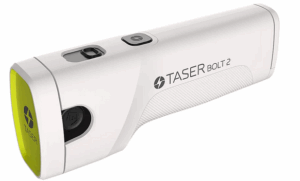
The TASER Bolt 2 is one of the best tasers for self defense, it is designed to keep danger at a distance while giving you simple, reliable options when a threat appears. It fires reloadable cartridges that launch barbed probes up to 15 feet, which creates a comfortable buffer between you and an attacker and increases your chances of escaping without physical contact.
If the probes connect the device delivers a neuromuscular shock that can immobilize a person for about 30 seconds, a window long enough to create distance and seek safety. If a cartridge is not loaded the unit still functions as a contact stun device, so you have both ranged and close-up options in a single tool.
Visually the Bolt 2 is intentionally nonthreatening in appearance. It resembles a flashlight rather than a firearm so it is less likely to be mistaken for a handgun in a tense confrontation. When the safety is disengaged the protective cap will fall off and the trigger will light up to show the unit is live.
At that point a 210 lumen LED and a red targeting laser activate to help you aim and to temporarily disorient an attacker with a bright beam if needed. The cartridge also releases 20 to 30 small anti felon identification tags that can stick to an assailant and help law enforcement locate and identify them later.
Practical details matter with everyday carry and the Bolt 2 checks a lot of boxes. It is compact at 6.5 inches long and weighs just 8.4 ounces so it fits comfortably in a purse, bag or in hand.
Power comes from two CR123A batteries which are included and rated to last up to one year under normal conditions. The housing is molded from high impact polymer, is textured for a confident grip and has been drop tested to four feet to withstand rough handling.
For peace of mind TASER offers a one year manufacturer warranty and provides a lifetime replacement guarantee if the unit is lost during an attack provided a police report is filed.
User safety and usability are clearly considered in the Bolt 2 design. The safety cap helps prevent accidental firings and the visual power indicator makes it obvious when the device is armed.
Cartridge based deployments penetrate clothing to deliver their effect and may cause temporary symptoms such as vertigo, freezing in place, falling or involuntary muscle contractions.
Because the unit doubles as a contact stun device you are not left without options if close proximity becomes unavoidable. The combination of range, illumination and identification tags gives the Bolt 2 a broader set of defensive tools than a simple contact stun gun.
Pros
- Keeps attackers at a distance with up to 15 foot reach
- Functions as a contact stun device when no cartridge is loaded
- Protective safety cap and illuminated trigger for clear armed state indication
- Built in 210 lumen LED and red targeting laser for aiming and temporary disorientation
- Cartridge deploys 20 to 30 anti felon ID tags to assist law enforcement
- Compact and lightweight for easy carry at 6.5 inches and 8.4 ounces
- Uses commonly available CR123A batteries that are included and replaceable
- Durable polymer body with textured grip and four foot drop rating
- One year manufacturer warranty plus lifetime replacement if lost during an attack with a police report
Cons
- Cartridge based operation requires replacement cartridges that add ongoing cost
2) TASER Strikelight 2 TASER
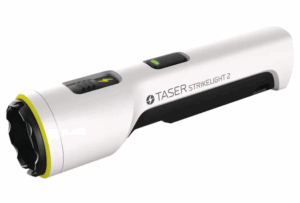
The TASER StrikeLight 2 blends everyday utility with serious personal protection in a compact flashlight-style package. It offers a three-mode LED light for illumination, a loud electrical arc warning to deter threats, and a 20kV contact stun option for close-range defense. The overall approach is simple: provide a tool you can carry daily that also gives you multiple ways to respond if a confrontation escalates.
Lighting and deterrence are central to how the StrikeLight 2 performs in real situations. The three light settings — high, low, and red — cover common needs from walking at night to preserving night vision.
The bright beam also serves as a non-kinetic way to disorient or distract an attacker. If a potential threat moves closer the arc warning produces an audible electrical crack that signals aggression and can stop many situations from becoming physical. The combination of visible light and audible arc makes the device useful for both illumination and early-stage deterrence.
When the situation calls for more direct intervention the StrikeLight 2 delivers a 20kV contact stun designed to deter and disable. Because it is a contact device you must be close enough to press it against an aggressor, which makes training and familiarity with the unit important.
The contact stun provides immediate, measurable pain and disruption without the complexity of cartridge systems, and the flashlight form factor reduces the chance it will be mistaken for a firearm during a tense encounter.
Practical everyday features help the StrikeLight 2 fit into normal routines. It is USB-C rechargeable so powering it up is fast and convenient with common cables and chargers. The sleek flashlight design keeps the device discreet and easy to carry in a pocket, purse, or glove compartment.
Build materials and ergonomics are engineered for confident handling so you can access light and protection quickly. Taken together the StrikeLight 2 works well as a multi-function tool for people who want a single compact device for both illumination and less-lethal self-defense.
Pros
- Combines a three-mode LED flashlight with a 20kV contact stun for dual utility
- Arc warning provides a loud, visible deterrent before physical contact is required
- USB-C rechargeable for convenient and fast power top-ups
- Red light mode helps preserve night vision when needed
- Sleek flashlight-style design enables discreet carry without drawing attention
- Simple operation that reduces complexity compared with cartridge-based devices
Cons
- Contact-only operation requires getting close to an aggressor to be effective
3) TASER 7 CQ Home Defense Gun
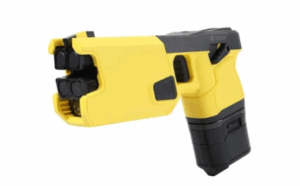
The TASER 7 CQ Home Defense Gun is built for close quarters encounters where split second response matters. It uses cartridges designed to perform well from as close as three feet out and can reach up to twelve feet, giving you both immediate stopping power and a modest standoff option inside the home.
The unit holds two cartridges so you have a backup if the first shot does not connect, which is an important redundancy in high stress situations.
This generation of cartridges, labeled 7 CQ, delivers roughly twice the kinetic energy of earlier designs so the darts fly straighter and faster, improving the chances of penetrating clothing and making contact. Each dart has a breakaway body to help maintain an attachment even when strikes occur at awkward angles.
The system also includes an Adaptive Cross Connect feature that improves the probability of a solid electrical link by compensating for close probe spreads or clothing disconnects. Those engineered redundancies mean the TASER 7 CQ is optimized for the realities of short range defensive use.
Warning and aiming aids are integrated into the unit for practical usability. An audible warning arc sounds over the front of live cartridges to discourage escalation before a shot is fired.
A bright 210 lumen LED flashlight and a red targeting laser are built into the housing so you can illuminate dark areas and aim with clarity even during daylight. The flashlight can also be used to temporarily blind or disorient a would be assailant while you move to safety.
Ergonomics, durability and situational information are also addressed. The ambidextrous safety switch helps prevent accidental discharge while the Central Information Display shows power level, self diagnostics, status data, the cartridge type and the clock so you can quickly check the unit’s readiness.
The housing is molded from high impact polymer, is drop tested to four feet and is weather resistant for use in rain, snow and other conditions you might encounter at home. The unit measures 7.45 inches long, 1.65 inches wide and 3.25 inches high and weighs 0.6 pounds without a cartridge.
Powering the TASER 7 CQ is a proprietary TASER 7 CQ battery pack which is non rechargeable and covered by a Lifetime Replacement Guarantee if the unit is lost during an attack when required documentation is provided.
The manufacturer backs the product with a one year warranty and the unit is made in the USA. For home defense users who prioritize reliable close range performance and redundant safety and aiming systems, the TASER 7 CQ presents a purpose built option.
Pros
- Close range effectiveness from 3 feet to 12 feet with two cartridge capacity for immediate redundancy
- 7 CQ darts deliver increased kinetic energy for better trajectory and clothing penetration
- Adaptive Cross Connect feature improves probe connection when spreads are close or clothing interferes
- Audible warning arc discourages escalation before cartridges are fired
- Integrated 210 lumen flashlight and red laser provide illumination and aiming capability in low light and daylight
- Ambidextrous safety switch and Central Information Display provide clear status and simple operation
- Durable high impact polymer housing with four foot drop rating and weather resistant construction
- Lifetime Replacement Guarantee for battery pack if lost during an attack with required documentation
Cons
- Uses proprietary non rechargeable battery packs which require replacement rather than recharging
4) TASER X1 Reloadable Shooting Stun Gun
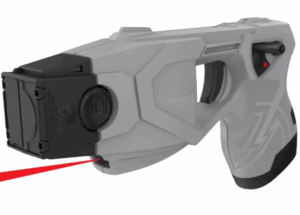
The TASER X1 is a serious self-defense tool built from a law enforcement pedigree and updated for civilian ownership where permitted. It replaces earlier X26 series units while remaining compatible with many of the same accessories, which makes it an easy upgrade path for users familiar with those systems.
The device fires barbed probes up to 15 feet (4.6 m) and is designed to produce neuromuscular incapacitation by delivering electrical impulses that mimic the body’s own signaling. That approach means the device can stop an aggressor without relying on pain alone, which is useful against people who may not respond to pain as a deterrent.
Probe performance and deployment are engineered to improve hit probability and effect. The X1 fires barbed probes that can penetrate clothing and in some cases arc electricity through very resistant materials.
When probes connect the electrical output can cause effects such as vertigo, freezing in place, falling to the ground, and involuntary muscle contractions. The cartridge locks into the unit snugly so there is little risk of it coming loose when fired and each cartridge also deploys 20 to 30 small Anti-Felon ID tags that help identify and track an assailant if they flee the scene.
Redundancy and follow up are built into the design so you are not left without options if a shot misses. Two metal electrodes on the front convert the X1 into a 50,000 volt contact stun device that can be used immediately after a missed cartridge.
The unit also features mechanical sights and a built in laser that align with the top probe’s flight path to aid aiming at distances up to 15 feet. An ambidextrous safety switch can be operated from either side of the housing with the switch up meaning armed and down meaning safe, which helps both right and left handed users deploy the device quickly under stress.
Information and readiness are clearly communicated via the Central Information Display on the back of the unit. The CID shows armed and battery status along with major and critical fault indicators such as invalid battery or abnormal spark duration so you can verify the unit’s condition at a glance.
Power is provided by a Performance Power Magazine single cell battery pack that is non rechargeable but delivers enough charge for up to 500 five second discharges. The unit is made in the USA and measures 7.3 inches by 1.3 inches by 3.2 inches, weighing 2.75 pounds. TASER also provides a lifetime replacement policy if the unit is lost during an attack when a police report is provided.
For users who want a proven, forceful option with redundancy and diagnostic feedback, the X1 is compelling. It combines long range probe capability, significant follow up contact stun power, clear aiming aids and an information display that reduces uncertainty about readiness.
Training and familiarity are recommended so you can operate the ambidextrous controls and interpret the CID quickly in a high stress situation.
Pros
- Fires barbed probes up to 15 feet (4.6 m) and uses cartridges that lock in securely
- Produces neuromuscular incapacitation that does not rely on pain as the sole mechanism
- Mechanical sights and built in laser align with probe flight path for improved aiming
- Contact electrodes provide a 50,000 volt stun option when probes miss or after deployment
- Cartridge deploys 20 to 30 Anti Felon ID tags for potential identification of a fleeing attacker
- Central Information Display reports armed status, battery level and major fault indicators
- Compatible with accessories used by previous X26 models for easy upgrades
- Performance Power Magazine supplies power for up to 500 five second discharges
- Made in USA and eligible for lifetime replacement if lost during an attack with a police report
Cons
- Requires close training to operate smoothly under stress including ambidextrous controls
5) TASER Pulse 2 Reloadable Stun Gun
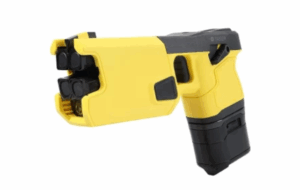
The TASER Pulse 2 is a compact, everyday self defense option that brings law enforcement standards into a civilian package where permitted. It launches two barbed probes up to 15 foot and is designed to create a meaningful buffer between you and an attacker. When the probes attach they can arc electricity through clothing and some resistant materials to interrupt the body’s electrical signals and cause neuromuscular incapacitation.
That means the device can produce effects such as falling to the ground, involuntary muscle contractions, freezing in place and vertigo without relying solely on pain as the deterrent.
A practical advantage of the Pulse 2 is the layered approach to stopping a threat. Each cartridge fits snugly so it will not loosen when fired and also ejects 20 to 30 small Anti Felon ID tags to mark a fleeing suspect. If a shot misses the front of the unit has two metal electrodes that function as a 50,000 volt contact stun that can be used immediately by pressing the device against an attacker.
Mechanical sights and a built in laser align with the top probe’s flight path to aid aiming at ranges up to 15 foot. The unit also includes an LED light to help you see in dark conditions.
Ergonomics and safety receive clear attention in the Pulse 2 design. The ambidextrous safety extends on both sides of the housing so it can be operated by right or left handed users and the switch position up means armed while down means safe.
For added protection the unit will go into low power mode if left armed for more than 20 minutes, preventing it from firing unintentionally. A power LED indicator shows battery level so you can check readiness at a glance.
Everyday carryability and maintenance are straightforward. The Pulse 2 is compact and lightweight, making it easy to carry in a purse or pocket, and it runs on one replaceable lithium battery that provides up to 50 firings before needing replacement.
The manufacturer backs the product with a lifetime replacement guarantee if the unit is lost during an attack when a police report is provided.
Made in USA, the Pulse 2 is well suited for people who want a reloadable, multi mode defensive option that offers both ranged and contact capability.
Pros
- Fires barbed probes up to 15 foot that can arc through clothing and some resistant materials
- Produces neuromuscular incapacitation that does not depend on pain alone
- Cartridge ejects 20 to 30 Anti Felon ID tags to mark a fleeing attacker
- Two front electrodes provide a 50,000 volt contact stun if probes miss
- Mechanical sights and built in laser help align shots with probe flight path
- Ambidextrous safety and a low power mode after 20 minutes of being armed improve safe handling
- Built in LED light aids visibility in low light situations
- Compact and lightweight design makes everyday carry practical
- Power LED shows battery level and the replaceable lithium battery supports up to 50 firings
- Lifetime replacement available if lost during an attack with a police report
Cons
- Probe effectiveness can be reduced by very heavy or layered clothing
Next Read: 7 Best Self Defense Batons
Factors to Consider when Choosing the Best Tasers for Self Defense
Here are the clear, focused factors to weigh when choosing a TASER:
Legal and regulatory restrictions
Check local, state and national laws before you consider a device. Rules about possession, carrying, and use vary widely; some places allow civilian ownership with restrictions, others prohibit these devices entirely.
Knowing the law up front affects what models you can legally buy, whether you can carry them concealed, and what training or permits (if any) you should seek.
Mechanism of effect and expected outcomes
Understand whether the device is built to produce neuromuscular incapacitation or primarily pain compliance, and what physiological effects are typical.
Devices designed to cause neuromuscular disruption send pulses that interfere with motor signals and can produce falling, involuntary contractions, loss of balance and temporary disablement; this mechanism differs from devices that mainly rely on pain to deter an attacker. Knowing the expected effects helps set realistic expectations for how a device will perform against different threats.
Range, probe performance and clothing penetration
If you need standoff capability, evaluate the effective range and the design of the probes or cartridges. Probe flight path, kinetic energy and barbed or breakaway designs influence the chance the probes will penetrate clothing and make a reliable electrical connection.
Keep in mind heavy or layered clothing can reduce effectiveness, and some devices include features to compensate for close probe spreads or clothing disconnects.
Safety systems and user-feedback features
Robust safeties, obvious armed-state indicators, and diagnostics reduce accidental discharges and increase user confidence.
Look for physical safeties that prevent unintended firing, visual or audible indicators that show power and armed status, and built-in diagnostics or displays that report battery condition and fault states so you can confirm readiness before you need it.
Battery life, power source and ongoing costs
Check what battery type the device uses, how many discharges the battery supports, whether the battery is rechargeable or replaceable, and the cost and availability of replacement batteries and cartridges.
Devices that require proprietary battery packs or single-use cartridges will have recurring costs and logistics to consider; planning for maintenance ensures the device is ready when you need it
Ergonomics, size and everyday carryability
Evaluate weight, dimensions, grip texture and how you intend to carry the device. A unit that is too large or awkward will be less likely to be carried consistently, which defeats the purpose of having immediate access to protection.
Consider how quickly you can bring the device into use from your normal carry location and whether the design is obvious or discreet in appearance.
Durability and environmental resilience
Check construction materials, drop ratings and weather resistance. If you keep the device in a bag, glove compartment, or on your person, it should tolerate the bumps and elements it will face in daily life.
Look for tested impact resistance and any stated operating temperature or moisture ratings to match your typical environments.
Training, policy and medical considerations
Plan for training and understand the medical and legal implications of use. Familiarity with deployment, aiming, safety operations and post-deployment steps reduces mistakes under stress.
Also be aware of guidance from public safety and medical authorities about limiting duration and repeated exposures, avoiding use on medically vulnerable people when possible, and how to communicate with emergency responders after an incident.
Final Thoughts
After reviewing the best Tasers for self-defense, it’s clear that these devices offer a reliable and effective way to protect yourself by combining distance, strong stopping power, and safety-focused designs. They are great because they provide peace of mind in high-stress situations, allow you to deter or disable an attacker long enough to escape, and come in different sizes and styles to fit everyday carry or home defense needs.
For the best overall option, I recommend a compact reloadable model that balances power, range, and portability, making it ideal for everyday use.
For those looking for the best budget choice, a stun-style model with a built-in flashlight provides effective close-contact protection at an affordable price.
If you want the best premium option, a law-enforcement grade unit with advanced features, multiple cartridges, and diagnostic displays is worth the investment for maximum reliability and performance.

Albert, the founder of Outdoormoran, is a dedicated outdoor enthusiast with a passion for delivering the most current, accurate, and easy-to-understand information on all different outdoor gear and optics. He shares his expertise with beginners by teaching the technical aspects of outdoor gear and optics through his comprehensive collection of guides.