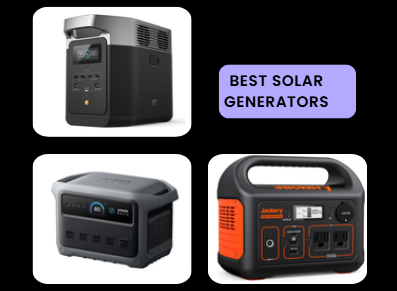
Let’s look at the Best Solar Generators.
Power outages, camping trips, and off-grid adventures all share one common need — reliable electricity when and where you need it most. Solar generators have quickly become the go-to solution, offering clean, silent, and fuel-free power that works just as well in your backyard as it does deep in the wilderness.
But with so many options on the market, knowing which one is worth your money is not always straightforward.
Here is a review of the best solar generators across every budget and use case, from ultralight companions for weekend campers to high-capacity units built for home backup and off-grid living, so you can make a confident, informed choice without the guesswork.
Here is a quick summary of the Best Solar Generators
- Jackery Explorer 300 Portable Power Station — Best Compact & Lightweight Option -Get it on Amazon
- Jackery Explorer 1000 v2 Portable Power Station — Best Overall Solar Generator -Get it on Amazon
- EF ECOFLOW DELTA 2 Portable Power Station — Best Expandable Power Station -Get it on Amazon
- Anker SOLIX C1000 Gen 2 Portable Power Station — Best Premium High-Output Option -Get it on Amazon
- BLUETTI Elite 30 V2 Portable Power Station — Best Lightweight Travel Pick -Get it on Amazon
- HOWEASY Portable Power Station 300W — Best Budget-Friendly Option -Get it on Amazon
- GRECELL 300W Solar Generator — Best Entry-Level Solar Kit -Get it on Amazon
How do Solar Generators Work?
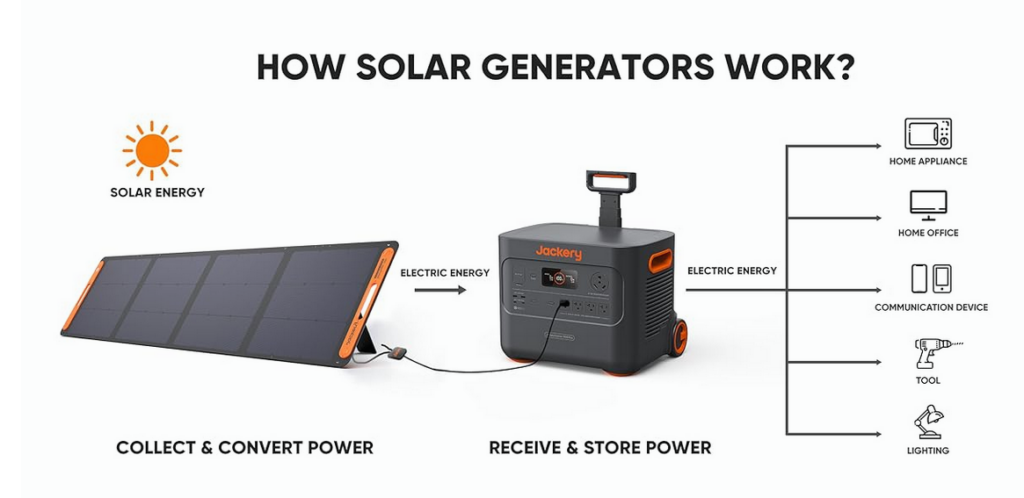
A solar generator works by capturing sunlight through connected solar panels and converting it into electrical energy, which is then stored in an internal battery for later use.
The solar panels contain photovoltaic cells that turn sunlight into direct current (DC) electricity, which passes through a built-in charge controller — often an MPPT controller — that regulates and optimises the energy flowing into the battery to prevent overcharging and maximise efficiency.
When you plug in a device, the stored DC energy passes through an inverter that converts it into alternating current (AC) electricity, matching the standard power delivered by a wall outlet, while DC and USB ports draw directly from the battery without conversion.
A Battery Management System monitors the entire process in real time, protecting against overheating, short circuits, and power surges to keep both the generator and your connected devices safe throughout the charging and discharging cycle.
Best Solar Generators
1) Jackery Explorer 300 Portable Solar Generator
Get it on Amazon
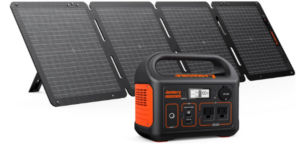
The Jackery Explorer 300 is a compact and capable portable power station that earns its place among the best solar generators for outdoor enthusiasts and everyday backup power needs. Built around a 293Wh lithium-ion battery pack, it delivers 300W of continuous power through two Pure Sine Wave AC outlets, ensuring stable and safe electricity for sensitive electronics like laptops, cameras, and drones.
Weighing just 7.1 pounds, it is light enough to toss in a pack without a second thought, making it a practical companion for tent camping, overlanding, and off-grid adventures.
One of the more impressive aspects of the Explorer 300 is its charging versatility. It reaches 80% capacity in just two hours when using a wall outlet and the 60W PD USB-C port simultaneously, and achieves a full charge in roughly four hours via AC alone.
For those on the move, a car port charges it in about 4.5 hours, while pairing it with the Jackery SolarSaga 100W solar panel, sold separately, brings it to full capacity in approximately 5.5 hours. The integrated MPPT controller optimizes solar input efficiency, keeping charging times as short as possible under real-world conditions.
In terms of connectivity, the Explorer 300 covers most bases with two AC outlets, a 60W USB-C PD port that supports both input and output, a Quick Charge 3.0 USB-A port, a standard USB-A port, and a DC car port. That totals up to six devices that can be powered simultaneously, which is genuinely useful when a group of people needs to charge gear at once.
Pass-through charging is also supported, meaning the unit can recharge devices while it is itself being recharged. Working time for any given device can be estimated using the formula: 300Wh × 0.85 ÷ device wattage — so a 60W device would run for roughly 4.3 hours.
Pros
- Lightweight at 7.1 pounds, making it easy to transport
- Fast recharge time, reaching 80% in just two hours with combined AC and USB-C input
- Pure Sine Wave AC outlets ensure safe power delivery for sensitive electronics
- Six-port output supports simultaneous charging of multiple devices
- Compatible with Jackery SolarSaga solar panels for green, off-grid recharging
- Pass-through charging allows use while recharging
- MPPT controller maximizes solar panel efficiency
Cons
- 300W output limit means it cannot power high-wattage appliances like microwaves or power tools
2) Jackery Explorer 1000 v2 Portable Solar Generator
Get it on Amazon
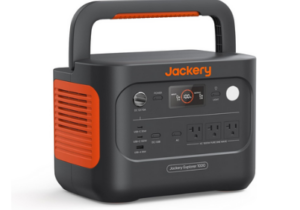
The Jackery Explorer 1000 V2 is a serious step up in portable power, making a strong case for itself among the best solar generators available today. It delivers a substantial 1,500W of AC output with a 3,000W surge peak, meaning it can comfortably handle power-hungry appliances that smaller units simply cannot manage, including AC units, refrigerators, and electric pots.
Despite packing a 1,070Wh capacity, it weighs just 23.8 pounds and features a foldable handle, keeping portability a genuine priority rather than an afterthought. Whether the intended use is outdoor camping, a road trip, or emergency home backup, the Explorer 1000 V2 is built to rise to the occasion.
Charging speed is one of the most compelling aspects of this unit. Through the Jackery App, users can activate emergency charging to bring the station from 0% to 100% in just one hour — a remarkable turnaround for a battery of this size.
By default, the station charges in 1.7 hours to better preserve long-term battery health, which is a thoughtful balance between convenience and longevity. Underpinning both modes is Jackery’s ChargeShield 2.0 technology, which is engineered to make the charging process safer, faster, and more intelligent overall.
Battery durability is another area where the Explorer 1000 V2 distinguishes itself. It uses a lithium iron phosphate (LFP) battery that retains over 70% of its original capacity after 4,000 charge cycles, translating to a usable lifespan exceeding 10 years.
This is a meaningful advantage over standard lithium-ion alternatives, which typically degrade significantly faster under regular use. For anyone investing in a long-term power solution, this kind of longevity adds real value to the purchase.
The app-based control system adds a layer of flexibility that sets this model apart from more basic units. Through the Jackery App, users can toggle between different charging modes including the one-hour emergency charge, a whisper-quiet 30 dB overnight charging mode, and an energy efficiency mode.
This level of customization means the station can adapt to the environment and situation rather than operating on a one-size-fits-all basis. On the output side, the unit includes three pure sine wave AC ports, two USB-C ports with 100W PD fast charging, one USB-A port, one DC car port, and built-in LED lights, giving users the ability to power and charge multiple devices at once without needing additional adapters.
Pros
- High 1,500W AC output and 3,000W surge capacity handle demanding appliances
- Impressively fast charging, reaching full capacity in as little as one hour via the app
- LFP battery rated for 4,000 charge cycles and a lifespan of over 10 years
- ChargeShield 2.0 technology ensures safe and optimized charging
- App-controlled charging modes, including quiet overnight and energy efficiency options
- Generous port selection with three AC outlets, two USB-C PD ports, USB-A, and a DC car port
- Relatively lightweight at 23.8 lbs for its capacity, with a foldable handle for easy transport
- Built-in LED lights add practical utility for outdoor or emergency scenarios
Cons
- App dependency for advanced features may be a limitation for users who prefer simple plug-and-play operation
3) EF ECOFLOW PortableSolar Generator
Get it on Amazon
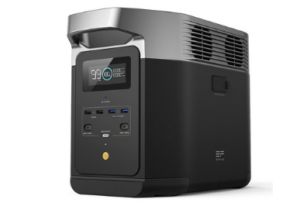
The EF EcoFlow DELTA 2 earns its reputation as one of the best solar generators on the market by combining rapid charging, substantial power output, and long-term durability into a single versatile package. It comes equipped with 1,800W of output power across 15 outlets, putting it on par with traditional outdoor generators in terms of capability , but without the noise, fumes, or fuel dependency that comes with combustion-based alternatives.
For anyone looking for a clean, capable power solution for home backup, camping, RV trips, or off-grid living, the DELTA 2 presents a compelling all-around option.
Where the DELTA 2 genuinely impresses is in its charging speed. Using a standard AC wall outlet, it charges from 0% to 80% in just 50 minutes and reaches full capacity in approximately 80 minutes.
This kind of turnaround time is exceptional for a unit of this size and capacity, and it makes the DELTA 2 especially practical as a home backup solution where quick replenishment after an outage is a real priority. The speed advantage over competing units in this class is difficult to overlook.
The base unit carries a 1kWh capacity, but what makes the DELTA 2 particularly future-proof is its expandable design. Users can add extra batteries to scale the total capacity up to 3kWh, allowing the system to grow alongside changing power needs.
This kind of modularity is a genuine advantage for those who start with lighter use cases like weekend camping but later need more capacity for extended off-grid living or RV setups. With up to 500W of solar panel input supported, the unit can also be recharged entirely through clean solar energy while in the field.
Battery longevity is handled through LFP (LiFePO4) chemistry, which gives the DELTA 2 a rated cycle life of over 3,000 charges. This translates to years of regular use before any meaningful capacity degradation, making it a sound long-term investment.
A sophisticated Battery Management System (BMS) monitors and auto-regulates performance to keep operations safe under varying conditions. The package also includes a five-year customer service commitment, which adds an extra layer of confidence for buyers making a significant purchase.
Pros
- Exceptionally fast AC charging, reaching 80% in 50 minutes and 100% in 80 minutes
- 1,800W output powers up to 90% of common household and outdoor appliances
- 15 outlets provide broad simultaneous device charging capability
- Expandable capacity from 1kWh up to 3kWh with additional batteries
- LFP battery chemistry is rated for 3,000-plus charge cycles for long-term durability
- Supports up to 500W solar input for clean, off-grid recharging
- Built-in BMS ensures safe, auto-regulated operation
- Includes a five-year customer service plan
Cons
- Expansion batteries required to reach higher capacities add to the overall cost
4) Anker SOLIX C1000 Gen 2 PortableSolar Generator
Get it on Amazon
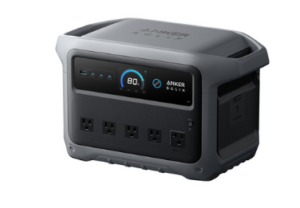
The Anker SOLIX C1000 Gen 2 positions itself as a premium portable solar generator built for users who demand fast charging, reliable output, and long-term dependability in a compact form. With 2,000W of continuous output, a 3,000W peak surge capacity, and a 1,024Wh battery, it can handle a wide range of power needs spanning emergency home backup, remote work setups, RV living, camping, and even tiny home applications.
Compared to similar models in its class, the C1000 Gen 2 is 14% smaller and 11% lighter, making it genuinely easier to carry between rooms, load into a vehicle, or bring along to outdoor events without the bulk that typically accompanies high-capacity units.
Charging speed is one of the most talked-about aspects of the C1000 Gen 2, and with good reason. Using the upgraded HyperFlash technology enabled through the Anker app, the unit recharges at up to 1,600W and reaches full capacity in just 49 minutes.
It is worth noting that this speed is temperature-dependent. UltraFast Charging activates when the battery cell temperature is above 20°C, and charging at lower temperatures will slow the process noticeably. The feature also carries a recommendation to use it only when necessary in order to preserve long-term battery health, which reflects a thoughtful approach to balancing convenience with longevity.
Solar recharging is well catered for, with support for up to 600W of solar input at a maximum of 60V, allowing the unit to reach a full charge in approximately 1.8 hours under optimal conditions. This makes it a practical off-grid solution for sustained use in remote locations, campsites, or van and RV setups where grid access is limited or unavailable.
For critical equipment that cannot afford any interruption, the C1000 Gen 2 also features a UPS switchover time of under 10 milliseconds, ensuring devices like CPAP machines and laptops stay running seamlessly during a power transition.
Battery longevity is backed by an InfiniPower rating that sees the unit retain at least 80% of its capacity after 4,000 charge cycles, projecting a useful lifespan of roughly 10 years under regular use.
App-based management through the Anker app gives users access to UltraFast Charging controls, Standard Mode for everyday plug-and-play use, and a Time-of-Use (TOU) Mode that intelligently manages charging and discharging based on electricity price fluctuations, a genuinely useful feature for those monitoring energy costs in off-grid or remote work scenarios.
With 10 output ports available, the unit can simultaneously power up to 10 devices across a variety of connection types.
Pros
- UltraFast HyperFlash charging reaches full capacity in as little as 49 minutes
- Strong 2,000W continuous output with 3,000W peak handles most common appliances
- Compact and lightweight design is 14% smaller and 11% lighter than comparable models
- LFP-based InfiniPower battery rated for 4,000 cycles and approximately 10 years of use
- Solar recharging supported up to 600W for a full charge in around 1.8 hours
- Under 10 ms UPS switchover protects sensitive and critical devices
- App-controlled TOU Mode helps reduce energy costs through smart charge management
- 10 output ports allow simultaneous powering of multiple devices
Cons
- Repeated use of UltraFast Charging is not recommended, as it can reduce long-term battery lifespan
5) BLUETTI Elite 30 V2 Portable Solar Generator
Get it on Amazon
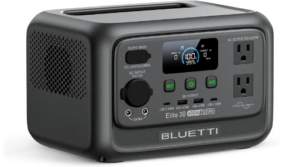
The BLUETTI Elite 30 V2 makes a strong case as one of the best entry-level solar generators for those who need reliable portable power without the bulk or weight of larger units. Weighing just 9.4 pounds with a 288Wh LiFePO4 battery, it is compact enough to carry on camping trips, road trips, beach outings, and beach visits while still being robust enough to serve as emergency backup during home blackouts or winter storms.
It strikes a practical balance between portability and genuine power capability that makes it a versatile pick across a broad range of everyday and outdoor scenarios.
Despite its compact size, the Elite 30 V2 punches above its weight in terms of power output. It delivers 600W of continuous AC output, which is notably higher than many competing units in its class, and features a Power Lifting Mode that temporarily boosts output to 1,500W for more demanding devices.
This means it can comfortably run camping essentials like lights, speakers, and car fridges alongside more critical equipment such as laptops and CPAP machines, and can even handle small kitchen appliances like a kettle or toaster when needed. The flexibility of that power range makes it useful well beyond what a typical entry-level station can offer.
Energy efficiency is another area where BLUETTI has made clear improvements with this model. The upgraded UltraCell technology, combined with a smart cooling system,reduces overall power consumption by 50% compared to previous iterations, which directly translates to longer device runtimes per charge.
Standby power draw is impressively low at just 4.5W, with DC use drawing 5W and AC drawing 8W. This level of efficiency is particularly valuable for extended outdoor trips or prolonged emergency use where every watt-hour counts.
Charging flexibility is well covered across eight supported charging modes. Using an AC wall outlet, the Elite 30 V2 charges from 0% to 80% in just 45 minutes and reaches full capacity in 70 minutes at up to 380W input, with a 200W option available for battery-safe charging.
It also supports solar input, car charging, and compatibility with the BLUETTI PV60L solar panel for fully off-grid recharging on the go. For homes and workplaces where uninterrupted power is critical, the unit’s 10ms UPS switchover ensures that connected devices like routers, laptops, and CPAP machines experience no meaningful interruption during a sudden power cut.
Pros
- Ultralight at 9.4 lbs, making it one of the most portable options in its capacity range
- Power Lifting Mode extends output from 600W up to 1,500W for demanding devices
- LiFePO4 battery chemistry ensures long cycle life and reliable performance
- Exceptionally fast AC charging, reaching 80% in 45 minutes and a full charge in 70 minutes
- 50% reduction in power consumption, thanks to UltraCell technology, extends runtime
- Eight charging modes offer broad flexibility across home, outdoor, and emergency scenarios
- 10ms UPS switchover protects critical devices during unexpected power cuts
- Very low standby power draw of just 4.5W
Cons
- Power Lifting Mode is a temporary boost rather than a sustained output rating
6) HOWEASY Portable Solar Generator
Get it on Amazon
The HOWEASY Portable Solar Generator enters the market as an accessible, ultra-compact power solution aimed at campers, travelers, and anyone who needs a lightweight backup power source for essential devices on the go.
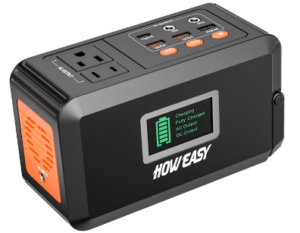
Built around an 88Wh battery with a cycle life of over 1,500 charges, it is designed for light-duty use rather than heavy power demands, making it best suited for keeping smaller electronics like mobile phones, laptops, cameras, tablets, and wireless headphones running when grid power is unavailable. It is a practical entry point into portable solar power for those who do not need high wattage but do need reliable, portable energy in a very small package.
This HOWEASY is one of the most portable options in the solar generator category. Its hidden handle design keeps the form factor slim and space-efficient without sacrificing ease of carrying, and the unit supports pass-through charging, allowing devices to be powered while the station itself is recharging.
For someone heading out on a camping weekend, navigating an emergency at home, or simply wanting a compact backup for daily essentials, the size and weight profile makes it genuinely easy to keep on hand at all times.
Output is handled through eight ports covering a broad range of connection types. These include two AC sockets rated at 110V with 120W continuous and 240W peak output, one 18W USB-C port, two Quick Charge 3.0 USB ports, one standard USB port at 5V/2.4A, and two DC ports at 12V/10A.
An LED display provides clear visibility of working status and remaining battery level, and separate AC and DC buttons allow straightforward control without navigating complex menus. The unit also features built-in LED lighting with three modes, including steady light, flash, and SOS, adding a layer of practical utility for camping or emergencies where external lighting may not be available.
Recharging is supported through three methods: a standard AC wall outlet using the included adapter, solar panel input accepting 15V to 24V panels sold separately, and a 12V or 24V car socket using the included car charger.
This flexibility means the HOWEASY can be topped up in most environments, whether at home before a trip, on the road during a drive, or out in the field using a compatible solar panel. The package also includes a 24-month product warranty and 24/7 customer service access, which adds a reasonable degree of purchase confidence for a budget-friendly unit.
Pros
- Extremely lightweight at 2.3 pounds and compact enough to fit in a bag or backpack
- Eight output ports cover AC, USB-C, QC 3.0, standard USB, and DC connections simultaneously
- Three recharging options, including AC, solar, and car chargin,g provide broad flexibility
- Pass-through charging allows device use while the unit is being recharged
- Built-in three-mode LED lighting adds practical emergency and camping utility
- Includes AC adapter and car charger in the box
- 24-month warranty and 24/7 customer support offer solid after-purchase coverage
Cons
- 88Wh capacity is quite limited and will not sustain extended use or power-hungry devices
- AC output is capped at 120W continuous, restricting use to smaller, low-wattage equipment
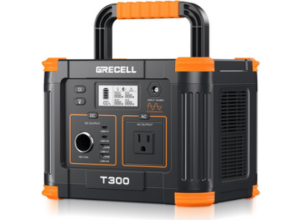
7) GRECELL Portable Solar Generator
Get it on Amazon
The GRECELL Portable Solar Generator is a compact and capable mid-range option that delivers a solid combination of capacity, output, and charging versatility for outdoor enthusiasts and everyday backup power users.
Built around a 230.88Wh battery with 330W of continuous output and a 600W surge capacity through a pure sine wave inverter, it can reliably power a wide range of devices, including laptops, tablets, phones, fans, lights, CPAP machines, projectors, mini-refrigerators, and speakers, provided their rated power falls under 330W.
Its lightweight and compact build makes it a practical companion for camping, car trips, and family outings where portability is just as important as power.
Battery safety and management receive notable attention in the GRECELL’s design. The upgraded Battery Management System provides built-in protection against overload, overcharging, and short circuits, with the station automatically stopping the charge cycle once a connected device reaches full capacity.
Dual silent cooling fans work continuously to regulate internal temperature during operation, helping to extend both the safety and longevity of the unit. GRECELL’s commitment to using quality lithium cells rather than lower-grade alternatives reflects a considered approach to a part of the product that directly affects user safety and long-term reliability.
On the output side, the GRECELL offers six ports for simultaneous device charging, covering one AC outlet, one USB-C PD 60W port, one USB-C PD 18W port, two USB-A Quick Charge 3.0 ports at 15W each, and one DC car port.
The 60W USB-C PD port charges compatible laptops and smartphones more than twice as fast as a standard USB-C output, which is a meaningful advantage in situations where time is limited. All USB-A ports are Quick Charge 3.0 enabled, ensuring that each connected device benefits from efficient, accelerated charging rather than slow trickle speeds.
Recharging flexibility is well addressed through three available input methods: a standard AC wall outlet, a compatible solar panel, and a car outlet. A built-in MPPT controller optimises solar energy extraction by continuously tracking the maximum power point of the connected panel, ensuring that variable sunlight conditions do not result in wasted charging potential.
The included 40W solar panel works in tandem with the MPPT system to make solar recharging as efficient as possible, making this a genuinely usable solar generator setup right out of the box rather than requiring a separate panel purchase.
Pros
- 330W continuous output with 600W surge handles a broad range of common devices
- A pure sine wave inverter ensures safe power delivery for sensitive electronics
- Upgraded BMS with overload, overcharge, and short-circuit protection enhances safety
- Dual silent cooling fans maintain safe operating temperatures during extended use
- Six output ports, including fast-charge USB-C PD 60W and QC 3.0 USB-A ports
- Built-in MPPT controller maximises solar panel charging efficiency
- Three recharging methods provide flexibility across home, outdoor, and travel scenarios
- Solar panel included, offering a more complete out-of-the-box experience
Cons
- Expandability is not supported, meaning capacity is fixed at 230.88Wh
Next Read: 6 Best 1000W Solar Generators
How to Pick the Right Solar Generator?
Battery Capacity
Battery capacity, measured in watt-hours (Wh), determines how long a generator can keep your devices running before needing a recharge. Smaller capacities between 88Wh and 300Wh suit light users charging phones and small electronics, while mid-range units from 300Wh to 1,000Wh handle laptops, CPAP machines, and car fridges. For extended off-grid living or home backup, units above 1,000Wh — especially those with expandable capacity — are the more practical choice.
Power Output and Surge Capacity
Continuous wattage determines which devices a generator can run, while surge capacity covers the brief power spike many appliances draw at startup. Units rated between 120W and 300W cover basic electronics, while 600W to 2,000W open up refrigerators, kettles, and larger appliances. Always check both ratings against your specific devices, as a generator without adequate surge headroom will shut off under startup loads.
Battery Chemistry and Lifespan
Battery chemistry directly affects how long a unit remains useful over time. Lithium iron phosphate (LFP) batteries endure 3,000 to 4,000 charge cycles while retaining most of their capacity, far outlasting standard lithium-ion cells, which typically degrade after 500 to 1,000 cycles. For regular long-term use, an LFP-based unit offers significantly better value and inherently safer thermal performance.
Charging Speed and Input Options
How quickly a generator recharges matters as much as how much it stores, especially in emergencies or off-grid settings. The fastest units reach full capacity in under two hours via a wall outlet, while solar input speed depends on maximum wattage acceptance and whether a built-in MPPT controller is present to optimise energy extraction. Having multiple input options, including AC, car port, and sola,r ensures the unit can be recharged in virtually any environment.
Number and Type of Output Ports
Output port variety determines how many devices can be powered simultaneously and how efficiently each one charges. A well-equipped unit should include AC outlets, USB-C Power Delivery ports, Quick Charge USB-A ports, and DC outputs to cover the widest range of devices. Pay close attention to individual port wattage ratings, as the difference between an 18W and a 100W USB-C port has a significant impact on real-world charging speed.
Portability and Build Quality
Physical weight and size determine where a generator can realistically be used. Units under 3 pounds work well for hiking and travel, mid-weight options between 7 and 25 pounds suit car camping and road trips, and heavier units above 25 pounds are better suited to RVs or stationary home backup setups. Build quality, effective cooling, and the ability to operate across a wide temperature range are equally important for reliable long-term performance.
Smart Features and Safety Protections
App-based controls allow users to switch charging modes, monitor power usage, and set time-of-use schedules for smarter energy management. A robust Battery Management System is essential, providing automatic protection against overcharging, overheating, short circuits, and overload. For users running sensitive equipment like medical devices or computers, a UPS switchover time of 10 milliseconds or less ensures those devices experience no interruption during a sudden power outage.
Best Solar Generators FAQs
1. What size solar generator do I need?
The right size depends on what you plan to power. For charging phones, laptops, and small electronics, a unit between 88Wh and 300Wh is sufficient. For running appliances like car fridges, CPAP machines, and fans during camping or road trips, aim for 300Wh to 1,000Wh. For home backup, RV living, or off-grid use, a unit above 1,000Wh with expandable capacity is the most practical choice.
2. How long does a solar generator last?
Lifespan depends largely on battery chemistry. Units built with LFP (lithium iron phosphate) batteries typically last 3,000 to 4,000 charge cycles, which translates to 10 or more years of regular use. Standard lithium-ion units generally offer a shorter cycle life of around 500 to 1,500 cycles. Proper storage, avoiding full discharges, and using manufacturer-recommended charging methods all help extend the life of any unit.
3. Can a solar generator power a refrigerator?
Yes, but only if the generator’s continuous output rating exceeds the refrigerator’s running wattage, and its surge capacity can handle the compressor’s startup spike. Most full-size refrigerators require between 100W and 400W to run and can draw two to three times that at startup. Units with 1,500W or more of continuous output and a strong surge rating are best suited for this purpose, while smaller units are better matched to compact or car fridges.
4. Is a solar generator worth it for home backup?
For most households, a solar generator is a practical and cost-effective backup solution for outages caused by storms or grid failures. It can keep essential devices running, including lights, routers, medical equipment, and small appliances without the noise, fumes, or fuel costs associated with gas generators. For whole-home backup needs, a high-capacity unit with expandable battery options and strong solar input will deliver the most reliable performance during extended outages.
Solar Generators vs Gas Generators
Solar generators and gas generators both serve the same fundamental purpose — providing power when grid electricity is unavailable — but they differ significantly in how they operate and where they perform best.
Gas generators run on fuel combustion, which means they can produce high wattage output continuously for as long as fuel is available, making them a strong choice for whole-home backup or powering heavy-duty equipment during extended outages. However, they produce exhaust fumes, making them unsafe for indoor use, and they generate considerable noise during operation. Ongoing fuel costs, regular maintenance, and the need to store flammable fuel add to the long-term expense and inconvenience.
Solar generators, by contrast, run silently and produce zero emissions, making them safe for indoor and outdoor use alike. They rely on sunlight or a wall outlet for recharging, eliminating fuel costs entirely, and have far fewer moving parts which means lower maintenance requirements over time. The trade-off is that output capacity and runtime are limited by battery size, and recharging via solar panels depends on weather and daylight availability.
For most everyday uses such as camping, road trips, emergency backup for essential devices, and off-grid living, a solar generator is the cleaner, quieter, and more practical choice. For situations requiring sustained high-wattage output over long periods, particularly during prolonged grid outages, a gas generator still holds the advantage in raw power delivery.
| Solar Generator | Gas Generator | |
|---|---|---|
| Fuel Source | Sun / Grid | Gasoline |
| Emissions | Zero | Yes |
| Noise Level | Silent | Loud |
| Indoor Safe | ✓ | ✗ |
| Maintenance | Minimal | Regular |
| Fuel Cost | Free (solar) | Ongoing |
| Output Capacity | Low to high | Very high |
| Best For | Camping / backup / off-grid | Extended high-power outages |
Glossary of Key Terms in Solar Generators
Watt-hours (Wh) A unit of measurement that indicates how much total energy a solar generator can store. The higher the watt-hour rating, the longer the generator can power your devices before needing a recharge. For example, a 500Wh battery running a 50W device will last approximately 10 hours.
Watts (W) A measure of power output at any given moment. A generator’s watt rating determines which devices it can run simultaneously. Always check that your generator’s continuous watt output meets or exceeds the combined wattage of all devices you intend to power at once.
Pure Sine Wave A type of electrical output that closely mimics the smooth, consistent power delivered by a standard wall outlet. Pure sine wave inverters are safe for sensitive electronics like laptops, CPAP machines, and medical devices, unlike modified sine wave alternatives which can cause damage or interference.
LFP / LiFePO4 Battery Lithium iron phosphate is a battery chemistry known for its long cycle life, thermal stability, and safety. LFP batteries typically last 3,000 to 4,000 charge cycles, far outlasting standard lithium-ion alternatives, making them the preferred choice for long-term solar generator use.
Lithium-Ion Battery The most common battery type found in portable electronics and entry-level solar generators. Lithium-ion batteries are lightweight and energy-dense but generally have a shorter cycle life of 500 to 1,500 cycles compared to LFP chemistry.
MPPT (Maximum Power Point Tracking) A technology built into solar charge controllers that continuously optimizes the energy drawn from connected solar panels. An MPPT controller adjusts in real time to changing light conditions, ensuring the generator extracts the maximum possible power from its solar input at all times.
Surge Capacity The maximum peak power a generator can deliver for a brief moment to handle the startup spike of appliances like refrigerators, air conditioners, and power tools. Surge capacity is always higher than continuous output and is a critical spec to check when powering motor-driven devices.
Pass-Through Charging A feature that allows a solar generator to charge connected devices while it is simultaneously being recharged itself. This is particularly useful during emergencies or extended outdoor use where downtime cannot be afforded.
UPS (Uninterruptible Power Supply) A function that allows a solar generator to switch to battery power almost instantly when it detects a loss of grid power. Units with a switchover time of 10 milliseconds or less ensure that sensitive devices like computers, routers, and medical equipment experience no meaningful interruption during a power outage.
BMS (Battery Management System) An internal protection system that monitors and regulates the battery’s performance in real time. A BMS safeguards against overcharging, over-discharging, overheating, short circuits, and overload conditions, protecting both the generator and any connected devices.
PD (Power Delivery) A fast-charging standard used in USB-C ports that allows compatible devices to charge significantly faster than standard USB connections. USB-C PD ports rated at 60W or 100W can charge laptops and smartphones in a fraction of the time of conventional charging.
Quick Charge (QC) A fast-charging technology developed for USB-A ports that delivers higher voltage and current than standard USB charging. Quick Charge 3.0, the most common version found in solar generators, can charge compatible devices up to four times faster than a standard USB port.
Cycle Life The total number of complete charge and discharge cycles a battery can undergo before its capacity drops below a specified threshold, typically 80% of its original rating. A higher cycle life means a longer-lasting investment and lower long-term cost of ownership.
Solar Input (W) The maximum wattage of solar energy a generator can accept from connected panels at any one time. A higher solar input rating means faster recharging from the sun, which is critical for off-grid use where grid access is unavailable.
Expandable Capacity A feature available on select solar generators that allows users to connect additional external battery modules to increase the total energy storage beyond the base unit. This is particularly valuable for users whose power needs grow over time or who require extended runtime for off-grid living.
Conclusion
Choosing the best solar generator comes down to understanding your specific power needs and matching them to the right combination of capacity, output, and portability. For light travellers and campers who need a compact, no-fuss option, smaller units in the 88Wh to 300Wh range offer reliable power for essential electronics without adding bulk or weight.
Those with heavier demands — from running appliances in an RV to keeping critical home devices online during an outage — will find far greater value in mid to high-capacity units equipped with LFP batteries, fast charging, and smart app controls.
Across every category, the best solar generators share a few common qualities: clean, silent operation, multiple charging input options, a robust Battery Management System, and enough output versatility to handle a wide range of devices simultaneously.
Solar technology continues to improve year on year, and today’s portable solar generators deliver more power, faster charging, and longer lifespans than ever before.
Whichever model you choose from this list, you can be confident you are investing in a cleaner, smarter, and more self-sufficient approach to portable power

Albert, the founder of Outdoormoran, is a dedicated outdoor enthusiast with a passion for delivering the most current, accurate, and easy-to-understand information on all different outdoor gear and optics. He shares his expertise with beginners by teaching the technical aspects of outdoor gear and optics through his comprehensive collection of guides.