Choosing your first camera is an exciting step into the world of photography, and the best mirrorless cameras for beginners have become the go-to choice for those new to photography.
Why? They offer an ideal blend of compact design, advanced features, and excellent image quality, all without the bulk of traditional DSLR systems.
In this guide, we’ll walk you through the top mirrorless camera options that strike a balance between ease of use, performance, and value.
We’ll also break down key features to consider, such as sensor size, autofocus, and video capabilities, so you can confidently choose a camera that fits your needs and budget.
What are Mirrorless Cameras?
Mirrorless cameras are digital cameras that use an interchangeable-lens system but do not have a mirror mechanism like traditional DSLR cameras. Instead of reflecting light through a mirror to an optical viewfinder, mirrorless cameras send light directly to the image sensor, which then displays a live preview on the rear LCD screen or an electronic viewfinder (EVF).
Why Mirrorless Cameras are Great for Beginners
Mirrorless cameras combine professional-level image quality with modern features and portability. They are suitable for everything from everyday photography and travel to wildlife, portraits, and video creation. For beginners, mirrorless cameras are ideal because they are:
-
Lightweight and Compact. Easier to carry and handle, especially for travel, daily use, and long shooting sessions.
-
Easy-to-Use Controls. Many models include beginner-friendly menus, touchscreen controls, and guided shooting modes.
-
What You See Is What You Get (WYSIWYG). The electronic viewfinder shows real-time exposure, colors, and depth of field before you take the shot.
-
Excellent Image Quality. The large sensors (APS-C or full-frame) deliver sharp images with great low-light performance.
-
Fast and Accurate Autofocus. Features like face and eye detection help beginners capture sharp portraits effortlessly.
-
Strong Video Capabilities. Furthermore, the best mirrorless cameras for beginners offer 4K video, making them ideal for beginners interested in both photography and video.
-
Interchangeable Lenses. With interchangeable lenses, beginners are able to start simple and upgrade lenses as their skills grow.
-
Quiet Shooting. The silent or near-silent shutters are great for events, wildlife, or candid photography.
-
Built-In Connectivity. Moreover, Wi-Fi and Bluetooth make it easy to transfer photos to a smartphone for sharing.
-
Future-Proof System. Most major brands focus their innovation on mirrorless systems, ensuring long-term support and upgrades.
Best Mirrorless Cameras for Beginners
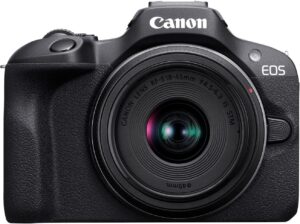
1) Canon EOS R100 Mirrorless Camera
Get it on Amazon
The Canon EOS R100 is the best mirrorless camera for beginners.
Built around a 24.1MP APS-C CMOS sensor paired with Canon’s DIGIC 8 image processor, it delivers clean, detailed images with natural color reproduction. Furthermore, the camera’s compact, lightweight body makes it easy to carry for everyday shooting, travel, and casual photography, while the RF mount opens the door to Canon’s growing lineup of modern RF lenses.
For video and general usability, the EOS R100 offers solid basics without unnecessary complexity. It records 4K video using a crop from the sensor, which maintains detail but limits wide-angle framing, while Full HD video benefits from smooth autofocus performance.
Moreover, the simplified control layout and guided menus are beginner-friendly, helping new users learn camera fundamentals without feeling overwhelmed. The camera also features a Dual Pixel CMOS autofocus that provides fast and accurate subject acquisition for stills. This makes it well suited for portraits, landscapes, and family moments.
Pros
- 24.1MP APS-C sensor delivers sharp images and pleasing colors
- Compact and lightweight design, ideal for travel and daily use
- Canon Dual Pixel autofocus is fast and reliable for still photography
- RF lens mount provides access to modern Canon lenses
- Beginner-friendly controls and intuitive menu system
Cons
- No in-body image stabilization
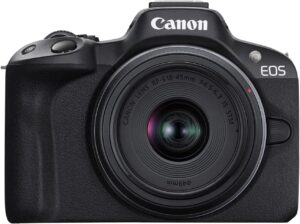
2) Canon EOS R50 Mirrorless Camera
Get it on Amazon
The Canon EOS R50 Mirrorless Camera is a compact yet capable entry-level mirrorless camera designed for beginners, content creators, and travelers who want excellent image quality without the complexity of professional gear.
Built around a 24.2MP APS-C sensor and Canon’s powerful DIGIC X processor, the R50 delivers crisp photos with pleasing color science and impressive low-light performance for its class.
Furthermore, its Dual Pixel CMOS AF II system offers fast, accurate autofocus with intelligent subject detection for people, animals, and vehicles, making it especially reliable for everyday photography, vlogging, and casual action shots.
Despite its lightweight body, the camera feels responsive and modern, with intuitive menus that make it easy for newcomers to grow their skills.
Moreover, the Canon EOS R50 punches above its weight by offering oversampled 4K video and smooth Full HD recording, resulting in sharp, detailed footage ideal for social media and YouTube content. The vari-angle touchscreen is another major advantage for vloggers and solo shooters, allowing flexible framing from virtually any angle.
Pros
- Lightweight and compact body, ideal for travel and daily use
- Excellent autofocus with reliable subject tracking
- Sharp 24.2MP APS-C sensor with pleasing color output
- Oversampled 4K video for high-quality content creation
- Vari-angle touchscreen great for vlogging and selfies
- Beginner-friendly controls and intuitive interface
Cons
- No in-body image stabilization (IBIS)
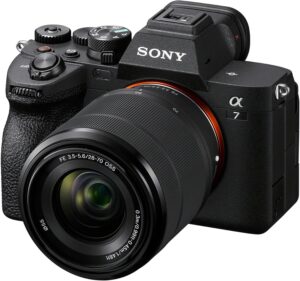
3) Sony Alpha 7 IV Full-frame Mirrorless Interchangeable Lens Camera
Get it on Amazon
As one of the best mirrorless cameras for beginners, the Sony Alpha 7 IV is a powerful hybrid camera designed for photographers and content creators who demand exceptional image quality and modern performance.
At its core is a 33MP full-frame Exmor R CMOS sensor. Paired with Sony’s advanced BIONZ XR processor, it delivers outstanding detail, impressive dynamic range, and excellent low-light performance.
Furthermore, colors are natural and well-balanced, while the wide ISO range ensures clean results in challenging lighting conditions. The included 28–70mm zoom lens adds versatility, making the kit suitable for everyday shooting, portraits, landscapes, and travel photography.
For added convenience, Sony’s refined ergonomics, high-resolution electronic viewfinder, and fully articulating touchscreen enhance usability, making long shooting sessions comfortable and intuitive.
Beyond still photography, the Alpha 7 IV truly shines as a hybrid workhorse for video creators. It offers 4K video recording with advanced color science, impressive autofocus performance, and reliable subject tracking for both humans and animals.
Additionally, the Real-time Eye AF and AI-driven autofocus system lock onto subjects quickly and accurately, even in fast-paced or unpredictable scenarios.
Pros
- Excellent full-frame image quality and dynamic range
- Fast, reliable autofocus with real-time tracking
- 4K video with 10-bit color and flexible profiles
- Effective in-body image stabilization
- Comfortable ergonomics and robust build
- Fully articulating touchscreen and rich feature set
Cons
-
Limited battery life for heavy video use
4) Sony Alpha ZV-E10 Camera
Get it on Amazon
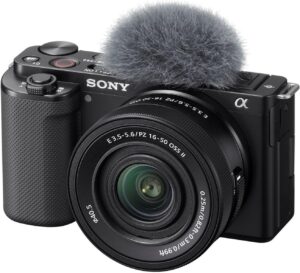
Next, we have the Sony Alpha ZV-E10 – APS-C Interchangeable Lens Mirrorless Vlog Camera Kit .
It features an APS-C sensor that delivers impressive image quality with vibrant colors and excellent detail, even in challenging lighting conditions.
Furthermore, the lightweight, compact design makes it highly portable, and the fully articulating touchscreen allows for easy framing and monitoring while vlogging or taking selfies.
This camera supports 4K video recording at 30fps with full pixel readout, giving creators smooth and professional-looking footage. Additionally, its fast and reliable autofocus system, including real-time Eye AF and face detection, ensures subjects stay sharp and in focus, reducing the need for constant adjustments while filming.
Beyond its imaging capabilities, the ZV-E10 includes features tailored to creators. It has a built-in directional microphone that captures clear audio, while also supporting external microphones for higher-quality sound.
The camera also offers interchangeable lenses, intuitive controls, and menu options that simplify video production, making it accessible even for beginners.
Pros
- Compact and lightweight, ideal for vlogging on the go
- High-quality APS-C sensor with excellent image detail
- Fully articulating touchscreen for easy self-recording
- 4K video recording with full pixel readout
- Fast and accurate autofocus with Eye AF and face detection
- Built-in directional microphone with external mic support
- Interchangeable lens system for creative flexibility
Cons
- Limited low-light performance compared to full-frame cameras
5) Canon EOS R50 Mirrorless Vlogging Camera
Get it on Amazon
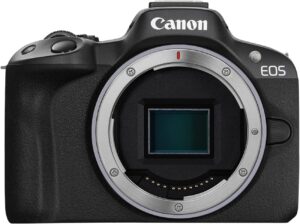
The Canon EOS R50 is a compact mirrorless camera designed with vloggers and content creators in mind.
Its lightweight body and intuitive controls make it incredibly portable, perfect for on-the-go shooting. The camera also features a 24.2-megapixel APS-C sensor, delivering crisp, vibrant images with excellent color reproduction, even in low-light conditions.
The fully articulating LCD screen is a highlight, allowing vloggers to frame themselves easily and record from challenging angles. Coupled with Canon’s renowned Dual Pixel CMOS autofocus, the camera ensures smooth and accurate focus tracking, making it ideal for dynamic video content.
Furthermore, its built-in Wi-Fi and Bluetooth connectivity allow seamless file transfer and remote control, streamlining the workflow for creators.
Video performance on the EOS R50 is also impressive, supporting 4K recording at 30fps and Full HD at 120fps for slow-motion capture.
Above all, the camera offers a variety of creative video modes, including time-lapse and vertical video for social media platforms.
Pros
- Compact, lightweight, and portable design
- Excellent 24.2MP APS-C image quality
- Fully articulating LCD screen for vlogging
- Fast and accurate Dual Pixel CMOS autofocus
- 4K video recording and Full HD slow-motion support
- Wi-Fi and Bluetooth connectivity for easy sharing
Cons
-
Limited advanced manual video controls compared to higher-end models
6) Nikon Z 30 with Wide-Angle Zoom Lens
Get it on Amazon
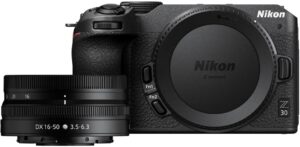
Carrying the renowned Nikon name, the Z 30 paired with its wide-angle zoom lens is a versatile mirrorless camera designed with content creators and enthusiasts in mind.
Its compact, lightweight body makes it incredibly portable, ideal for vlogging, travel, and everyday photography. Additionally, the camera features a 20.9-megapixel APS-C sensor, delivering sharp, vibrant images with excellent color reproduction.
The wide-angle zoom lens extends its versatility, capturing expansive landscapes, group shots, and creative perspectives that are difficult with standard lenses.
Furthermore, its autofocus system is fast and accurate, especially for subjects in motion, and the eye-detection AF ensures your subjects remain in crisp focus.
Regarding ease of use, the camera’s intuitive touchscreen interface and user-friendly controls make it accessible to both beginners and more experienced photographers. Besides, its lightweight design paired with excellent stabilization makes handheld shooting smooth and manageable.
Video capabilities are another strong suit of the Nikon Z 30. It records in 4K UHD at 30fps, providing high-quality footage suitable for social media, vlogs, and online content creation. The camera also supports vertical video recording and comes with a microphone input for improved audio quality.
Pros
- Lightweight and portable design
- Sharp 20.9MP APS-C sensor with vibrant color output
- Fast and accurate autofocus with eye-detection
- Versatile wide-angle zoom lens for creative framing
- 4K UHD video recording with vertical video support
- User-friendly interface ideal for beginners and vloggers
Cons
-
Fixed LCD screen limits some shooting angles
7) FUJIFILM X-T30 III Mirrorless Camera Body
Get it on Amazon
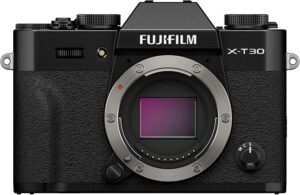
The FUJIFILM X-T30 III is a compact yet powerful mirrorless camera that caters to both enthusiasts and semi-professional photographers.
Its sleek, retro-inspired design houses a 26.1-megapixel APS-C X-Trans CMOS 4 sensor, delivering sharp, vibrant images with excellent color reproduction.
Furthermore, the camera excels in autofocus performance, offering fast and accurate subject tracking even in low-light conditions.
Its 4K video recording capability at up to 60fps makes it a versatile tool for content creators, while the high-resolution electronic viewfinder and tilting touchscreen LCD make composing shots intuitive and comfortable.
Another impressive feature of the X-T30 III is its film simulation modes, which allow photographers to achieve rich, cinematic tones straight out of the camera without heavy post-processing.
Battery life is decent for a mirrorless body of its size, and connectivity options like USB-C and Wi-Fi make sharing files and remote control straightforward.
Pros
- Compact and lightweight design, easy to carry
- 26.1MP APS-C sensor with excellent image quality
- Fast and reliable autofocus system
- 4K video recording up to 60fps
- Film simulation modes for creative photography
- High-resolution electronic viewfinder and tilting touchscreen
- USB-C and Wi-Fi connectivity for file transfer and remote shooting
Cons
-
No in-body image stabilization (IBIS)
8) Fujifilm X-T30 II Camera
Get it on Amazon
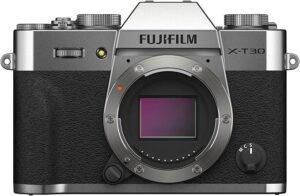
Last but not least, we have the Fujifilm X-T30 II. This is a compact and powerful mirrorless camera that delivers professional-level performance in a surprisingly small package.
Its 26.1-megapixel X-Trans CMOS 4 sensor paired with the X-Processor 4 ensures crisp, vibrant images with excellent color reproduction, even in low-light conditions. Furthermore, the camera’s autofocus system is fast and reliable, offering face and eye detection that makes portrait photography effortless.
As one of the best mirrorless cameras for beginners, it’s solid and ergonomic, with intuitive dials and controls that allow for quick adjustments on the fly. The tilting touchscreen and high-resolution electronic viewfinder add flexibility, making it ideal for both traditional and creative shooting angles.
Video performance on the X-T30 II is impressive for its class, supporting 4K recording at 30fps with detailed clarity and accurate color rendering. Moreover, its film simulation modes provide photographers with instant creative options, and the continuous shooting speed of up to 8 frames per second makes capturing action shots smooth and responsive.
Pros
- Compact, lightweight, and portable body
- Excellent image quality with 26.1MP X-Trans CMOS 4 sensor
- Fast and accurate autofocus with face/eye detection
- High-resolution electronic viewfinder and tilting touchscreen
- Impressive 4K video recording
- Wide range of creative film simulation modes
- Continuous shooting up to 8 fps
Cons
-
No in-body image stabilization (IBIS)
Next Read: 8 Best Nikon Mirrorless Cameras for Beginners
Factors to Consider when Choosing the Best Mirrorless Cameras for Beginners
Here are the key factors to consider when purchasing a mirrorless camera for beginners:
Sensor Size
Firstly, the sensor is the heart of any camera, and for beginners, it plays a huge role in image quality. Larger sensors, such as APS-C or full-frame, capture more light and detail, producing sharper images and better low-light performance. While smaller sensors may make the camera more affordable and compact, understanding the trade-offs in image quality is key for those just starting out.
Megapixels
While more megapixels don’t always mean better photos, they do allow for more detailed images and larger prints. Beginners should balance resolution with the camera’s overall performance, as extremely high megapixel counts can slow down processing and take up more storage space without significant benefits for everyday photography.
Autofocus Performance
Furthermore, fast and accurate autofocus is essential, especially for capturing moving subjects or spontaneous moments. The best mirrorless cameras for beginners with reliable autofocus systems make learning photography easier because users can focus more on composition rather than struggling with blurry shots. Features like eye-detection autofocus are also helpful for portraits.
Ease of Use
A beginner-friendly camera should have an intuitive menu system, simple controls, and helpful features like guided modes or automatic settings. Cameras that are overly complicated can frustrate new users, whereas models designed with simplicity in mind encourage learning while allowing room to experiment and grow.
Lens Availability
Mirrorless cameras rely heavily on interchangeable lenses, so it’s important to consider the variety and cost of lenses available for the camera system. Beginners benefit from versatile lenses, such as a kit zoom lens, which can cover multiple situations like landscapes, portraits, and everyday photography without requiring an expensive lens collection.
Portability and Build
Furthermore, many beginners prefer cameras that are lightweight and easy to carry, especially for travel or everyday use. The best mirrorless cameras for beginners are generally more compact than DSLRs, but the size and ergonomics should still feel comfortable in hand. Durable construction is also important to ensure the camera withstands minor bumps and outdoor conditions.
Video Capabilities
Even if photography is the main focus, having decent video features adds value. Beginners who want to explore vlogging or family videos will benefit from cameras that shoot in high-definition or 4K and offer simple video controls. Built-in stabilization and microphone options also make shooting videos easier and more enjoyable.
Budget and Value
Finally, beginners should consider their budget carefully. While it’s tempting to go for the latest high-end model, a mid-range camera often offers the best balance of features, image quality, and ease of use. Factoring in the cost of essential accessories like memory cards, extra batteries, and a camera bag ensures the overall investment is practical and sustainable for someone just starting out.
FAQs
- Is a mirrorless camera better than a DSLR for beginners?
Yes. Mirrorless cameras are generally lighter, more compact, and easier to handle while still providing excellent image quality.
- Do I need extra lenses as a beginner?
A versatile kit lens is enough for most beginners. You can gradually expand your lens collection as your skills improve.
- Can I shoot video with a mirrorless camera?
Absolutely. Many mirrorless cameras offer Full HD or 4K video recording, making them great for beginners who want to explore both photography and videography.
Final Words
Whether you’re capturing travel memories, shooting portraits, or exploring creative video content, a beginner-friendly mirrorless camera will help you grow your skills without feeling overwhelmed. Focus on key factors like sensor size, autofocus, ease of use, lens options, and budget to find a camera that helps you learn, grow, and enjoy your photography journey from the very start.

Albert, the founder of Outdoormoran, is a dedicated outdoor enthusiast with a passion for delivering the most current, accurate, and easy-to-understand information on all different outdoor gear and optics. He shares his expertise with beginners by teaching the technical aspects of outdoor gear and optics through his comprehensive collection of guides.