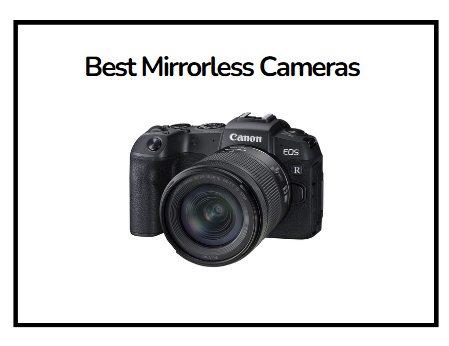
Choosing the best mirrorless cameras involves balancing factors like sensor performance, autofocus capabilities, video features, lens compatibility, and workflow efficiency to match your specific needs.
Mirrorless cameras have revolutionized photography by combining the image quality and versatility of traditional DSLRs with compact, lightweight designs.
Unlike their bulkier predecessors, mirrorless cameras eliminate the mirror mechanism, allowing for faster shooting speeds, advanced autofocus systems, and innovative features like in-body image stabilization and real-time exposure previews.
Whether you’re a professional photographer seeking cutting-edge performance, an enthusiast looking to upgrade, or a beginner wanting room to grow, today’s mirrorless cameras offer impressive capabilities across various price points and sensor sizes.
Here is a summary of the Best Mirrorless Cameras:
- Canon EOS R50 Mirrorless Camera – Best for Content Creators / Vlogging – Get it on Amazon
- Canon EOS R6 Mark II Mirrorless Camera – Best for Hybrid Photography and Video – Get it on Amazon
- Sony Alpha 1 II Full-Frame Mirrorless Camera – Best Premium / Professional Option – Get it on Amazon
- Panasonic LUMIX GH7 Mirrorless Camera – Best for Video Production / Filmmakers – Get it on Amazon
- Leica SL2 Mirrorless Camera – Best for High-Resolution Photography / Professional Studio Use – Get it on Amazon
- Sony Alpha a6400 Mirrorless Camera – Best for Fast Action / Autofocus Performance – Get it on Amazon
- FUJIFILM X-E5 Mirrorless Digital Camera – Best Stylish / Retro Design with IBIS – Get it on Amazon
- Canon EOS R100 Mirrorless Camera – Best Budget / Entry-Level Option – Get it on Amazon
- Nikon Z6 III Full-Frame Mirrorless Camera – Best Low-Light Performance / All-Rounder – Get it on Amazon
- Nikon Z 7II Full-frame Mirrorless Camera – Best High-Resolution / Landscape Photography – Get it on Amazon
What is a Mirrorless Camera?
A mirrorless camera is a type of digital camera that captures images without using the reflex mirror system found in traditional DSLR cameras. In a DSLR, light enters through the lens, bounces off a mirror, and is directed into an optical viewfinder. In contrast, a mirrorless camera sends light directly from the lens to the image sensor, which then displays a live image on an electronic viewfinder (EVF) or the rear LCD screen.
Because there is no mirror flipping up and down, what you see in the viewfinder is exactly what the sensor sees. This means photographers can preview exposure, white balance, color profiles, depth of field, and even focus effects in real time before pressing the shutter—something optical viewfinders cannot do.
Key advantages
Removing the mirror mechanism allows manufacturers to design cameras that are:
- Smaller and lighter than DSLRs
- Quieter, making them ideal for wildlife, events, and street photography
- Faster, since there’s no mirror movement limiting shooting speed
Modern mirrorless cameras also deliver professional-grade image quality, matching or exceeding DSLRs thanks to large sensors and advanced image processors.
Mirrorless cameras are now widely regarded as the industry standard in digital photography. Early concerns, such as weather sealing, cold-weather reliability, and durability—have largely been resolved. Today’s mirrorless systems commonly include:
-
Extremely fast continuous shooting (up to 40 frames per second)
-
AI-powered autofocus with face, eye, animal, and vehicle detection
-
In-body image stabilization (IBIS) for sharper handheld shots
-
Advanced video capabilities, including 4K and 8K recording, log profiles, and high frame rates
Battery life and trade-offs
One drawback of mirrorless cameras is shorter battery life compared to DSLRs, since the sensor and screen or EVF are always active. However, improved battery technology and USB-C charging have made this less of an issue for most users.
Why Mirrorless Cameras Dominate today
With advantages like real-time exposure previews, cutting-edge autofocus, compact design, and strong photo/video performance, mirrorless cameras have become the preferred choice for both professionals and enthusiasts. As a result, many manufacturers have scaled back or discontinued DSLR development in favor of fully mirrorless systems.
In short, a mirrorless camera combines modern technology, portability, and precision, making it the go-to camera format for today’s photographers and videographers.
Best Mirrorless Cameras
1) Canon EOS R50 Mirrorless Camera
Get it on Amazon
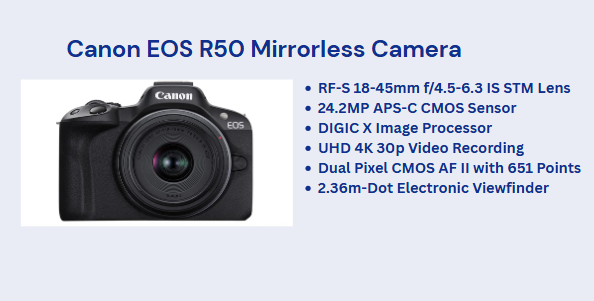
The Canon EOS R50 is the best mirrorless camera, delivering an impressive balance of image quality, speed, and ease of use in a compact and lightweight body. Designed with beginners and content creators in mind, this camera makes it easy to capture high-quality photos and videos without a steep learning curve, while still offering performance that more experienced users can appreciate.
Image quality is a major strength of the EOS R50. It features a 24.2-megapixel APS-C CMOS sensor paired with Canon’s DIGIC X processor, producing images with excellent clarity, accurate colors, and pleasing detail.
Whether shooting everyday scenes, portraits, or travel photos, the camera consistently delivers clean results, while its processing power helps maintain good performance across a wide range of lighting conditions.
For action, wildlife, or candid moments, the EOS R50 offers impressive speed for its class. Continuous shooting reaches up to 12 frames per second with the electronic first curtain shutter, and up to 15 frames per second with the silent electronic shutter.
This makes it well suited for capturing fast-moving subjects, sports, or energetic vlogging sequences where timing is critical.
Autofocus performance is another area where the EOS R50 shines. Dual Pixel CMOS AF II covers up to 100 percent of the frame with 651 autofocus zones, ensuring confident focus across the entire image area.
Advanced subject detection and tracking can recognize people, animals, and vehicles using deep learning technology, making focus acquisition reliable and accurate for both still photography and video recording.
Low-light shooting is supported by Advanced A+ Assist, which expands the range of auto-compatible scenes and helps the camera adapt to challenging conditions such as night scenes or strong backlighting. This allows users to capture usable, well-balanced images even when lighting is less than ideal, especially when working in automatic modes.
Video capabilities make the EOS R50 particularly appealing to creators and vloggers. It records uncropped 4K video oversampled from 6K at up to 30 frames per second, delivering sharp and detailed footage. Full HD recording is available at up to 120 frames per second for smooth slow-motion effects. Features like Movie for Close-up Demo Mode automatically shift focus to the nearest subject, which is especially useful for product demonstrations and talking-head content.
Framing and operation are comfortable and intuitive thanks to the 2.36-million-dot electronic viewfinder and the Clear View LCD II vari-angle touchscreen.
The screen allows easy composition from high, low, or front-facing angles, making it ideal for vlogging, selfies, and creative shooting perspectives. The interface is simple and smartphone-like, helping new users feel at ease quickly.
Connectivity is another strong point. Built-in Wi-Fi and Bluetooth allow easy pairing with smartphones and tablets through the Canon Camera Connect app.
This enables wireless image transfer, remote shooting, and quick sharing to social platforms, reinforcing the EOS R50’s role as a modern content creation camera.
Overall, the Canon EOS R50 stands out as a versatile and approachable mirrorless camera that delivers strong photo and video performance in a small, travel-friendly package. It is an excellent choice for beginners, vloggers, and anyone looking to step into Canon’s RF system with confidence.
Pros
- Excellent image quality from a 24.2-megapixel APS-C sensor
- Fast continuous shooting up to 15 fps
- Reliable Dual Pixel CMOS AF II with subject detection and tracking
- High-quality uncropped 4K video oversampled from 6K
- Compact, lightweight body with vari-angle touchscreen
- Easy wireless connectivity with smartphones
Cons
- No in-body image stabilization
2) Canon EOS R6 Mark II Mirrorless Camera
Get it on Amazon
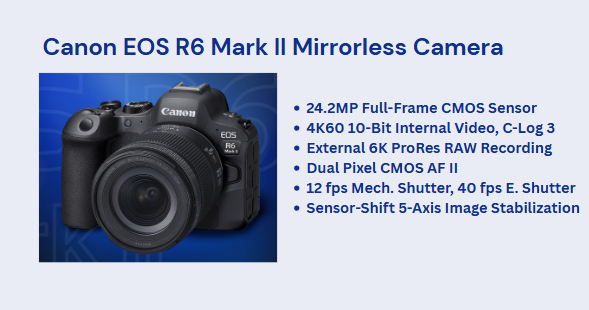
The Canon EOS R6 Mark II firmly earns its reputation as one of the best mirrorless cameras by blending professional-level performance with a flexible hybrid design suited for both still photography and video production. Designed to bridge everyday creativity and serious content creation, it appeals to photographers, filmmakers, and creators who want a reliable full-frame camera that adapts easily to different shooting styles.
Image quality is a major strength of the EOS R6 Mark II. It features a newly developed 24.2 megapixel full-frame CMOS sensor paired with the DIGIC X image processor, delivering detailed images with natural color reproduction and excellent dynamic range.
The native ISO range of 100 to 102400, expandable to 204800, allows confident shooting in challenging lighting conditions, making it a strong option for events, indoor photography, and low-light scenes.
Speed and responsiveness are well suited for action and wildlife work. The camera supports continuous shooting up to 12 frames per second with the mechanical shutter and up to 40 frames per second with the silent electronic shutter.
RAW burst mode with pre-shooting captures moments just before the shutter is fully pressed, helping ensure fleeting action is not missed. This level of performance makes the camera highly capable for sports, birds in flight, and fast-moving subjects.
Autofocus performance is refined and dependable thanks to Dual Pixel CMOS AF II. Coverage extends across nearly the entire frame with 1,053 autofocus zones, ensuring precise focus regardless of subject position.
Deep learning technology enables automatic detection and tracking of people, animals, and vehicles, with added recognition for subjects such as aircraft, trains, and horses. This makes subject tracking smooth and consistent for both stills and video.
Video capabilities are equally impressive. The EOS R6 Mark II records 10-bit 4K video at up to 60 frames per second internally, with support for Canon Log 3 for greater flexibility in color grading.
For advanced workflows, external 6K ProRes RAW recording is supported, making the camera suitable for professional video production. These features allow creators to move seamlessly between photography and high-quality filmmaking.
Stability and handling enhance real-world usability. Sensor-shift 5-axis image stabilization helps reduce camera shake, especially when shooting handheld or in low light.
Composition is comfortable through the 3.69-million-dot OLED electronic viewfinder and the 3-inch vari-angle touchscreen LCD with 1.62-million-dot resolution, which supports flexible shooting angles for both photos and video.
Practical features round out the camera’s appeal. Dual UHS-II memory card slots provide reliability and workflow flexibility, while built-in Wi-Fi and Bluetooth enable fast file transfer and remote operation. The multi-function shoe expands compatibility with modern accessories, further supporting hybrid shooting setups.
When paired with the compact RF24-105mm F4-7.1 IS STM lens, the EOS R6 Mark II becomes a versatile kit capable of covering a wide range of subjects.
Overall, the Canon EOS R6 Mark II stands out as a powerful and adaptable mirrorless camera that excels in image quality, speed, autofocus, and video performance.
It is an excellent choice for creators who want a full-frame camera that performs confidently across photography and filmmaking.
Pros
- Excellent full-frame image quality with wide ISO performance
- Extremely fast continuous shooting up to 40 fps
- Highly reliable autofocus with advanced subject detection
- Strong video features including 10-bit 4K60 and external RAW support
- Effective in-body image stabilization
- Solid connectivity and dual memory card slots
Cons
- Electronic shutter may show rolling shutter in some scenarios
3) Sony Alpha 1 II Full-Frame Mirrorless Interchangeable Lens Camera
Get it on Amazon
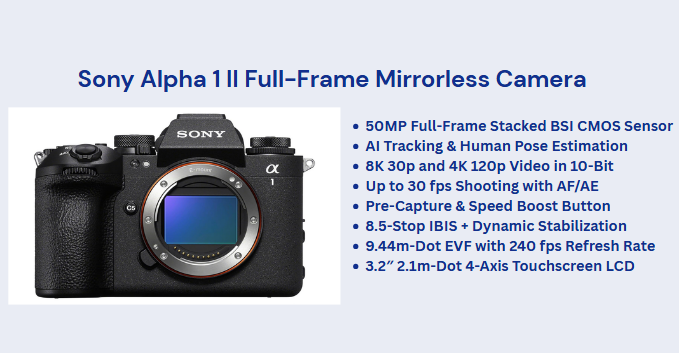
The Sony Alpha 1 II combines extreme resolution, incredible speed, and advanced intelligence in a single professional body for an incredible mirrorless camera experience. Built for photographers and filmmakers who demand uncompromising performance, it seamlessly handles everything from high-end commercial work to fast-paced wildlife and sports shooting.
Image quality is exceptional thanks to the 50.1 megapixel full-frame Exmor RS image sensor working in harmony with Sony’s BIONZ XR image processing engine and the company’s premium G Master lenses. Images display remarkable depth, lifelike color, and outstanding fine detail.
The high pixel count also provides impressive flexibility, delivering approximately 21 megapixels when shooting in APS-C mode or cropping, which is ideal for extending reach without sacrificing clarity.
Processing power plays a major role in the camera’s performance. The large volume of data produced by the sensor is handled in real time, enabling smooth operation even at extreme resolutions. Blackout-free viewing and continuous full autofocus and auto exposure tracking are maintained at speeds of up to 30 frames per second, allowing photographers to follow fast-moving subjects naturally and confidently.
Autofocus performance is elevated by a dedicated AI processing unit. Human recognition is enhanced through advanced pose estimation, improving accuracy when tracking eyes, faces, and body movement. In addition to people, the camera reliably recognizes animals, vehicles, and insects with high precision.
This significantly improves Real-time Recognition AF and Real-time Tracking, making subject acquisition fast and dependable in complex shooting environments.
Speed is another defining strength. Continuous shooting reaches up to 30 frames per second at the full 50.1 megapixel resolution, with autofocus and exposure calculations performed up to 120 times per second.
Blackout-free shooting ensures uninterrupted framing, giving a natural view of the scene and making it easier to capture decisive moments in action photography.
Video capabilities are equally impressive and designed for professional production. The camera can generate highly detailed 4K footage cropped from 8K source material using 8.6K oversampling. It supports internal 8K 4:2:2 10-bit recording in XAVC HS, with optional Full HD proxy files for efficient workflows.
Multiple 4K recording options are available, including full-frame and Super 35mm oversampled from 5.8K with full pixel readout and no pixel binning. XAVC S-I recording at up to 600 Mbps delivers exceptional image quality for demanding post-production needs.
Pros
- Extremely high-resolution 50.1 megapixel full-frame sensor
- Fast continuous shooting up to 30 frames per second
- Advanced AI-powered autofocus with broad subject recognition
- Blackout-free electronic viewfinder experience
- Professional-grade 8K and oversampled 4K video options
- Excellent flexibility for cropping and APS-C shooting
Cons
- Premium pricing limits accessibility
4) Panasonic LUMIX GH7 Mirrorless Camera
Get it on Amazon
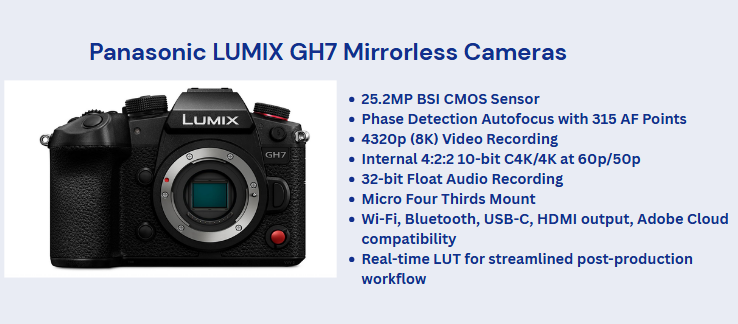
The Panasonic LUMIX GH7 secures its position as one of the best mirrorless cameras for serious video creators by pushing workflow efficiency and production quality to new levels. Built as a true professional tool, it delivers major advances in video performance while retaining the flexibility that has long defined the GH series.
This camera is designed for filmmakers, content creators, and small production teams who need reliability, speed, and creative freedom in demanding environments.
Image and video quality benefit from a 25.2 megapixel BSI CMOS sensor that delivers rich detail and a wide dynamic range with more than 13 stops of gradation. This allows the GH7 to capture vibrant highlights, smooth tonal transitions, and strong low-light performance.
Improved autofocus adds phase detection with Real-time Recognition AF, accurately tracking people, animals, cars, motorcycles, trains, and airplanes. This makes focusing more dependable for fast-moving subjects and dynamic shooting situations.
Workflow efficiency is a major strength of the LUMIX GH7. Internal recording of Apple ProRes RAW HQ at up to 5.7K 30p eliminates the need for external recorders, allowing creators to capture high-quality footage with minimal setup.
Improved gimbal compatibility further expands creative options, making the camera well suited for handheld and motion-based shooting styles.
Audio production is significantly simplified through support for 32-bit float recording when paired with the optional DMW-XLR2 adapter. This format captures an extremely wide dynamic range, from very quiet to very loud sounds, without requiring manual audio level adjustments during recording.
As a result, creators can focus on the shot rather than monitoring sound levels, saving time in both production and post.
The GH7 is built for extended recording sessions. It supports unlimited internal video recording at 4:2:2 10-bit C4K and 4K up to 60p when operated within recommended temperature limits.
Simultaneous internal and external recording via HDMI is also supported, offering redundancy and flexibility for professional workflows. This makes the camera ideal for interviews, live events, and long-form content.
Modern production demands are met with advanced connectivity features. Camera-to-cloud integration with Adobe Frame.io allows still images and proxy videos to be uploaded directly from the camera, enabling fast collaboration and backup in the cloud.
Live streaming options include wireless RTMP and RTMPS for outdoor use, as well as stable wired RTP and RTSP streaming for studio environments.
Creative control is further enhanced through Real-time LUT support. Users can apply LUTs directly to photos and videos in camera, enabling distinctive color styles straight out of the camera. Support for VLT and CUBE formats, along with compatibility with the LUMIX Lab app, makes it easy to create and install custom looks.
Open Gate recording allows all aspect ratios to be captured simultaneously, providing maximum flexibility for delivering content across multiple social media platforms from a single shoot.
For advanced cinema workflows, the GH7 also supports ARRI LogC3 recording through an optional software upgrade. This enables color matching with ARRI digital cinema cameras, offering rich color information and a wide dynamic range that integrates smoothly into professional post-production pipelines.
Overall, the Panasonic LUMIX GH7 is a powerful and forward-thinking mirrorless camera built around professional video creation. Its combination of high-quality imaging, advanced recording formats, efficient workflow tools, and modern connectivity makes it one of the strongest choices for creators who prioritize video performance without compromise.
Pros
- Internal Apple ProRes RAW and ProRes 422 HQ recording
- World-first 32-bit float audio recording support with optional adapter
- Wide dynamic range with detailed 25.2 megapixel sensor
- Reliable phase detection autofocus with broad subject recognition
- Unlimited 10-bit 4K recording for long production sessions
- Open Gate recording for multi-platform content delivery
Cons
- Advanced features may be excessive for casual users
5) Leica SL2 Mirrorless Camera
Get it on Amazon
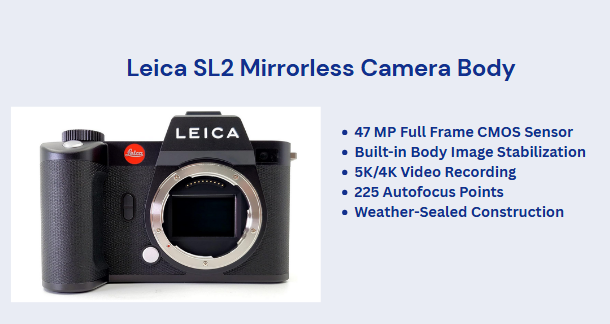
The Leica SL2 stands as one of the best mirrorless cameras for photographers and filmmakers who value uncompromising image quality, precision engineering, and a refined shooting experience. Designed and built in Germany, the SL2 blends classic Leica design philosophy with modern performance, delivering a professional camera system that feels equally at home in the studio, on location, or in demanding outdoor conditions.
Image quality is a defining strength of the Leica SL2. Its 47 megapixel full-frame CMOS sensor delivers outstanding resolution, fine detail, and rich tonal depth, making it well suited for landscape, commercial, and fine art photography.
With an ISO range from 50 to 50,000, the camera maintains excellent performance across a wide variety of lighting conditions. The Maestro III processor ensures responsive operation, fast burst shooting, and consistent image quality for both stills and video.
Stability and versatility are enhanced by built-in Body Image Stabilization. The sensor-shift system provides up to 5.5 stops of stabilization with all lenses, including adapted Leica lenses that previously lacked stabilization.
This allows photographers and videographers to shoot confidently at slower shutter speeds or in low light while maintaining sharp results and smoother footage.
Video performance places the SL2 firmly in the hybrid category. It records DCI 4K video across the full sensor at up to 60 frames per second, along with a cropped 5K mode in APS-C. Internal 10-bit recording with L-Log support delivers wide dynamic range and color depth suitable for professional post-production.
Cine Mode further tailors the camera to cinematic workflows by using familiar concepts such as shutter angle and ASA, helping filmmakers work more intuitively on set.
Autofocus is handled by a sophisticated contrast-detection system with 225 autofocus points. Face and body detection allow the camera to track moving subjects accurately, while Intelligent AF can lock onto still subjects and seamlessly begin tracking as soon as movement is detected. Users can also fine-tune autofocus behavior, adjusting tracking sensitivity and response to suit different shooting styles.
Handling and usability reflect Leica’s minimalist approach. A high-resolution 5.76-million-dot OLED electronic viewfinder offers a clear, immersive view for precise composition.
The large 3.2-inch rear LCD, combined with a streamlined menu system and the classic three-button control layout, makes operation fast and intuitive even in professional shooting environments.
The SL2 also supports demanding workflows beyond the camera body. Long exposure shooters benefit from the option to disable long exposure noise reduction, reducing downtime and allowing shutter speeds of up to 30 minutes.
Tethered shooting is supported through Capture One Pro, enabling photographers to control exposure settings, capture images remotely, and take advantage of advanced color editing tools in studio setups.
Overall, the Leica SL2 is a premium mirrorless camera that delivers exceptional still and video performance with a refined, durable design.
It is an ideal choice for professionals and enthusiasts who appreciate precision craftsmanship, high resolution imaging, and a camera system built to last.
Pros
- Exceptional 47 megapixel full-frame image quality
- Effective built-in image stabilization with all lenses
- Professional-grade 4K and 5K internal video recording
- High-resolution electronic viewfinder with excellent clarity
- Rugged weather-sealed construction and refined ergonomics
Cons
- Premium pricing limits accessibility
6) Sony Alpha a6400 Mirrorless Camera
Get it on Amazon
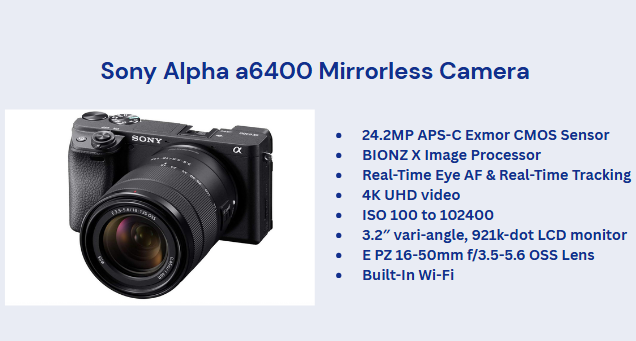
The Sony Alpha a6400 combines speed, image quality, and advanced autofocus into a compact APS-C body making it one of the best mirrorless cameras.
Designed for photographers, vloggers, and video creators, it delivers reliable performance for everyday shooting while offering professional features that support both stills and video production.
Image quality is driven by a 24.2 megapixel APS-C Exmor CMOS sensor paired with Sony’s BIONZ X image processing engine and a front-end LSI. This combination enables excellent detail, pleasing color reproduction, and strong low-light performance across a wide ISO range expandable up to 102400.
Copper wiring and an efficient circuit design improve light collection and readout speed, resulting in clean images and reduced noise even at higher sensitivities.
Autofocus performance is one of the a6400’s strongest attributes. Its advanced 4D FOCUS system achieves autofocus acquisition in as little as 0.02 seconds and uses 425 phase detection and 425 contrast detection points covering approximately 84 percent of the frame.
This dense coverage allows subjects to be tracked accurately as they move across the scene, making the camera highly capable for action, wildlife, and candid photography.
Real-time Eye AF and Real-time Tracking further enhance focusing accuracy. Using artificial intelligence, the camera detects and tracks eyes with impressive precision, maintaining focus on the subject even during movement. Users can select the left or right eye or allow automatic selection, which is especially useful for portraits.
Real-time Tracking analyzes color, depth, brightness, and face and eye information to keep focus locked on the subject with minimal effort.
Speed is another highlight of the Sony a6400. It supports continuous shooting at up to 11 frames per second with full autofocus and auto exposure tracking, or up to 8 frames per second in silent shooting mode.
A generous buffer allows long bursts of JPEG or RAW images, ensuring photographers can capture decisive moments without interruption.
Video capabilities make the a6400 a strong option for content creators. It records internal 4K video with full pixel readout and no pixel binning, using 2.4x oversampling from 6K data for sharp, detailed footage.
Support for HDR, S-Log profiles, and Full HD recording at up to 120 frames per second provides flexibility for creative video production and slow-motion effects. Fast Hybrid AF ensures smooth and reliable focus transitions during video recording.
Handling and usability are well suited for solo creators and vloggers. The 180-degree tiltable touchscreen LCD allows easy self-recording and composition from a variety of angles.
Touch functionality enables intuitive focus control, subject tracking, and shutter release, while built-in Wi-Fi supports fast file transfer and remote camera control.
Overall, the Sony Alpha a6400 delivers an impressive mix of speed, autofocus intelligence, and video performance in a compact and lightweight design.
It remains a highly capable mirrorless camera for photographers and creators seeking reliability and versatility in a portable system.
Pros
- Excellent image quality from a 24.2 megapixel APS-C sensor
- Extremely fast and accurate autofocus with advanced subject tracking
- Strong continuous shooting performance up to 11 fps
- High-quality oversampled 4K video with professional profiles
- Compact body with a fully tiltable touchscreen
- Reliable wireless connectivity for sharing and remote use
Cons
- No in-body image stabilization
7) FUJIFILM X-E5 Mirrorless Digital Camera
Get it on Amazon
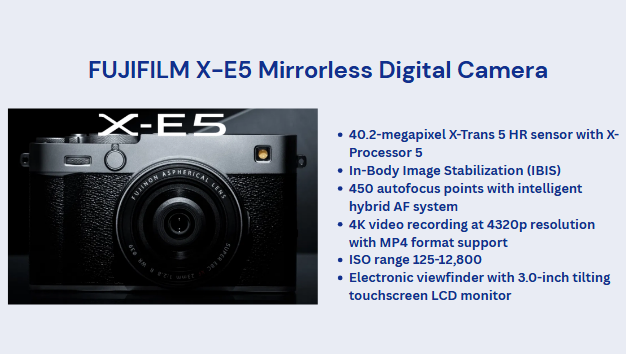
The FUJIFILM X-E5 is crafted for photographers who appreciate tactile controls and refined aesthetics, it delivers a shooting experience that feels both nostalgic and thoroughly modern, all within a compact and beautifully finished body.
Design and handling are a major part of the X-E5’s appeal. The machined aluminum top plate reflects the timeless style of film rangefinder cameras, offering a premium look and a reassuring sense of durability.
Analog-style dials provide quick access to core shooting functions, while thoughtful details such as the Bluetooth connectivity button placed on the base, reminiscent of a film rewind button, reinforce the camera’s heritage-inspired character.
Creative control is elevated by the introduction of a customizable Film Simulation dial, a first for the X Series. Positioned beneath the aluminum top plate with a circular window for easy viewing, this dial allows fast switching between Fujifilm’s renowned Film Simulation modes, delivering rich color and distinctive looks straight out of the camera.
Three customizable positions enable users to save and recall their own film recipes instantly, making the X-E5 especially appealing to photographers who value consistent in-camera results.
Low-light performance benefits greatly from in-body image stabilization. The X-E5 features a newly developed IBIS system that provides up to seven stops of stabilization at the center of the frame and six stops at the edges.
An updated algorithm and improved gyro sensor work together to reduce camera shake, helping ensure sharp images when shooting handheld in dim environments or with slower shutter speeds.
Image quality is exceptional thanks to the latest 40.2 megapixel X-Trans 5 HR sensor paired with the X-Processor 5 imaging engine. This combination delivers high resolution, refined detail, and excellent color reproduction, along with a lower base ISO of 125 for greater flexibility in bright conditions.
Deep learning AI-powered subject detection autofocus expands focusing accuracy across a wider range of subjects, improving reliability for both stills and everyday action.
The high-resolution sensor also unlocks additional in-camera versatility through a two-step digital teleconverter. By cropping into the sensor, photographers can achieve 1.4x or 2x zoom options while retaining impressive image quality, providing extra reach without changing lenses. This feature adds convenience for travel, street, and documentary photography.
Overall, the FUJIFILM X-E5 stands out as a mirrorless camera that prioritizes design, creative expression, and advanced imaging performance. It is an excellent choice for photographers who value hands-on controls, distinctive color science, and modern features wrapped in a compact, beautifully crafted body.
Pros
- High-resolution 40.2 megapixel sensor with excellent image quality
- Elegant rangefinder-style design with premium aluminum construction
- Customizable Film Simulation dial with user-defined presets
- Effective in-body image stabilization for low-light shooting
- Advanced AI-powered subject detection autofocus
Cons
- High-resolution files require more storage and processing power
8) Canon EOS R100 Mirrorless Camera
Get it on Amazon
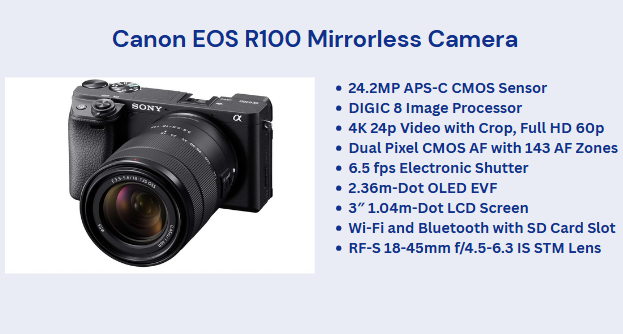
The Canon EOS R100 earns its place among the best mirrorless cameras as an accessible and lightweight entry into Canon’s EOS R system. Designed for beginners, students, and everyday shooters, it delivers solid image quality, modern autofocus, and 4K video in a compact body that is easy to carry and simple to use.
Image quality is a strong point for a camera in this class. The EOS R100 features a 24.1 megapixel APS-C CMOS sensor that produces sharp images with pleasing color and natural background blur. Paired with the DIGIC 8 image processor, the camera delivers reliable performance for everyday photography, from family moments to travel and casual portrait work.
Portability is one of the EOS R100’s biggest advantages. It is the smallest and lightest camera in the EOS R series, making it ideal for users who want a capable interchangeable-lens camera without the bulk of larger systems. Despite its compact size, the grip offers a secure and comfortable hold, helping maintain stability during shooting.
Autofocus performance is well suited for both photos and video. Dual Pixel CMOS AF covers a wide area with up to 143 autofocus zones, providing accurate and smooth focusing. Face and eye detection for people improves portrait results, while added animal and vehicle detection brings modern autofocus capabilities to an entry-level camera.
Continuous shooting reaches up to 6.5 frames per second when using One-Shot AF, allowing users to capture everyday action with confidence.
Video features make the EOS R100 an appealing option for beginners interested in content creation. It records 4K video at up to 24 frames per second and Full HD video at up to 60 frames per second.
High-frame-rate HD recording at approximately 120 frames per second enables smooth slow-motion playback, adding creative flexibility for short videos and social media content.
The shooting experience is enhanced by a precise electronic viewfinder. The 0.39-inch OLED EVF with approximately 2.36 million dots provides a clear and detailed view for composing images, even in bright outdoor conditions. Silent Mode allows quiet operation, making it suitable for events, performances, or capturing candid moments without distraction.
Connectivity options further strengthen the EOS R100’s appeal. Built-in Bluetooth and Wi-Fi allow easy pairing with smartphones through the Canon Camera Connect app for remote shooting, image transfer, and quick sharing. Bluetooth also enables GPS location data from a connected phone to be embedded in images.
Support for the image.canon service allows automatic uploading and forwarding of photos and videos, streamlining backup and workflow across devices.
Overall, the Canon EOS R100 is a practical and affordable mirrorless camera that delivers solid performance in a compact package.
It is an excellent starting point for anyone looking to move beyond smartphone photography and explore interchangeable-lens cameras with dependable image quality and modern connectivity.
Pros
- Good image quality from a 24.1 megapixel APS-C sensor
- Extremely compact and lightweight design
- Reliable Dual Pixel autofocus with face and eye detection
- Useful 4K and high-frame-rate HD video options
- Built-in electronic viewfinder and silent shooting mode
- Strong wireless connectivity and cloud integration
Cons
- Limited continuous shooting speed for fast action
9) Nikon Z6 III Full-Frame Mirrorless Camera
Get it on Amazon
The Nikon Z6 III secures its position among the best mirrorless cameras by delivering a powerful balance of speed, image quality, and professional video capability in a compact full-frame body. Designed for photographers and creators who demand accuracy and responsiveness, it represents a major step forward for the Z6 line, offering performance that confidently covers action, portraits, low-light work, and advanced video production.
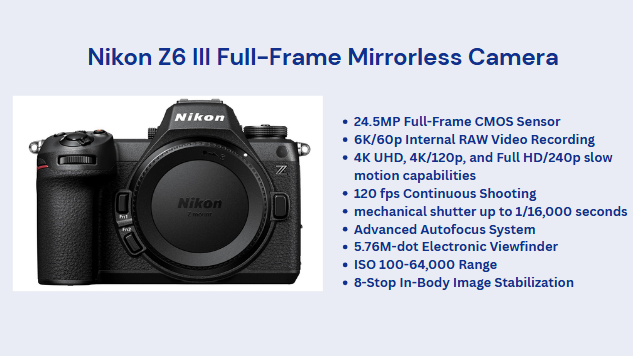
Image quality is driven by a 24.5 megapixel full-frame CMOS sensor with a partially stacked design, paired with the EXPEED 7 image processing engine. This combination enables exceptional detail, strong dynamic range, and refined color rendering across a wide range of shooting conditions.
The native ISO range of 100 to 64000, expandable to ISO 204800, delivers impressive low-light performance with effective noise control, making the Z6 III a reliable choice for night photography and dimly lit environments.
Speed and responsiveness define the shooting experience. The Z6 III supports continuous shooting up to 120 frames per second with the electronic shutter, along with a mechanical shutter speed reaching 1/16,000 of a second. This level of performance allows photographers to freeze fast-moving subjects with confidence.
A Pre-Release Capture function adds another layer of reliability by saving JPEG frames from moments just before and after the shutter is fully pressed, reducing the risk of missing critical action.
Autofocus performance is significantly enhanced with an advanced system featuring 299 autofocus points and sensitivity down to minus 10 EV. Powered by deep learning technology, the camera offers automatic recognition of up to nine subject types, including highly accurate face and eye detection even when subjects appear very small within the frame.
Autofocus remains dependable in backlit scenes and low-light situations, delivering consistent tracking for both stills and video.
The electronic viewfinder is among the most impressive available, offering a 5.76 million dot resolution, a maximum brightness of 4000 nits, and a refresh rate up to 120 frames per second.
This results in a clear, smooth, and color-accurate viewing experience, even in bright outdoor conditions. Coverage equivalent to the DCI-P3 color gamut ensures natural and precise tonal reproduction, supporting critical composition and exposure decisions.
Video creators benefit from extensive professional features. The Z6 III supports internal 6K at 60p RAW video recording, along with oversampled 4K UHD, 4K at 120p, and Full HD at 240p for slow motion capture.
In-camera RAW recording, high resolution digital zoom options, line-in audio support, and professional monitoring tools make it well suited for serious filmmaking. Compatibility with industry-standard rigs and accessories further expands its production flexibility.
In-body image stabilization enhances handheld shooting with up to eight stops of vibration reduction, supported by Focus Point VR for improved sharpness around the active focus area.
The camera body is built for durability, rated to operate in cold conditions down to minus 10 degrees Celsius and offering dust and drip resistance comparable to higher-end Nikon models.
A vari-angle touchscreen LCD, dual card slots for SD UHS-II and CFexpress Type B or XQD, and camera to cloud connectivity through Nikon Imaging Cloud complete a well-rounded and professional feature set.
Pros
- Excellent full-frame image quality with strong low-light performance
- Extremely fast continuous shooting up to 120 frames per second
- Advanced autofocus with deep learning subject recognition
- Industry-leading electronic viewfinder with high brightness and resolution
- Powerful in-body image stabilization for handheld shooting
- Extensive professional video features including 6K RAW recording
Cons
- CFexpress media can be costly for new users
10) Nikon Z 7II Full-frame Mirrorless Camera
Get it on Amazon
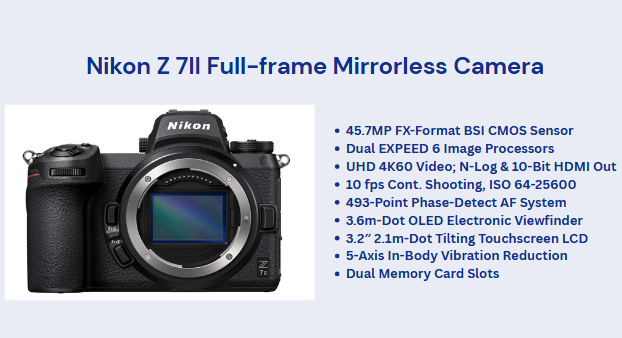
The Nikon Z 7II is a high-resolution full-frame mirrorless camera designed for photographers who demand precision, flexibility, and advanced functionality. With a 45.7-megapixel sensor, the Z 7II delivers incredible detail and image quality suitable for professional work, from landscape and studio photography to high-end portraits and commercial assignments.
Autofocus performance and subject acquisition have been significantly improved over the original Z 7. The camera can track and lock onto subjects with speed and accuracy, and faster continuous shooting combined with 3.3 times the original buffer capacity allows photographers to capture extended sequences without missing critical moments.
Dual card slots support CFexpress/XQD and UHS-II SD cards, providing security and flexibility for professional work, especially when shooting weddings, events, or other important assignments.
The camera is built for comfort and durability. Thoughtful design choices ensure the body is easy to handle during long shoots, and the Z 7II is compatible with Nikon’s vertical battery grip for extended power and easier vertical shooting.
USB-C constant power and charging further enhance usability for extended timelapses, live streams, or video shoots without worrying about battery life.
Video capabilities are strong, with 4K UHD recording at up to 60 frames per second. Smooth motion capture and the ability to slow down 4K footage in post-production make the Z 7II a versatile tool for hybrid shooters.
Its compatibility with the growing line of NIKKOR Z lenses, as well as approximately 360 F-mount NIKKOR lenses using the FTZ mount adapter, ensures a wide range of creative possibilities.
Overall, the Nikon Z 7II combines exceptional image quality, robust autofocus, and professional-level features in a camera that is both reliable and versatile.
It is an excellent choice for photographers seeking a high-resolution full-frame mirrorless system capable of meeting demanding professional needs.
Pros
- Extremely high-resolution 45.7MP full-frame sensor
- Improved autofocus and fast continuous shooting with large buffer
- Dual card slots for flexibility and security
- 4K UHD 60p video with smooth motion and slow-motion capability
- Compatible with NIKKOR Z lenses and F-mount lenses via FTZ adapter
- Comfortable, durable body with vertical grip compatibility and USB-C charging
Cons
- High-resolution sensor may slow down workflow for casual shooters
Read Also: 5 Best Long Range Shooting Camera Systems
Factors to Consider when Choosing the Best Mirrorless Cameras
Here are the most important factors to consider when choosing the best mirrorless camera:
Sensor Type and Resolution
The sensor is the core of any camera, and its type and resolution greatly influence image quality. Full-frame sensors capture more light and detail, offering better low-light performance and dynamic range, while APS-C or smaller sensors provide lighter, more compact systems.
High-resolution sensors allow for large prints and extensive cropping flexibility, but they may generate larger files that require more storage and processing power. Choosing the right sensor depends on your intended use, whether it’s professional photography, casual shooting, or videography.
Autofocus Performance
Autofocus speed, accuracy, and tracking capabilities are essential, particularly for action, wildlife, or sports photography. Modern mirrorless cameras often feature advanced AF systems with hundreds of focus points, face and eye detection, and AI-assisted subject tracking.
Fast and reliable autofocus ensures that moving subjects remain sharp and in focus, while sophisticated detection technologies can improve performance in low-light conditions or when subjects are partially obscured.
Continuous Shooting and Shutter Speed
The camera’s ability to capture rapid sequences, measured in frames per second (fps), is important for capturing fast action moments. Electronic and mechanical shutters offer different advantages, with electronic shutters enabling silent operation and ultra-fast speeds.
Higher continuous shooting rates combined with quick shutter speeds allow photographers to freeze motion and capture fleeting expressions or sports sequences without motion blur.
Video Capabilities
Video features are crucial for hybrid shooters or content creators. Important considerations include resolution options (such as 4K or higher), frame rates, color depth, and the ability to record in professional formats.
Oversampling, slow-motion recording, and in-camera stabilization enhance video quality, while options like high-bit-rate recording and external audio inputs improve post-production flexibility. A camera that performs well in both stills and video allows for versatile creative projects.
Image Stabilization
In-body image stabilization (IBIS) reduces blur caused by camera shake, especially in low-light environments or when using longer lenses. Effective stabilization allows for slower shutter speeds while maintaining sharpness, which is beneficial for handheld shooting and video recording.
The performance of stabilization systems can vary, with some offering multiple stops of compensation and advanced tracking for moving subjects, making this a critical factor for portability and versatility.
Electronic Viewfinder and LCD Display
The quality of the electronic viewfinder (EVF) and rear LCD screen affects composition, focus accuracy, and usability in bright or low-light conditions. High-resolution EVFs with fast refresh rates provide clear, lifelike previews of the scene and help with precise framing and focus.
Vari-angle or fully articulating touchscreens improve flexibility for shooting from unconventional angles or vlogging, while touch functionality often enhances focus control and menu navigation.
Lens Compatibility and System Expansion
A camera is only as versatile as its lens ecosystem. Access to a wide range of lenses, including prime, zoom, and specialty options, is important for adapting to different shooting scenarios. Compatibility with older lenses through adapters can further expand creative possibilities.
Considering the available lens options and the potential for future expansion ensures that the camera system can grow with your photography needs.
Connectivity and Workflow Features
Modern mirrorless cameras often include wireless connectivity, cloud integration, and remote control functionality, which streamline workflows and sharing.
Built-in Wi-Fi or Bluetooth allows file transfer to mobile devices or remote operation, while cloud services can automate backup and organization.
Workflow-focused features such as dual card slots, in-camera RAW recording, and efficient file management also enhance productivity for professional photographers and content creators, reducing the risk of lost images or inefficient post-processing.
Best Mirrorless Cameras FAQs
What should I look for in a mirrorless camera for both photography and video?
When choosing a mirrorless camera for hybrid use, focus on sensor size and resolution, autofocus performance, image stabilization, and video capabilities. A high-resolution sensor ensures detailed photos, while advanced autofocus and tracking systems keep both moving subjects and videos in sharp focus.
In-body stabilization helps reduce blur for handheld shooting, and features such as 4K or higher video, slow-motion recording, and professional codec support allow for versatile video production. Articulating LCD screens and high-quality electronic viewfinders further enhance composition for both stills and video.
How important is lens compatibility when selecting a mirrorless camera?
Lens compatibility is a critical factor because the lenses define the creative possibilities of your camera. A wide selection of native lenses allows you to cover different focal lengths, apertures, and specialty options such as macro, wide-angle, or telephoto.
Additionally, the ability to use older lenses through adapters adds flexibility and expands your system without needing to invest in entirely new glass. Choosing a camera system with a strong and growing lens ecosystem ensures long-term versatility and future-proofing for your photography and videography needs.
Are connectivity and workflow features necessary in a mirrorless camera?
Yes, connectivity and workflow features can significantly improve efficiency, especially for professionals or content creators. Wireless options such as Wi-Fi and Bluetooth allow easy transfer of images and remote camera control.
Cloud integration can automate backup and sharing, while dual card slots and in-camera RAW recording provide redundancy and storage flexibility.
Efficient workflow features reduce the risk of lost files and make it easier to manage high-resolution photos and video footage, allowing creators to focus more on shooting and less on technical logistics.
Final Thoughts
The mirrorless camera market continues to evolve rapidly, with manufacturers pushing boundaries in autofocus technology, video capabilities, and computational photography.
While the “best” camera ultimately depends on your specific needs—whether that’s portability, resolution, video features, or lens ecosystem—the current generation of mirrorless cameras represents an exciting time for photographers.
By carefully considering your shooting style, budget, and long-term goals, you will be able to settle on a mirrorless system that not only meets your current needs but will continue to inspire your creative vision for years to come.

Albert, the founder of Outdoormoran, is a dedicated outdoor enthusiast with a passion for delivering the most current, accurate, and easy-to-understand information on all different outdoor gear and optics. He shares his expertise with beginners by teaching the technical aspects of outdoor gear and optics through his comprehensive collection of guides.