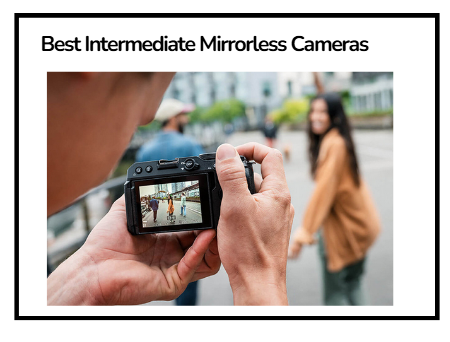
Moving beyond a beginner camera is both thrilling and overwhelming, and picking the right mirrorless camera is usually the first major choice you’ll face. The best intermediate mirrorless cameras are a game-changer for photographers looking to elevate their skills to the next level without investing in professional gear.
In this guide, we’ll explore the best intermediate mirrorless cameras available today, highlighting key features, performance factors, and tips to help you make an informed choice that suits your photography style and budget. Read on to make the right purchase.
Here is a summary of the Best Intermediate Mirrorless Cameras:
- Canon EOS R100 Mirrorless Camera — Best Budget-Friendly Intermediate Option – Get it on Amazon
- Canon EOS R50 Mirrorless Camera — Best for Canon Enthusiasts & Vlogging – Get it on Amazon
- Sony Alpha a6400 Mirrorless Camera — Best All-Around APS-C Performer – Get it on Amazon
- Sony Alpha A6100 Camera — Best Entry-Level APS-C Step-Up – Get it on Amazon
- FUJIFILM X-T30 III Mirrorless Camera — Best for Image Quality & Color Science – Get it on Amazon
- Panasonic LUMIX GH5 4K Digital Camera — Best for Video & Hybrid Creators – Get it on Amazon
- Panasonic LUMIX G7 4K Digital Camera — Best Value 4K Video Option – Get it on Amazon
- Sony Alpha 7 IV Camera — Best Premium Full-Frame Intermediate Camera – Get it on Amazon
What is a Mirrorless Camera?
A mirrorless camera is a type of digital camera that, unlike a DSLR, does not have a mirror mechanism inside the body. In a DSLR, light enters through the lens and bounces off a mirror into an optical viewfinder, but in a mirrorless camera, the light goes straight to the image sensor. This fundamental difference leads to several advantages including portability and speed for photographers and videographers.
Benefits of Mirrorless Cameras for Intermediates
Mirrorless cameras offer numerous benefits for intermediates that include:
1. Compact and Lightweight. Without the mirror and optical viewfinder system, mirrorless cameras are generally smaller and lighter than DSLRs, making them easier to carry for travel, street photography, or long shooting sessions.
2. Electronic Viewfinder (EVF). Instead of looking through a glass optical viewfinder, mirrorless cameras use an EVF or the rear LCD screen to display a live preview of your shot. This allows you to see exactly how exposure, white balance, and color settings will look before taking the photo.
3. Faster Autofocus. The best intermediate mirrorless cameras often use on-sensor phase detection or hybrid autofocus systems, which provide faster and more accurate focusing, especially for moving subjects. Many models also include eye and face detection, making portraits much easier.
4. Silent Shooting. Without a mirror flipping up and down, you can shoot in silent mode. This feature is useful for events, wildlife photography, or any situation where noise could be disruptive.
5. Stunning Video Performance. Mirrorless cameras are typically superior for video because the sensor can directly capture live images for high-quality recording. Many intermediate models also support 4K video, slow-motion, and other advanced features that appeal to vloggers and content creators.
6. Future-Proof System. Mirrorless systems are becoming the industry standard, with most manufacturers focusing on lens and accessory development for these cameras. Choosing a mirrorless camera often means better long-term support and more options for upgrades.
Best Intermediate Mirrorless Cameras
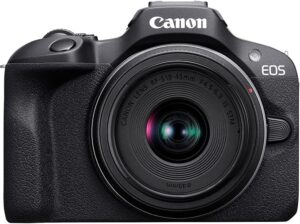
1) Canon EOS R100 Mirrorless Camera
Get it on Amazon
The Canon EOS R100 is the best intermediate mirrorless camera. It delivers impressive performance for beginners and casual photographers looking to step up from a smartphone or compact camera.
The compact and lightweight design makes it highly portable, while the intuitive controls and touchscreen interface make navigating settings straightforward.
Furthermore, the included RF-S18-45mm lens offers versatile focal lengths for everyday shooting, from landscapes to portraits, and the camera’s 24.2MP APS-C sensor captures detailed, vibrant images with good dynamic range.
Additionally, the EOS R100 supports Full HD video recording at 60fps, making it suitable for casual vlogging or content creation. Autofocus performance is smooth and reliable, especially with face and eye detection, helping users achieve sharp focus quickly even in changing environments.
While not a professional-grade camera, the Canon EOS R100 stands out for its ease of use and solid image quality. Battery life is decent, allowing for a full day of casual shooting, though heavy video recording requires extra batteries.
Above all, the camera also features built-in Wi-Fi and Bluetooth for simple file transfer and remote control, making it convenient for social media sharing.
Pros
- Lightweight and portable design
- Easy-to-use touchscreen interface
- Good 24.2MP image quality
- Reliable autofocus with face/eye detection
- Versatile RF-S18-45mm kit lens
- Full HD video recording at 60fps
- Built-in Wi-Fi and Bluetooth for sharing and remote control
Cons
-
Lacks in-body image stabilization
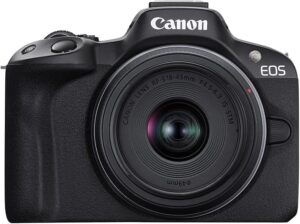
2) Canon EOS R50 Mirrorless Camera
Get it on Amazon
The Canon EOS R50 Mirrorless Camera offers a compact, versatile, and beginner-friendly option for photographers and content creators alike.
Its lightweight design makes it easy to carry around for travel, vlogging, or everyday shooting, while the intuitive touchscreen interface simplifies navigation and settings adjustments.
The camera features a powerful APS-C sensor that delivers sharp, vibrant images with excellent color accuracy and dynamic range. This make it suitable for both still photography and video recording.
Furthermore, the included RF-S18-45mm lens provides a flexible zoom range, ideal for landscapes, portraits, and casual photography, while maintaining a fast and responsive autofocus system that locks onto subjects with precision.
If you are a video enthusiast, you will appreciate the R50’s impressive 4K recording capabilities and smooth frame rates, which allow for high-quality footage without excessive cropping.
The camera also supports built-in Wi-Fi and Bluetooth connectivity, making it easy to transfer files and control the camera remotely via a smartphone.
Pros
- Lightweight and portable design
- Excellent APS-C sensor image quality
- Fast and accurate autofocus
- 4K video recording capability
- User-friendly touchscreen interface
- Wi-Fi and Bluetooth connectivity for easy sharing
Cons
-
Limited physical control dials compared to higher-end models
3) Sony Alpha a6400 Mirrorless Camera

Get it on Amazon
The Sony Alpha a6400 is an advanced mirrorless camera that strikes a perfect balance between performance and portability.
It features a 24.2MP APS-C sensor, delivering sharp, vibrant images with excellent dynamic range, even in challenging lighting conditions.
Furthermore, the BIONZ X processor ensures fast image processing, while the autofocus system is one of the camera’s standout features.
With 425 phase-detection points and real-time Eye AF for humans and animals, tracking moving subjects has never been easier. Moreover, the tiltable 180-degree LCD screen is a boon for vloggers and content creators, allowing flexible framing for selfies, videos, or creative angles.
Regarding portability, the camera’s compact body and lightweight design make it ideal for travel and on-the-go photography, without compromising on image quality or control options.
Video capabilities are equally impressive, with 4K recording at 30fps and Full HD at 120fps for smooth slow-motion footage. The camera also supports S-Log3 and HLG picture profiles, giving creators more flexibility for color grading in post-production. It also include Wi-Fi, NFC, and Bluetooth connectivity options to make file transfer and remote shooting seamless.
Pros
- Excellent 24.2MP APS-C sensor with vibrant colors and sharp detail
- Fast and accurate autofocus with real-time Eye AF
- 4K video recording with S-Log3 and HLG support
- 180-degree tiltable LCD screen for vlogging and creative angles
- Compact and lightweight design ideal for travel
- Reliable continuous shooting at 11fps
Cons
-
No in-body image stabilization (IBIS)
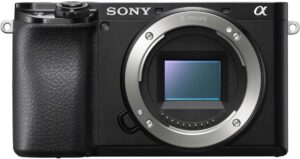
4) Sony Alpha A6100 Camera
Get it on Amazon
As one of the best intermediate mirrorless cameras, the Sony Alpha A6100 is a versatile mirrorless camera designed for both photography enthusiasts and content creators looking for high performance in a compact body.
It features a 24.2-megapixel APS-C sensor that delivers sharp, vibrant images with excellent color accuracy and low-light performance.
Furthermore, the camera boasts impressive autofocus capabilities, including real-time eye autofocus for humans and animals, making it effortless to capture fast-moving subjects. With a continuous shooting speed of up to 11 frames per second, this camera excels in action photography while maintaining crisp detail.
Its compact design and lightweight body make it highly portable, ideal for travel, street photography, or daily vlogging. Besides, video capabilities on the A6100 are equally impressive, offering 4K recording with full pixel readout and no pixel binning, which ensures clear and detailed footage.
The camera also brings to the table a fully articulating LCD screen, perfect for selfies and vlogging, along with a high-resolution electronic viewfinder for more traditional shooting styles.
Pros
- High-quality 24.2MP APS-C sensor
- Fast real-time eye autofocus for humans and animals
- 11 fps continuous shooting
- 4K video recording with full pixel readout
- Fully articulating touchscreen for vlogging and selfies
- Compact and lightweight for portability
- Strong connectivity options via Wi-Fi, Bluetooth, and USB-C
Cons
-
Limited in-body image stabilization
5) FUJIFILM X-T30 III Mirrorless Camera
Get it on Amazon
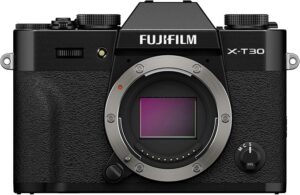
Next, we have the FUJIFILM X-T30 III Mirrorless Camera Body. This is a compact powerhouse that balances portability with professional-level imaging capabilities.
Its sleek, retro-inspired design houses a 26.1MP APS-C X-Trans CMOS 4 sensor, delivering crisp, vibrant images with excellent color reproduction and low-light performance.
Moreover, the camera excels in speed, offering 8 fps continuous shooting with the mechanical shutter and up to 30 fps with the electronic shutter. This makes it ideal for fast-moving subjects.
The X-T30 III also features FUJIFILM’s renowned film simulation modes, allowing photographers to produce cinematic color profiles straight out of the camera without extensive post-processing. Besides, the face and eye detection are precise and responsive thanks to the improved autofocus algorithms.
Video enthusiasts will also appreciate the 4K/30p recording capabilities and 1080p at 120 fps for smooth slow-motion footage, while the intuitive menu system and touchscreen interface make navigation simple and efficient.
Pros
- Compact, lightweight design
- Excellent image quality with 26.1MP X-Trans CMOS 4 sensor
- Fast and accurate autofocus with face/eye detection
- 4K video recording and 1080p slow-motion capability
- Wide range of film simulation modes
- Intuitive touchscreen and customizable controls
Cons
-
No full weather sealing
6) Panasonic LUMIX GH5 4K Digital Camera
Get it on Amazon
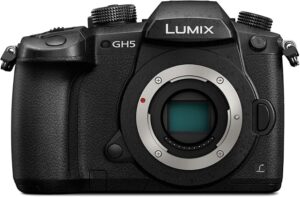
The Panasonic LUMIX GH5 is a powerhouse in the world of mirrorless cameras, designed for both professional videographers and serious photographers.
One of its impressive features is its ability to record 4K video at up to 60 frames per second, delivering ultra-smooth footage with incredible detail. Its 20.3-megapixel Micro Four Thirds sensor captures sharp stills with excellent dynamic range, making it versatile for a wide range of shooting conditions.
Furthermore, the camera boasts advanced in-body image stabilization, which significantly reduces shake, whether you’re shooting handheld video or taking photos in low light. Its fully articulating touchscreen makes composing shots from creative angles easy, and the robust weather-sealed body ensures durability in challenging environments.
Beyond video, the GH5 excels in connectivity and customization, offering dual SD card slots, a variety of photo and video formats, and extensive manual controls that give you complete creative freedom. Additionally, the autofocus system is fast and reliable, though it may occasionally struggle in very low-light conditions.
Above all, the camera’s ergonomics and grip are comfortable for extended use, making it ideal for long shoots.
Pros
- 4K video recording at up to 60 fps
- 20.3 MP Micro Four Thirds sensor with excellent image quality
- Advanced in-body image stabilization
- Fully articulating touchscreen
- Weather-sealed, durable body
- Dual SD card slots and extensive connectivity
- Fast and customizable autofocus
Cons
- Slightly larger and heavier than other mirrorless cameras
7) Panasonic LUMIX G7 4K Digital Camera
Get it on Amazon
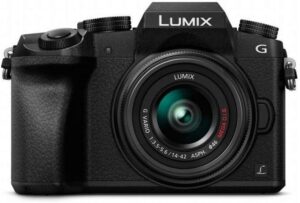
If you are looking for a reliable mirrorless camera for everyday photography and 4K videography. the Panasonic LUMIX G7 is a great option. It is a versatile mirrorless camera that strikes a balance between advanced features and affordability.
Its standout feature is 4K video recording at 30p, which allows for stunningly sharp footage and the ability to extract high-resolution stills from video clips. Furthermore, the camera’s 16-megapixel Micro Four Thirds sensor delivers detailed images with accurate colors, and the ISO range provides decent low-light performance for its class.
The fully articulated touchscreen adds flexibility for shooting at unconventional angles and makes navigating menus intuitive. Combined with a lightweight and compact body, the LUMIX G7 is comfortable for extended shooting sessions and travel.
In terms of performance, the G7 impresses with fast autofocus in good lighting and a responsive 8 frames-per-second burst mode, ideal for capturing action shots. Moreover, the electronic viewfinder offers a clear and detailed preview, making composition precise even in bright sunlight.
Pros
- 4K video recording with photo extraction
- Fully articulated touchscreen for flexible shooting angles
- Lightweight and compact design
- Fast 8 fps continuous shooting
- Built-in Wi-Fi for easy sharing and remote control
Cons
-
The low-light performance is limited compared to higher-end cameras
8) Sony Alpha 7 IV Camera
Get it on Amazon
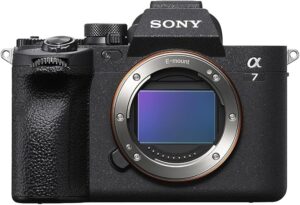
The Sony Alpha 7 IV is our last recommendation for the best intermediate mirrorless cameras.
As a highly capable hybrid camera, it excels in stills, video, and live streaming scenarios. This make it a reliable choice for enthusiasts and professionals alike.
Furthermore, the camera is equipped with a 33-megapixel back-illuminated sensor that delivers exceptional image quality with impressive dynamic range and low-light performance. The fast and accurate autofocus system covers almost the entire frame and excels at tracking moving subjects.
Furthermore, the 5-axis in-body image stabilization ensures sharp shots even in challenging conditions, making it an ideal choice for both handheld photography and videography.
Regarding construction, its robust build, weather sealing, and ergonomic design give it a professional feel while remaining surprisingly comfortable for extended shoots.
On the video side, the Alpha 7 IV supports 4K 60p recording with 10-bit 4:2:2 color, offering filmmakers excellent flexibility and cinematic quality straight out of the camera. The fully articulating touchscreen, advanced connectivity options, and real-time eye autofocus for humans and animals further make it versatile for vloggers and content creators.
Pros
- Excellent image quality with 33MP full-frame sensor
- Advanced autofocus with real-time eye tracking for humans and animals
- 5-axis in-body image stabilization
- 4K 60p video recording with 10-bit 4:2:2 color
- Fully articulating touchscreen for vlogging and creative angles
- Robust, weather-sealed body
- Dual card slots for flexible storage
Cons
-
Slightly complex menu system
Next Read: 10 Best Full Frame Mirrorless Cameras
Criteria for Choosing the Best Intermediate Mirrorless Cameras
When selecting an intermediate mirrorless camera, consider these factors:
Image Quality
One of the most important factors to consider is image quality. This depends largely on the sensor size and resolution, which determine how detailed your photos will be and how well the camera performs in low-light conditions. For intermediate users, a camera with an APS-C or full-frame sensor often strikes the best balance between image quality and affordability.
Autofocus Performance
Another key criterion is autofocus performance. A reliable and fast autofocus system allows you to capture sharp images, especially for moving subjects or during spontaneous moments. Look for cameras with advanced tracking and face/eye detection features to make your shooting experience smoother and more enjoyable.
Lens Availability and Compatibility
Next, consider lens availability and compatibility. Even if a camera body is excellent, the overall potential of your photography depends on having a wide selection of lenses, including primes and zooms. Consider the ecosystem of the brand, third-party lens support, and future upgrades when making a choice.
Ergonomics and Handling
Furthermore, ergonomics and handling play a significant role in your comfort during extended shooting sessions. The best intermediate mirrorless cameras should feel balanced in hand, with intuitive controls and a well-placed grip. Touchscreen interfaces, customizable buttons, and a tilting or fully articulating LCD are other key features that enhance usability.
Video Capabilities
Video capabilities are increasingly important, even for photographers. Check for features like 4K recording, frame rate options, and clean HDMI output if you plan to integrate video into your work. Cameras that support high-quality audio inputs or stabilization can give you more flexibility for content creation.
Viewfinder and LCD Quality
The viewfinder and LCD quality are essential for precise composition and reviewing your work. A high-resolution electronic viewfinder (EVF) helps with accurate focus and exposure adjustments, while a bright, responsive LCD screen aids in live view shooting and framing challenging angles.
Battery Life and Portability
Moreover, battery life and portability are practical considerations for intermediate users who may shoot for longer sessions or travel frequently. The best intermediate mirrorless cameras typically consume more power than DSLRs, so choosing one with a larger battery or the option for portable charging can prevent interruptions. Weight and size also matter if you want a camera that’s easy to carry without compromising performance.
Connectivity
Finally, connectivity and extra features enhance convenience and creativity. Wi-Fi, Bluetooth, and USB-C support allow for quick sharing, remote control, and firmware updates. Other features like in-body image stabilization (IBIS), weather-sealing, and customizable shooting modes add versatility, making the camera more adaptable as your skills grow.
FAQs
What makes a mirrorless camera “intermediate”?
An intermediate mirrorless camera typically offers more advanced features than entry-level models, such as faster autofocus, higher-resolution sensors, better build quality, and more manual control options. It’s ideal for users who want to grow their photography skills without jumping straight to professional-grade equipment.
Should I choose APS-C or full-frame for an intermediate camera?
Both APS-C and full-frame sensors have advantages. APS-C cameras are generally more affordable, compact, and still produce excellent image quality. Full-frame sensors deliver better low-light performance, wider dynamic range, and shallower depth of field but tend to be larger and pricier. Your choice depends on your budget and photography style.
Do intermediate mirrorless cameras shoot good video?
Yes. Most intermediate mirrorless cameras can shoot 4K video with decent frame rates and features like focus tracking. Some even support external microphones, image stabilization, and clean HDMI output for higher-quality video production.
Final Words
The best intermediate mirrorless camera combines portability, speed, and modern technology, making them a great choice for photographers and videographers looking to move beyond entry-level cameras. Look at the features that make each camera the right model for your skills and choose one that not only improves your photography today but also gives you room to expand as your skills evolve.

Albert, the founder of Outdoormoran, is a dedicated outdoor enthusiast with a passion for delivering the most current, accurate, and easy-to-understand information on all different outdoor gear and optics. He shares his expertise with beginners by teaching the technical aspects of outdoor gear and optics through his comprehensive collection of guides.