Join me as we look at the Best Garmin Transducers.
Choosing the best Garmin transducers will significantly improve your fishing success by providing accurate, real-time sonar data beneath and around your boat.
With a wide range of sonar technologies available, including traditional CHIRP, ClearVü, and SideVü, Garmin transducers offer anglers the tools to locate fish, identify structure, and navigate underwater environments with greater precision.
Whether you’re fishing shallow lakes, deep offshore waters, or scanning narrow channels, selecting the right transducer depends on your fishing style, target depth, and the clarity you need to make informed decisions on the water.
Best Garmin Transducers
1) Garmin GT56UHD-TM All-in-One Transom Mount Transducer
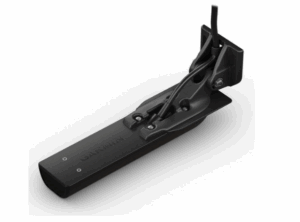
The Garmin GT56UHD-TM transducer is the best Garmin transducer. It is an all-in-one transducer for anglers seeking high-performance sonar capabilities across a range of fishing conditions. Designed to work seamlessly with compatible Garmin chartplotters, delivering an impressive combination of Ultra High-Definition SideVü and ClearVü scanning sonar, along with high wide CHIRP traditional sonar for deep water coverage and precision targeting.
This transducer’s Ultra High-Definition SideVü sonar offers enhanced image clarity with a 20 percent greater range at 1000 kHz, allowing users to see fish and underwater structure farther off to the sides of the boat. Whether scanning banks, submerged timber, or drop-offs, the detail is crisp and reliable.
The Ultra High-Definition ClearVü scanning sonar also provides remarkable clarity beneath the boat, putting more power on targets using a focused, downward-facing element. This makes it easier to identify isolated fish and bottom contour at greater depths.
The high-wide CHIRP traditional sonar included with the GT56UHD-TM adds to its versatility, offering target separation and definition down to 800 feet. Fish arches appear clean and distinct, with minimal interference or noise, which is especially helpful when tracking baitfish or gamefish in deeper water.
Another advantage is the transducer’s use of multiple scanning sonar frequencies. Operating at 455 kHz, 800 kHz, and 1000 kHz with 500 watts of power, it ensures strong performance whether fishing in shallow rivers or deep offshore environments.
The vivid scanning sonar color palettes further improve usability by making it easy to distinguish targets from structure and the bottom, even in varying water conditions.
Installation is straightforward thanks to the included transom and trolling motor mounts, making it a convenient choice for both small and large boats.
With its advanced imaging technology, versatile frequency support, and user-friendly design, the GT56UHD-TM is an outstanding option for anglers who want to spend less time searching and more time fishing.
Pros
- Ultra High-Definition SideVü sonar offers 20 percent more range at 1000 kHz
- ClearVü scanning sonar delivers excellent image clarity beneath the boat
- High wide CHIRP sonar provides precise target separation up to 800 feet deep
- Operates on three scanning sonar frequencies for all-depth performance
- Vivid color palettes improve target and structure visibility
- Easy to install on transom or trolling motor mounts
Cons
-
Requires a compatible Garmin chartplotter for full functionality
2) Garmin 010-12909-00 Transducer
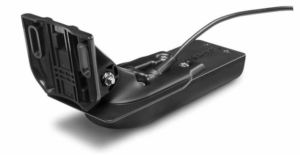
The Garmin 010-12909-00 GT54UHD-TM transducer is an exceptional all-in-one sonar solution built for anglers who want maximum clarity and versatility from a single unit. It delivers remarkably detailed sonar imagery that reveals structure and fish with impressive precision.
Whether you’re locating fish tucked inside submerged trees or observing bait balls in open water, this transducer provides the resolution and target separation needed to fish more efficiently.
One of its key features is Ultra High-Definition ClearVü scanning sonar at 800 kHz, which captures high-resolution images up to 200 feet beneath the boat.
This level of detail allows users to distinguish not only structure but also subtle changes in the underwater landscape. You can see fish holding close to rocks, brush piles, and other cover with clarity that rivals more expensive sonar systems.
The GT54 also includes dual-frequency SideVü sonar, using both 455 kHz and 1200 kHz to deliver sharp, wide-area coverage up to 500 feet to either side of the boat.
This gives you the flexibility to scan different ranges depending on water conditions and depth. Whether you need extended reach or sharper detail, the selectable frequencies provide a valuable advantage.
In addition to its ClearVü and SideVü performance, the transducer includes high-wide CHIRP traditional sonar that excels at detecting fish and separating targets throughout the water column.
It is particularly effective at picking up individual fish swimming within bait schools, offering clean returns with minimal noise or distortion.
Installation is straightforward thanks to the included transom and trolling motor mounts, and the 20-foot cable provides enough length for most setups.
The transducer is compatible with Garmin GPSMAP 8400xsv and 8600xsv chartplotter and sonar combos, ensuring smooth integration for users of those systems. Its 12-pin connector simplifies plug-in and enhances overall performance.
Pros
- Ultra High-Definition ClearVü sonar delivers detailed imagery up to 200 feet below the boat
- Dual-frequency SideVü sonar offers up to 500 feet of range for wide-area scanning
- High wide CHIRP sonar provides clear target separation and minimal noise
- Excellent image resolution allows users to see fish near structure and inside bait balls
- Includes transom and trolling motor mounts for flexible installation
- Long 20-foot cable offers installation flexibility
Cons
- Only compatible with specific Garmin chartplotter models (8400xsv and 8600xsv)
- No live sonar capabilities
3) Garmin 010-01960-01 GT20-TM Transducer
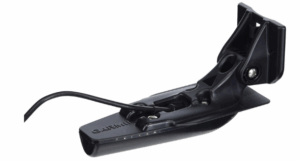
The Garmin 010-12909-00 GT20-TM transducer is a solid choice for anglers seeking dependable sonar performance in both traditional and ClearVü scanning formats. It is designed to consistently deliver clear images of fish arches, structure, and bottom contours while offering excellent depth penetration and reliable target tracking.
Whether you’re fishing in deep lakes or scanning shallow cover, this transducer provides the tools needed for accurate fish detection and underwater mapping.
Equipped with traditional sonar operating at 77 and 200 kHz, the GT20-TM offers impressive depth capability, reaching up to 1900 feet in optimal conditions. It presents clear fish arches and strong returns, allowing anglers to differentiate between fish sizes and spot isolated targets near the bottom or suspended in the water column.
The wide beamwidth at 77 kHz provides solid coverage for locating fish over broader areas, while the narrower 200 kHz setting improves resolution in more targeted zones.
The ClearVü CHIRP scanning sonar uses two frequency ranges,455 kHz and 800 kHz, to generate high-detail images of structure and fish directly beneath the boat. At 455 kHz, it offers a broader coverage area, while the 800 kHz frequency provides greater resolution in shallower water.
This dual-frequency setup makes the GT20-TM versatile across a wide range of fishing environments, helping anglers distinguish between fish, vegetation, rocks, and other underwater features.
With 500 watts of power for both traditional and ClearVü sonar, the GT20-TM balances energy efficiency with dependable signal strength. The built-in temperature sensor provides accurate readings to help gauge water conditions in real time.
Installation is made simple with the included transom and trolling motor mounts, and the 20-foot cable ensures enough length for most boat setups. The transducer supports a range of transom angles from 0 to 70 degrees and connects via an 8-pin plug for quick and secure integration.
Pros
- Reaches up to 1900 feet in traditional mode and 750 feet with ClearVü scanning
- Dual-frequency operation allows for flexible depth and resolution tuning
- Consistent display of fish arches and detailed bottom structure
- Includes a fast-response temperature sensor
- Comes with both transom and trolling motor mounts for easy installation
- A 20-foot cable provides flexible routing options
Cons
-
Limited to an 8-pin connector, which may require an adapter for some units
4) Garmin 010-01960-00 GT20-TM Transducer
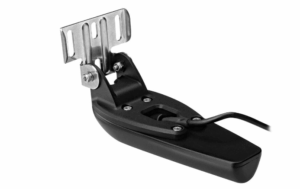
The Garmin 010-01960-00 GT20-TM transducer is one of the best Garmin transducers. It is a reliable and well-rounded option for anglers who fish in shallow to moderate depths and want both traditional and ClearVü CHIRP scanning sonar. Designed to be mounted on either a transom or trolling motor, this transducer consistently produces clear images of fish arches, underwater structure, and passing fish beneath your boat, giving anglers the visual accuracy needed to make better decisions on the water.
This transducer offers a depth capability of up to 1,900 feet using traditional sonar and up to 750 feet with ClearVü, making it a good fit for inland lakes, rivers, and coastal waters.
Its operating frequencies of 77 and 200 kHz in traditional mode provide flexible sonar coverage depending on your fishing needs. The wider 77 kHz beam is ideal for scanning large areas, while the narrower 200 kHz beam enhances detail and resolution.
In ClearVü mode, the GT20-TM operates at 455 kHz, producing crisp, near-photographic images of what lies directly beneath the boat. This is particularly useful for identifying bottom contours, submerged structure, and fish holding tight to cover.
Combined with its traditional sonar capabilities, this all-in-one transducer helps anglers identify both suspended and bottom-hugging fish with confidence.
The transducer features a 20-foot cable with an integrated fast-response temperature sensor, giving you accurate, real-time water temperature data to further guide your fishing strategy. It delivers 500 watts of power for both sonar types and supports a wide range of transom angles from 0 to 70 degrees.
Installation is straightforward with the included transom and trolling motor mounts, and clear instructions help ensure a secure fit without damaging your boat.
Pros
- Consistently provides clear fish arches and structure images
- Supports depths of up to 1,900 feet (traditional) and 750 feet (ClearVü)
- Offers flexible frequency operation for a variety of fishing conditions
- Built-in temperature sensor provides real-time water temperature readings
- Comes with both transom and trolling motor mounts for installation versatility
- Includes 20-foot cable for convenient setup on most boats
Cons
-
Designed primarily for shallow and mid-depth fishing rather than deep-sea use
5) Garmin GT52-TM Transducer
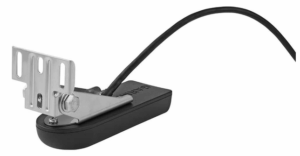
The Garmin GT52HW-TM transducer is an excellent choice for freshwater anglers who want a compact, high-performance solution that combines multiple sonar technologies in one unit. Designed for transom mounting but compact enough for trolling motor installation, this transducer offers reliable performance with CHIRP traditional sonar, CHIRP ClearVü, and CHIRP SideVü.
It delivers detailed imaging of both fish and underwater structure, helping anglers locate their targets with confidence and precision.
This transducer features high, wide CHIRP traditional sonar, which produces clear, crisp fish arches and delivers excellent target separation. Whether you are tracking fish in shallow coves or deeper channels, this sonar provides consistent returns that allow you to distinguish individual fish even when they are close together or near cover.
The high wide band provides broader coverage than narrow beam CHIRP, making it particularly effective for scanning open water areas.
The GT52 also includes both CHIRP ClearVü and CHIRP SideVü scanning sonar operating at 455 and 800 kHz. ClearVü reveals what lies directly beneath your boat with near-photographic clarity, while SideVü allows you to scan both sides of your vessel to spot fish and structure without passing directly over them.
Together, these scanning technologies give a full picture of what’s happening around the boat, helping anglers spend less time searching and more time fishing.
With a power rating of 250 watts for traditional sonar and 350 watts for each scanning sonar element, the GT52HW-TM delivers a combined 1,050 watts of power. This ensures strong signal returns and reliable performance across a wide range of freshwater environments. It connects via a 12-pin plug and includes mounting instructions to assist with proper installation, reducing the risk of damage to the hull or trolling motor.
Pros
- Combines CHIRP traditional sonar with ClearVü and SideVü scanning for full underwater coverage
- High wide CHIRP provides superior target separation and broad area scanning
- SideVü sonar allows users to locate fish and structure to the sides of the boat
- Compact size makes it suitable for trolling motor mounting
- Delivers a total power output of 1,050 watts for strong and consistent returns
- Includes detailed installation instructions for a safer setup
Cons
-
Designed primarily for freshwater, not optimized for deep saltwater use
Next Read: 5 Best Fish Finders
Factors to Consider when Choosing the Best Garmin Transducers
Here are the most important considerations:
Sonar Technologies Included
When selecting a transducer, it’s important to consider the types of sonar technologies it supports. Traditional CHIRP sonar provides accurate fish arches and target separation, while ClearVü delivers high-resolution images of what lies directly beneath the boat. SideVü adds the ability to scan to the sides, which is particularly helpful for locating structure and fish outside of the boat’s path.
Some transducers also include live or ultra-high-definition sonar, which enhances the real-time view of moving targets. Choosing a model that includes the right combination of sonar technologies based on your fishing style will significantly improve underwater visibility.
Operating Frequencies
The operating frequencies determine how detailed and how far the sonar can scan. Higher frequencies (like 800 kHz or 1000 kHz) offer more detail but shorter range, while lower frequencies (like 455 kHz or 77 kHz) reach greater depths with less resolution.
Some transducers offer dual or multiple frequency options, allowing anglers to switch between modes depending on the fishing depth and clarity requirements. Matching frequency capabilities with the intended water conditions ensures more accurate and useful readings.
Power Output
Power output, measured in watts, affects the strength and clarity of sonar returns. Higher wattage enables deeper penetration and better image resolution, especially in murky or deeper waters.
Transducers with separate power ratings for traditional and scanning sonar are often more versatile, offering powerful performance across a range of fishing depths. Assessing the power rating concerning your fishing environment, whether it’s shallow lakes or deep offshore waters, helps determine the most suitable option.
Maximum Depth Capabilities
Each transducer is rated for specific depth limits for both traditional and scanning sonar. Anglers targeting deep reservoirs or offshore waters need a transducer with strong traditional sonar depth capacity, sometimes up to 1,900 feet or more.
For those fishing in shallower lakes and rivers, a unit with moderate depth capability might be more than sufficient. Knowing the typical depths you fish helps in selecting a model that won’t underperform in critical areas.
Mounting Options and Compatibility
Installation flexibility is another key factor. Most transducers come with hardware for transom and trolling motor mounting, while some offer through-hull or ice fishing compatibility.
The shape, size, and mounting angle supported can influence performance, especially on different boat types. Additionally, compatibility with your Garmin display unit (via 8-pin, 12-pin, or specific chartplotter models) must be checked to ensure seamless integration.
Imaging Clarity and Target Separation
Clarity in sonar imaging allows anglers to identify fish, structure, and bottom detail with confidence. High-resolution returns enable users to distinguish individual fish within schools or near structure. Strong target separation ensures that fish are clearly defined rather than blurred into background noise.
Transducers that deliver clean, crisp sonar images with minimal distortion are much more effective when precision fishing is required.
Water Type and Fishing Application
The environment in which the transducer will be used plays a big role in selection. Some models are designed specifically for freshwater use, with frequency and power ranges optimized for lakes and rivers.
Others can handle saltwater applications, deeper depths, or harsh conditions. Certain compact models are better suited for kayaks and smaller boats, while high-powered units may be ideal for trolling or offshore vessels.
Choosing a transducer that aligns with your target species and fishing location enhances overall performance.
Ease of Use and Installation
A transducer’s design and included components determine how quickly and easily it can be installed. Long cables, clear instructions, and versatile mounting options reduce the complexity of setup.
Features such as built-in temperature sensors and wide beam coverage can simplify operation once deployed. A user-friendly model that requires minimal adjustment during installation and use can save time and reduce errors, especially for less experienced users.
Best Garmin Transducers FAQs
What is the difference between ClearVü, SideVü, and traditional CHIRP sonar?
ClearVü sonar provides high-resolution images of what is directly beneath your boat, allowing you to see structure, vegetation, and fish with impressive detail. SideVü sonar extends this scanning ability to both sides of your boat, which is useful for spotting fish and cover without having to drive over them.
Traditional CHIRP sonar focuses on detecting fish throughout the water column, producing clear fish arches and strong target separation. The best transducers combine all three technologies to offer a comprehensive view of the underwater environment.
How do I know which Garmin transducer is compatible with my chartplotter?
Compatibility depends on the connector type (such as 8-pin or 12-pin), power requirements, and supported sonar features of your Garmin chartplotter. It’s important to check your device’s specifications and match them with the transducer’s requirements.
Some models are specifically designed for certain Garmin units, while others may require an adapter cable. Garmin’s official website and compatibility charts are helpful resources for verifying a proper match.
Which Garmin transducer is best for deep water fishing?
For deep water fishing, a transducer with high power output and low-frequency traditional sonar is most effective. Look for a model with at least 500 watts of traditional CHIRP power and the ability to scan depths up to 1,900 feet.
ClearVü and SideVü features are useful additions, but deep-water anglers benefit most from strong traditional sonar performance with wide and narrow beam options depending on coverage needs.
Conclusion
The best Garmin transducers combine powerful sonar performance, versatile mounting options, and sharp imaging to meet the demands of various fishing conditions.
By considering factors such as sonar type, frequency range, power output, and installation compatibility, we settled on the above transducers that enhance the ability to detect fish and understand the underwater landscape.
Whether you’re a weekend fisherman or a seasoned angler, a high-quality transducer is a valuable upgrade that turns sonar data into actionable insights, helping you spend more time catching and less time searching.

Albert, the founder of Outdoormoran, is a dedicated outdoor enthusiast with a passion for delivering the most current, accurate, and easy-to-understand information on all different outdoor gear and optics. He shares his expertise with beginners by teaching the technical aspects of outdoor gear and optics through his comprehensive collection of guides.