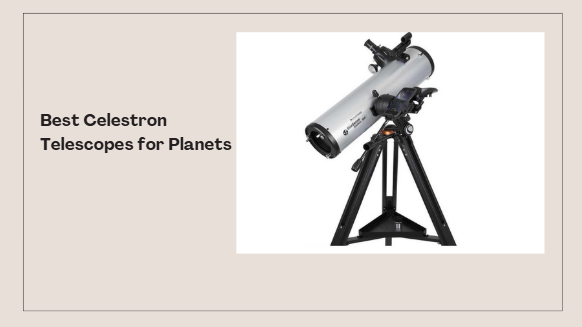
Exploring the planets through a telescope is one of the most exciting ways to experience astronomy. From the bright cloud bands of Jupiter to the stunning rings of Saturn and the reddish surface of Mars, the best Celestron telescopes for planets reveal incredible details that are invisible to the naked eye.
In this buying guide, we’ll highlight the best Celestron telescopes for observing planets and explain the key features to consider before making a purchase. By understanding factors such as aperture size, focal length, mount type, and ease of use, you’ll be better equipped to choose a telescope that delivers clear and detailed views.
Why Celestron Telescopes are Popular for Planetary Observation
Celestron is one of the most trusted brands in astronomy. Known for producing reliable telescopes for planetary and deep-sky observation, its telescopes feature:
-
High-Quality Optics. Celestron telescopes are known for producing sharp, high-contrast images, making it easier to observe planetary details such as Jupiter’s cloud bands and Saturn’s rings.
-
Long Focal Length Designs. Many Celestron models use optical designs with long focal lengths, which are ideal for achieving the high magnification needed for detailed planetary observation.
-
Advanced Optical Designs. Furthermore, Celestron offers efficient telescope designs such as Schmidt-Cassegrain telescope, which combine compact size with powerful magnification for viewing planets.
-
Computerized GoTo Technology. Many Celestron telescopes feature automated object-locating systems like Celestron SkyAlign. This allows users to quickly locate planets without extensive star-hopping knowledge.
-
Wide Range of Models. The brand offers telescopes suitable for beginners, intermediate users, and advanced astronomers, making planetary observation accessible to a wide audience.
-
Reliable Mount Systems. The best Celestron telescopes for planets often come with stable alt-azimuth or equatorial mounts that help keep planets centered in the eyepiece during observation.
-
Good Value for Performance. Lastly, many models offer a strong balance between price, optical quality, and features, making them popular among hobbyists and amateur astronomers.
Best Celestron Telescopes for Planets
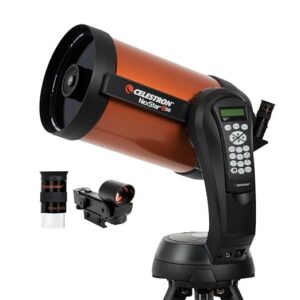
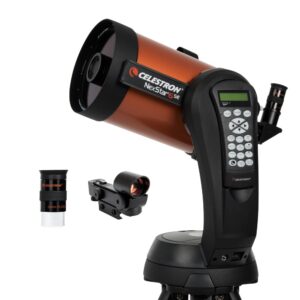
1. Celestron NexStar 8SE Computerized Telescope
3. Celestron – NexStar 130SLT Computerized Telescope
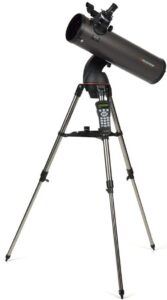
As one of the best Celestron telescopes for planets, the NexStar 130SLT Computerized Telescope delivers impressive performance for its price range and remains a popular choice for beginners looking to explore the night sky with a computerized telescope.
This telescope features a 130mm Newtonian reflector optical tube, which gathers plenty of light for observing planets, the Moon, and many deep-sky objects such as star clusters and bright nebulae. Additionally, it is mounted on a computerized single-fork arm mount with a built-in database of thousands of celestial objects, allowing users to locate targets automatically using the hand controller.
Performance-wise, the telescope provides crisp and detailed views thanks to its relatively large aperture and quality optics. The sturdy steel tripod offers good stability for visual observing, while the lightweight design makes the telescope easy to transport and set up in different viewing locations.
Over and above that, the SkyAlign technology simplifies alignment by allowing users to align the telescope using any three bright celestial objects.
Pros
- Large 130mm aperture gathers plenty of light for detailed observations
- Computerized GoTo mount automatically locates thousands of celestial objects
- SkyAlign technology makes alignment simple for beginners
- Lightweight and portable design
- Good optical performance for planetary and deep-sky viewing
Cons
-
Not ideal for long-exposure astrophotography
4. Celestron CGEM II 1100, 11″ Schmidt-Cassegrain Telescope
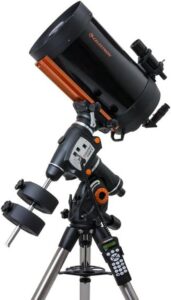
Next, we have the Celestron CGEM II 1100, 11″ Schmidt-Cassegrain Telescope.
This telescope features a Schmidt-Cassegrain optical design with a large 11-inch aperture, providing exceptional light-gathering ability for bright, detailed views of celestial objects. It achieves up to 660x magnification with compatible eyepieces, revealing intricate details on planets, the Moon, and deep-sky objects with stunning clarity.
Furthermore, the telescope benefits from enhanced light transmission and contrast thanks to Celestron’s premium StarBright XLT optical coatings that ensure brighter and sharper images.
The CGEM II equatorial mount with NexStar hand control boasts a database of over 40,000 objects, making it easy to locate and track celestial targets automatically. Moreover, the telescope is equipped with a sturdy 2-inch steel tripod and a robust equatorial mount that provides exceptional stability, minimizing vibrations for clear, steady viewing.
Pros
- Large 11-inch aperture provides excellent light-gathering capability
- Sharp, high-contrast images thanks to advanced optical coatings
- Accurate computerized GoTo system with a large object database
- Stable CGEM II equatorial mount suitable for visual use and astrophotography
- High payload capacity for cameras and additional accessories
- Durable construction designed for long-term use
Cons
- Heavy and challenging to set up
- Requires some experience to properly align and operate the mount
5. Celestron – AstroMaster 70AZ Telescope
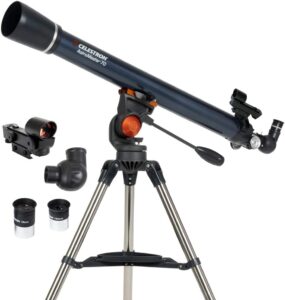
The Celestron AstroMaster 70AZ Telescope is an excellent entry-level refractor telescope designed for beginners who want an easy and affordable way to explore the night sky.
Featuring a 70mm aperture and fully coated glass optics, this telescope delivers bright and sharp views of the Moon, planets, and some brighter deep-sky objects.
Furthermore, the telescope uses a lightweight frame and a manual altazimuth mount that moves smoothly up, down, left, and right, making it simple to track celestial objects. It also comes with a sturdy tripod and an accessory tray for holding eyepieces, which adds convenience during observation sessions.
Thanks to the simple setup and intuitive controls, the AstroMaster 70AZ is ideal for first-time astronomers, students, or families who want a telescope that can be assembled and used quickly without complicated alignment procedures.
In terms of performance, it provides crisp lunar detail and clear views of planets such as Jupiter and Saturn under good viewing conditions. The included eyepieces allow users to experiment with different magnifications, giving flexibility for observing both wide star fields and more detailed planetary views.
To top it all off, its refractor design also means it requires very little maintenance compared to reflector telescopes, since the optics rarely need alignment.
Pros
- Easy to assemble and beginner-friendly
- Lightweight and portable design
- Fully coated optics for clearer, brighter images
- Smooth manual altazimuth mount for simple tracking
- Minimal maintenance required due to refractor design
- Good for viewing the Moon, planets, and bright star clusters
Cons
-
Limited aperture for faint deep-sky objects
6. Celestron – AstroMaster 90EQ Refractor
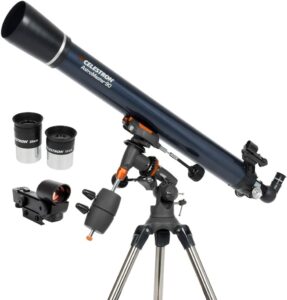
The AstroMaster 90EQ delivers sharp optics, a stable equatorial mount, and smooth manual controls. These features make it the top choice for beginners ready to explore the night sky.
Its 90mm aperture gathers plenty of light, allowing for clear and detailed views of the Moon, planets, and brighter deep-sky objects like star clusters and nebulae. Furthermore, the fully coated glass optics enhance brightness and contrast, making celestial objects stand out sharply.
The included EQ (equatorial) mount, while requiring a bit of initial setup, allows for smooth tracking of objects as they move across the sky, which is especially helpful for longer observation sessions.
Another notable feature is its versatility. The AstroMaster 90EQ comes with two eyepieces, providing options for low and high magnification, and a Barlow lens that effectively doubles your magnification range. This makes it easier to explore a wide range of celestial objects.
Pros
- Clear and sharp optics with fully coated lenses
- 90mm aperture gathers ample light for detailed views
- Comes with two eyepieces and a Barlow lens for versatile magnification
- Portable and relatively lightweight for easy transport
- Equatorial mount allows smooth tracking of celestial objects
Cons
- Limited aperture compared to more advanced telescopes for deep-sky objects
- No motorized tracking; requires manual adjustments
7. Celestron – AstroMaster 130EQ Newtonian Telescope
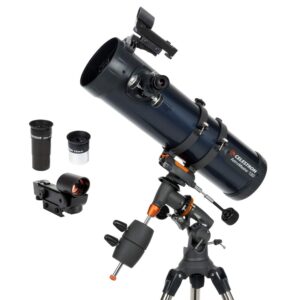
Next, we have the Celestron – AstroMaster 130EQ Newtonian Telescope. This is an excellent choice for beginner and intermediate stargazers who want to explore the night sky in detail.
Its 130mm aperture allows for bright, clear views of celestial objects like the Moon, planets, and even some deep-sky objects such as star clusters and nebulae.
Furthermore, the equatorial mount makes tracking objects across the sky easier once properly aligned, giving a more immersive and stable observing experience.
Assembly is relatively straightforward, and the telescope comes with essential accessories, including two eyepieces and a finder scope, making it ready for immediate use. The optical quality is impressive for its price range, delivering sharp images with minimal chromatic aberration.
Above all, the sturdy build ensures it can withstand regular use without frequent adjustments, and the included manual provides helpful guidance for new astronomers.
Pros
- Large 130mm aperture for bright, detailed views
- Equatorial mount allows easier tracking of celestial objects
- Good optical quality with minimal chromatic aberration
- Includes essential accessories like eyepieces and finder scope
- Sturdy build suitable for regular use
Cons
-
Limited field of view compared to higher-end models
8. Celestron Travel Scope 70 Portable Refractor Telescope
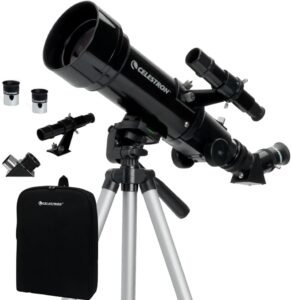
Last but not least, we have the Celestron Travel Scope 70 Portable Refractor Telescope.
With a 70mm aperture and fully-coated glass optics, it delivers bright and clear images of the moon, planets, and some brighter deep-sky objects.
As one of the best Celestron telescopes for planets, its lightweight design makes it easy to carry on trips or for quick backyard stargazing sessions, and it comes with a backpack for convenient storage and transport.
Furthermore, the telescope is user-friendly, especially for beginners, with a simple alt-azimuth mount that allows smooth horizontal and vertical adjustments. The included accessories, such as two eyepieces and a finder scope, provide flexibility in magnification and help users quickly locate celestial objects.
Overall, it is an accessible, practical, and enjoyable telescope for anyone starting in astronomy.
Pros
- Lightweight and portable for travel
- Fully-coated glass optics for clear, bright images
- User-friendly alt-azimuth mount
- Includes eyepieces and finder scope
- Comes with a convenient backpack for storage
Cons
- Small aperture limits deep-sky viewing
- Limited to basic beginner-level observation
Criteria for Choosing the Best Celestron Telescopes for Planets
When selecting the best Celestron telescope for planetary observation, consider these key factors:
Aperture Size
One of the primary factors to consider is aperture size. The aperture, or the diameter of the telescope’s main lens or mirror, directly affects how much light the telescope can gather. For planets, a larger aperture allows you to see finer details on planetary surfaces, such as the rings of Saturn or the cloud bands of Jupiter. While a bigger aperture generally provides clearer and more detailed images, it also makes the telescope bulkier and less portable, so striking a balance is essential.
Optical Design
Optical design is another crucial criterion. Celestron offers a variety of designs, including Schmidt-Cassegrain, Maksutov-Cassegrain, and refractors. Schmidt-Cassegrain models are versatile and compact, ideal for planetary and deep-sky viewing, while Maksutov-Cassegrain scopes often provide sharper planetary images due to their long focal lengths. Refractors, on the other hand, are excellent for crisp, high-contrast views of planets but can be more expensive per inch of aperture.
Focal Length and Focal Ratio
Focal length and focal ratio significantly impact planetary viewing as well. The best Celestron telescopes for planets with longer focal lengths and higher focal ratios provide higher magnification, which is useful for observing smaller planetary features. For example, a focal ratio above f/10 is generally recommended for planetary observation because it enhances image detail without excessive distortion.
Mount Type and Stability
Moreover, mount type and stability are often overlooked but are vital for smooth planetary viewing. A stable mount prevents vibrations that can blur fine planetary details. Equatorial mounts allow for precise tracking of planets as they move across the sky, which is especially helpful for long viewing sessions or astrophotography. Alt-azimuth mounts are simpler to use but may require manual adjustments more often.
Magnification Capabilities
Furthermore, magnification capabilities matter, but they should be considered in combination with aperture. While the best Celestron telescopes for planets can reach high magnifications, pushing beyond the telescope’s optimal limit often results in blurry images. Choosing a telescope with a balance between aperture, focal length, and maximum useful magnification ensures you can clearly see planetary features.
Portability
Portability and ease of setup are important if you plan to move your telescope to dark-sky locations. Some Celestron models are lightweight and compact, making them ideal for travel, while larger models require more effort to transport and set up. A telescope that is too cumbersome may discourage regular use, so portability can enhance your overall observing experience.
Accessories and Compatibility
Accessories and compatibility are also worth considering. The best Celestron telescopes for planets often support a wide range of eyepieces, Barlow lenses, and filters that can improve planetary viewing. High-quality planetary filters can enhance contrast, making details like Jupiter’s cloud bands or Saturn’s rings more visible. Ensuring your telescope is compatible with these accessories allows you to expand your observing capabilities over time.
Price and Value for Money
Finally, price and value for money play a key role in the decision-making process. While high-end Celestron telescopes offer exceptional optics and features, there are also mid-range models that provide excellent planetary views without breaking the bank. Evaluating what features are most important for your observing goals helps ensure you choose a telescope that fits your budget while delivering impressive views of the planets.
Accessories for Planetary Viewing
Consider getting these accessories to enhance your planetary viewing:
- Eyepieces. Provide different magnifications for detailed views; higher-quality eyepieces with good eye relief make long viewing sessions more comfortable.
- Barlow lens. Doubles or triples the magnification of existing eyepieces, offering versatility without buying extra eyepieces.
- Planetary filters . Colored filters enhance contrast and reveal subtle planetary features, such as Jupiter’s cloud bands or Saturn’s rings.
- Moon filters. Reduce brightness when observing the Moon, allowing clearer views of craters and surface details.
- Motor drive / GoTo mount. Keeps planets centered in the eyepiece automatically; GoTo mounts can locate and track planets for convenience.
- Telrad or red-dot finderscope. Helps quickly aim the telescope at planets without complicated star-hopping.
- Dew shield / dew heater. Prevents condensation on optics for sharper, clearer images during cooler nights.
- Star chart apps or planetarium software. Guides you to planets in real time.
FAQs
Which Celestron telescope design is best for beginners interested in planets?
Schmidt-Cassegrain telescopes are popular for beginners because they are versatile, compact, and relatively easy to use. Maksutov-Cassegrain scopes offer sharper images but tend to be heavier and more expensive.
Can I use my Celestron telescope for both planets and deep-sky objects?
Yes. Schmidt-Cassegrain and some Maksutov-Cassegrain telescopes are versatile enough for both planetary and deep-sky viewing, though most telescopes optimized for planets have a longer focal length and narrower field of view.
Do filters improve the view of planets?
Absolutely. Colored planetary filters enhance contrast and reveal surface details like Jupiter’s cloud bands or the rings of Saturn, especially under less-than-ideal sky conditions.
Parting Shots
In conclusion, a great Celestron telescope makes planetary viewing simple, exciting, and rewarding. By choosing one that balances clarity, stability, and ease of use, you will enjoy stunning views of Jupiter’s stripes, Saturn’s rings, or Mars’ surface. Look at the attributes that make each telescope the right purchase and choose accordingly to bring the planets closer than ever before.