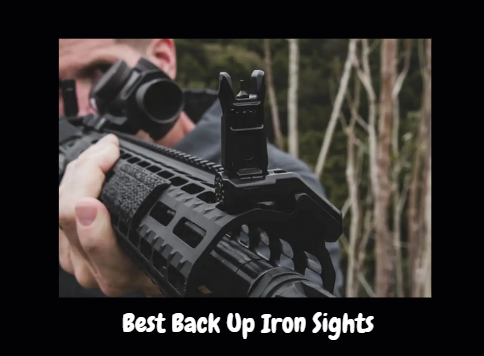
In this guide, I’ll cover the best backup iron sights available, focusing on their key features, durability, and performance. I’ll also walk you through a detailed buying guide and answer some of the most common questions to help you choose the right setup for your rifle.
When it comes to building a dependable rifle setup, I always make sure to include a solid pair of backup iron sights. These sights are great because they provide reliability when optics fail, ensuring that I can stay on target no matter the conditions.
Whether I’m running a red dot, a holographic sight, or a magnified scope, having a set of BUIS gives me peace of mind and versatility in the field.
Why Backup Iron Sights?
Backup iron sights (BUIS) serve as an essential insurance policy for any rifle setup, especially when using optics like red dots or scopes. Even the most reliable optics can fail due to battery loss, lens damage, or electronic malfunction—and when that happens, having a dependable set of iron sights ensures you can still stay on target.
BUIS provide a simple, mechanical aiming system that doesn’t rely on power or glass, making them invaluable for both tactical and defensive use.
Modern backup sights like the Magpul MBUS Pro Offset and the Samson True Back Up Top Mounted are designed for speed, precision, and rugged dependability. Offset models allow the shooter to instantly transition from an optic to irons by rotating the rifle 45 degrees, ideal for engaging close targets or reacting to a failed optic.
Top-mounted styles, on the other hand, align directly with your primary optic for a seamless co-witness setup, giving you quick access without changing your grip or cheek weld.
These backup sights are also built to endure harsh environments—using materials like steel or 6061-T6 aluminum, with finishes that resist corrosion and wear.
Their compact, low-profile designs prevent interference with optics or accessories, while tool-less adjustments make zeroing quick and straightforward.
In short, backup iron sights are about preparedness and confidence. They provide shooters with a fail-safe aiming system that works under any condition, ensuring your rifle remains functional and accurate even when your primary optic doesn’t.
Whether you’re a professional, competitor, or enthusiast, a solid pair of BUIS completes your rifle setup and keeps you ready for anything.
Best Backup Iron Sights
1) Magpul MBUS PRO Backup Sights
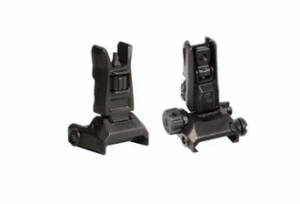
The Magpul MBUS PRO Flip Up Backup Sight combines a compact footprint with rugged, all-steel construction and a finish aimed at long service life, making it the best backup iron sight. If you want a set of backup sights you can trust to deploy quickly, hold zero, and survive hard use without adding unnecessary bulk, this is one of the best options I’ve handled.
Magpul built the MBUS PRO from steel and finished it with a case hardening process plus Melonite QPQ for corrosion and wear resistance. The result is a solid, compact sighting system that feels more like a primary component than a disposable backup.
The narrow width keeps the sights from getting in the way of most rail-mounted lasers and lights, and the overall dimensions make the sights unobtrusive when stowed.
The rear unit offers a dual aperture and a windage adjustment calibrated in fine clicks. With a 14.5 inch sight radius each windage click moves roughly 0.566 inches at 100 meters and with a 20 inch sight radius that becomes about 0.410 inches at 100 meters.
The front post uses a rectangular steel post that can be selected between Match width .040 inch for precision or Standard width .060 inch for faster target acquisition.
Front elevation and rear elevation are adjusted with a knob that requires no tools and both units feature positive detents in the up and down positions to ensure repeatable deployment and adjustment.
These sights mount on any Picatinny rail including receiver height gas blocks, and when deployed they sit at standard AR sight height for easy co witnessing with most red dots and optics.
The front sights now ship with the Enhanced Front Sight Post installed from the factory, and note that those enhanced posts are not compatible with standard MBUS polymer fronts if you are retrofitting older parts.
The sights are ambidextrous in practical use and deploy quickly with a solid, tactile lock in both positions.
In the field the MBUS PROs deploy crisply and snap into place with positive feedback, so you never wonder whether they are locked. The steel construction and Melonite finish held up well to rain, dust, and regular handling during my testing.
Because the sights are built from steel they are heavier than polymer backups, but that extra mass is exactly what gives the units their long term durability and consistent zero retention.
Pros
- All steel construction with case hardening and Melonite QPQ finish for long term wear and corrosion resistance
- Selectable rectangular sight post widths .040 inch Match for precision and .060 inch Standard for maximum visibility
- Tool free elevation adjustment on the front post for fast field zeroing
- Rear windage clicks calibrated to performance numbers of about 0.566 inch per click at 100 meters with a 14.5 inch sight radius and about 0.410 inch per click with a 20 inch sight radius
- Positive detents for both deployed and stowed positions and on the elevation knobs for repeatable, tactile feedback
- Mounts to any Picatinny rail including receiver height gas blocks and provides standard AR sight height when deployed for easy co witnessing
- Narrow footprint that plays nicely with rail mounted lasers and lights
Cons
- Enhanced Front Sight Posts are not compatible with older MBUS polymer front sights so retrofits may require attention
2) Magpul MBUS Pro Offset Front and Rear Flip-Up Backup Sights (526-525)
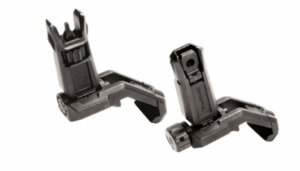
Magpul’s MBUS Pro Offset Front and Rear Flip Up Backup Sights 526 525 are a purpose-built iron sighting solution for shooters who want a reliable fallback without rearranging their rifle. Designed as an offset pair that sits 45 degrees to the right, these sights let you rotate the rifle for immediate iron sight use when a magnified optic is damaged, fails, or when a close target calls for faster transitions.
The package builds on the MBUS Pro lineage and brings that same level of durability and repeatable deployment to an offset configuration that integrates cleanly on M1913 Picatinny rails.
The construction is all steel with a case hardened Melonite QPQ finish for excellent resistance to wear and corrosion. That metal construction gives the sights a solid feel and long service life compared with polymer alternatives.
Positive detents in both the up and down positions make deployment tactile and obvious, and the standard height over bore when deployed preserves familiar sight geometry so transitions from primary optic to irons are predictable and fast.
Both front and rear units are tool free for elevation and windage adjustment using a low profile knob. The front post accepts rapid, tool free elevation changes for field zeroing while the rear features tool free windage adjustment and dual apertures for aiming flexibility.
The low profile footprint minimizes interference with most rail mounted accessories and keeps the offset sights from impeding the normal mounting of lasers, lights, or other equipment.
Functionally the 45 degrees offset orientation is a practical advantage for dynamic situations. Instead of removing or replacing optics or trying to reconfigure support hardware, the shooter simply rotates the rifle to access a fully featured iron sight solution that offers the precision of a dual aperture rear and the simplicity of a rectangular front post.
Because these sights mount on MIL STD 1913 rails they are compatible with a wide range of modern rifles and accessory layouts.
Made in U S A, the MBUS Pro Offset set is clearly aimed at professional users and serious enthusiasts who need a dependable backup that will tolerate hard use. For anyone who values robust materials, repeatable deployment, and convenient tool free adjustment in an offset package, this is one of the strongest backup iron sight options available.
Pros
- All steel construction with case hardened Melonite QPQ finish for excellent wear and corrosion resistance
- Standard height over bore when deployed preserves familiar sighting geometry
- 45 degrees offset right hand orientation for fast transition to irons without changing optics or mounts
- Tool free elevation and windage adjustment using a low profile knob for quick field zeroing
- Positive detents in both deployed and stowed positions for tactile, repeatable lockup
- Rear dual apertures provide aiming flexibility for different engagement distance
- Low profile footprint to reduce interference with most rail mounted accessories
- Made in U S A
Cons
- Offset orientation favors right handed users and may not suit left handed shooters without reconfiguration
3) Magpul MBUS Flip-Up Backup Sights
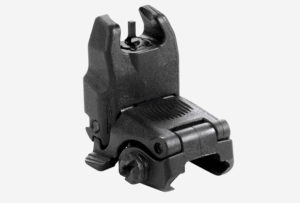
Magpul MBUS Flip Up Backup Sights earn their place among the best backup iron sights by combining lightweight construction, intuitive deployment, and broad compatibility with Picatinny rails.
These sights are designed as a practical, affordable fallback for rifles with optics, giving shooters a reliable mechanical aiming option that stays out of the way until it is needed.
If you want a set of backup sights that are simple to use, easy to install, and tolerant of hard handling, the MBUS line is a strong choice.
The MBUS series uses impact resistant polymer for both front and rear units which keeps weight down while resisting operational abuse. Protective wings shield the spring locking sight post and help protect the sight from accidental damage on the range or in the field.
The spring loaded flip up mechanism is easy to activate from either side or by pressing the top which makes rapid deployment straightforward under stress.
A detent and carefully tuned spring pressure keep the sight erect and usable but still allow it to fold cleanly when struck or knocked.
The front sight ships with an elevation adjustment tool and can accept most aftermarket A2 front sight adjustment tools for convenience. The rear sight detent knob provides positive and easy windage adjustment on models that include it.
When deployed the MBUS sights provide the same height over bore as standard A2 iron sights which simplifies transitions from optics to irons for shooters already familiar with A2 geometry.
The compact footprint and unobtrusive stowed profile mean these sights will not interfere with most optics and rail mounted accessories during normal operation.
MBUS 2 focuses on the basic, rugged polymer flip up design. MBUS 3 adds a detent knob on the rear for more positive windage control while retaining the same impact resistant polymer construction and spring loaded activation.
MBUS 4 clamps to most MIL STD 1913 Picatinny and STANAG 4694 rails and offers the same standard A2 sight height over bore. A practical mounting note is that MBUS 4 should not be mounted to railed gas blocks due to excess heat in those locations.
Overall these options let you choose the balance of features you want while keeping installation and setup straightforward.
In practice the MBUS units deploy crisply and remain locked in position when you need them. The lightweight polymer construction makes them an excellent fit for builds where minimizing bulk and weight matters, and the protective wings and detent design provide a good measure of longevity during typical use.
For budget conscious shooters, training rifles, and anyone who wants a dependable backup that will not add much weight, MBUS offers strong value.
Pros
- Impact-resistant polymer construction provides low weight and resilience under operational use
- Spring-loaded flip-up mechanism that can be activated from either side or by pressing the top for quick deployment
- Detent and spring pressure keep the sight erect while still allowing unobstructed folding under impact
- Protective wings help shield the spring locking sight post from damage
- Front sight includes an elevation adjustment tool and accepts most aftermarket A2 adjustment tools for easy zeroing
- Rear sight detent knob on select models provides positive windage adjustment
- Clamps to most MIL STD 1913 Picatinny and STANAG 4694 rails and provides standard A2 sight height over bore for simple optic transitions
- Low cost makes these sights a practical choice for backups and training rifles
Cons
- No built in illumination so low-light aiming requires external solutions
4) Troy Iron Sight
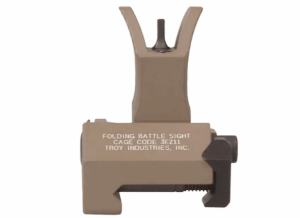
Troy Iron Sights earn a place among the best backup iron sights for shooters who want precision, durability, and a positive mechanical feel. Designed as folding battle sights for AR style rifles, they offer a premium machined construction and an intuitive deployment system that works smoothly with modern optics.
If you value a metal sight set that will stay zeroed under hard use and fold cleanly out of the way when not needed, these are an excellent option.
Construction and finish
These sights are machined from hardened aircraft aluminum with stainless steel components, then finished in Mil Spec hardcoat anodizing to resist wear and environmental exposure. The stainless steel cross locking system locks the sights upright and maintains zero under demanding conditions, and the overall build quality gives a reassuringly solid feel compared with polymer alternatives.
The front sight uses a classic post profile and protective geometry to survive rough handling while remaining easy to service or remove without permanent modification to the firearm.
A single push of a button releases the sight to fold or deploy quickly and without fumbling with levers or springs. Positive detents and the stainless cross lock keep the sights firmly in the deployed position so you do not worry about loss of zero during recoil, movement, or rough transport.
The zero canting attachment system simplifies alignment and helps ensure consistent registration when the sights are mounted or removed.
These Troy sights include dual apertures for flexible aiming options across distances and each click adjusts about 0.50 MOA for fine windage control.
The precise click values allow tight corrections when zeroing and make it straightforward to dial in small changes at the range. The design allows cowitnessing with red dot sights so transitions between optic and iron aiming are familiar and predictable for most AR shooters.
The sights clamp to standard Picatinny rails and can be moved or removed without altering the firearm. They are ambidextrous in practical use and the blade heights are configured to work with common AR sight geometry, making integration with a wide range of setups simple.
Because there are no awkward parts to manipulate during installation or use, the sights are well suited to both professional users and serious recreational shooters.
Troy Folding Battle Sights deliver a premium metal option for anyone who wants robust, repeatable backup iron sights that will survive operational use.
The combination of aircraft grade aluminum, stainless locking hardware, precise adjustment, and a clean folding action make them a dependable choice for backup or primary iron sight roles on AR style rifles.
Pros
- Machined from hardened aircraft aluminum with stainless steel components and Mil Spec hardcoat anodizing for long-term durability and corrosion resistance
- Stainless steel cross locking system that keeps sights upright and maintains zero under heavy use
- Push button folding action that deploys and stows the sights quickly without levers or fiddly springs
- Dual aperture rear and precise windage adjustment of approximately 0.50 MOA per click for fine-tuning at the range
- Zero canting attachment system for reliable alignment during mounting and removal
- Easy installation and removal without permanent modification to the firearm
- Designed to co-witness with red dot optics for familiar sight transitions
Cons
- Metal construction is heavier than polymer options which may be a consideration for the lightest builds
5) Samson True Back Up Top Mounted Deployable Front and Rear Sight
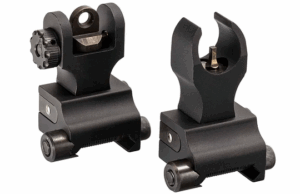
The Samson True Back Up Top Mounted Deployable Front and Rear Sight is a compact, purpose built backup iron sight set that earns a spot among the best backup options for AR style rifles. It was designed to be an effective fallback rather than a primary aiming system, and that design ethos shows in a clean, simple layout that emphasizes reliability, repeatable zeroing, and unobtrusive integration with modern optics.
These sights are machined from 6061 T6 aluminum and finished with Type III class 2 hard coat anodizing for long term resistance to wear and corrosion.
A stainless steel clamp secures the sights to any 1913 Picatinny rail and the precision laser engraving gives a clean, professional appearance while helping with alignment and setup. Build quality and materials keep weight low while still delivering the rigidity needed to hold zero under normal field use.
Samson chose a single .160 aperture rather than dual rear apertures. The size provides a practical balance between precision and usable low light performance.
The sights accept any aftermarket front sight post made to MIL SPEC dimensions, giving the user flexibility when dialing in a preferred post profile or when replacing parts in the future. When deployed the pair sit at perfect M4 cowitness height for straightforward transitions between optics and irons.
Both the front and rear lock in the folded and deployed positions so the shooter has tactile confidence in deployment and stowage. Windage adjustment is just over 0.5 MOA per click which lets you make fine corrections at the range without overshooting your adjustments.
The secure mounting system and positive lockup make it easy to trust that your point of aim will remain consistent after rough handling.
Because these sights are non illuminated and focused on simplicity they pair naturally with red dots and magnified optics as a fallback option. The top mounted orientation and ambidextrous usability make them straightforward to use from either shoulder, and the low profile when stowed keeps the sights from interfering with mounted accessories.
The combination of durable materials, repeatable click values, and compatibility with MIL SPEC front posts makes this set a practical choice for professionals and recreational shooters alike.
For anyone who wants a reliable, no fuss backup sighting solution that integrates cleanly with modern AR setups, the Samson True Back Up pair is a strong contender.
The choice of a single .160 aperture, robust aluminum construction, and secure Picatinny mounting produce an iron sight set that is easy to install, simple to zero, and dependable when it matters.
Pros
- Made from 6061 T6 aluminum with Type III class 2 hard coat anodizing for lasting wear resistance
- Stainless steel clamp that secures to any 1913 Picatinny rail for solid mounting and repeatable zero
- Single .160 aperture that balances precision and usable low light aiming
- Perfect M4 cowitness height for straightforward transitions between optics and irons
- Both front and rear lock in folded and deployed positions for tactile confidence on deployment
- Windage adjustment of just over 0.5 MOA per click for fine tuning at the range
- Accepts all aftermarket MIL SPEC front sight posts for easy customization or replacement
- Precision laser engraving for clear reference marks and a clean finished look
Cons
- Requires adequate rail space and placement planning on more compact handguards
Next Read: Best AR Iron Sights
Factors to Consider when Choosing the Best Backup Iron Sights
When choosing the best backup iron sights, several key factors determine how well they’ll perform in real-world conditions. From build quality to compatibility, every detail contributes to reliability, precision, and ease of use. Here are eight essential factors to consider:
1. Construction Material
Durability starts with the material. High-quality backup iron sights are usually made from aircraft-grade aluminum, steel, or impact-resistant polymer. Metal sights offer superior strength and heat resistance, while polymer models provide lightweight performance without adding bulk. The right material ensures your sights withstand recoil, environmental stress, and rough handling without losing zero.
2. Mounting Compatibility
Before purchasing, it’s important to confirm that the sights fit your firearm’s rail system. Most BUIS are designed for MIL-STD-1913 Picatinny or STANAG 4694 rails, which are standard on AR-platform rifles. Compatibility ensures a secure fit and proper height alignment for co-witnessing with optics. A sight that mounts easily and stays locked in place improves reliability and consistency in the field.
3. Co-Witness Height
Co-witness height determines how the sights align with your optic. A perfect co-witness means your iron sights sit in the same optical plane as your red dot, while a lower 1/3 co-witness allows for an unobstructed view through the optic. The right setup depends on your shooting style and optic height, ensuring smooth transitions between your primary and backup sights.
4. Deployment Mechanism
The speed and ease of deployment are crucial for backup sights. Many modern models feature spring-loaded or manually folding mechanisms that deploy instantly with a simple push or flip. A reliable locking system ensures the sights remain upright during shooting and fold securely when not in use. Quick deployment can make a real difference in defensive or competition situations.
5. Adjustability
Accurate windage and elevation adjustments are vital for maintaining precision. Quality BUIS offer tactile clicks that move the sight in small, measurable increments—often around 0.5 MOA per click. Some models include adjustment tools, while others are tool-less for convenience. Fine-tuning your sights helps ensure consistent accuracy across varying distances and shooting conditions.
6. Aperture Design
The rear sight aperture plays a big role in target acquisition and visibility. Some sights use dual apertures—one for close-range shooting and another for precision at longer distances. Others opt for a single medium-sized aperture to balance accuracy and low-light usability. Choosing the right aperture setup depends on your shooting environment and personal preference for sight picture clarity.
7. Profile and Weight
A low-profile design keeps the sight compact and prevents interference with optics or accessories. Lightweight construction helps maintain rifle balance, especially for those running additional attachments like lasers or lights. Backup sights should remain unobtrusive until needed, folding neatly out of the way yet deploying quickly when required.
8. Finish and Corrosion Resistance
The finish of your sights determines their longevity and performance in harsh environments. Hard coat anodizing and corrosion-resistant coatings protect against rust, moisture, and wear from regular use. A quality finish not only enhances durability but also preserves a clean, tactical appearance, ensuring your sights remain functional and reliable even after extensive exposure to the elements.
Best Backup Iron Sights FAQs
Why do I need backup iron sights if I already have an optic?
Backup iron sights are essential as a fail-safe in case your primary optic becomes damaged, runs out of battery, or malfunctions. They provide a reliable, battery-free aiming solution that ensures you can still engage targets accurately under any circumstance. Many shooters also use them for close-range engagements or as a training tool to maintain fundamental marksmanship skills.
Should I choose fixed or flip-up backup iron sights?
The choice between fixed and flip-up sights depends on your shooting setup and preference. Fixed sights are always ready and provide constant alignment, making them ideal for rugged or duty rifles.
Flip-up sights, on the other hand, can be folded out of the way when using optics and quickly deployed when needed. If you use magnified scopes or red dots, flip-up models offer more flexibility and cleaner sight pictures.
How do I properly zero my backup iron sights?
Zeroing backup iron sights involves aligning the point of impact with the point of aim at a specific distance, typically 25 or 50 yards for most rifles. Start by adjusting the front sight for elevation and the rear sight for windage.
Fire controlled groups, make small corrections per group, and repeat until your shots consistently hit the intended point. Once zeroed, your BUIS will provide dependable accuracy whenever your optic is unavailable.
Conclusion
After exploring the best backup iron sights, it’s clear that these accessories are invaluable for anyone who values reliability and accuracy. They offer a sturdy, no-battery solution that’s ready when technology fails, and their precision designs make them a trusted companion for tactical, hunting, or range use.
Each sight has unique strengths, from rugged all-steel construction to lightweight polymer builds, catering to different preferences and budgets.
Personally, I recommend choosing a model that balances toughness, easy deployment, and solid zero retention. Whether you’re looking for a compact flip-up option or a fixed co-witness setup, the right pair of backup iron sights can elevate your shooting confidence in any scenario.

Albert, the founder of Outdoormoran, is a dedicated outdoor enthusiast with a passion for delivering the most current, accurate, and easy-to-understand information on all different outdoor gear and optics. He shares his expertise with beginners by teaching the technical aspects of outdoor gear and optics through his comprehensive collection of guides.