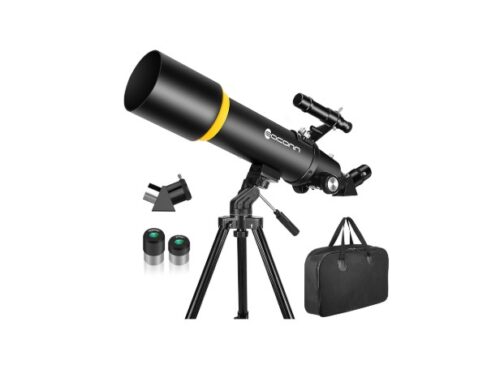
Exploring the night sky is an awe-inspiring experience, but the right telescope makes all the difference. The best 90mm telescopes strike the perfect balance between portability, affordability, and optical performance, making them an ideal choice for beginners and intermediate stargazers alike.
Whether you’re eager to observe the craters of the Moon, the rings of Saturn, or distant star clusters, a quality 90mm telescope will bring celestial wonders into stunning view. In this guide, we’ve carefully reviewed and selected the best 90mm telescopes available today to help you find a model that matches your stargazing goals, budget, and experience level.
What Makes 90mm Telescopes Popular?
90mm telescopes are a favorite among beginners and hobbyists for the following reasons:
1. Clear celestial views. The 90mm aperture gathers enough light to see detailed views of the Moon, planets like Jupiter and Saturn, and brighter deep-sky objects such as star clusters and nebulae.
2. Portable and convenient. Furthermore, the compact and lightweight design makes them easy to carry, set up, and move between locations.
3. Beginner-friendly. Simple optics and intuitive mounts let newcomers start stargazing without technical hassle.
4. Affordable performance. The best 90mm telescopes offer excellent clarity and versatility without the high cost of larger telescopes.
5. Versatile use. Lastly, these telescopes are perfect for casual backyard observation and hobbyist stargazing alike.
Best 90mm Telescopes
1. Gskyer Telescope 600x90mm AZ Astronomical Refractor Telescope
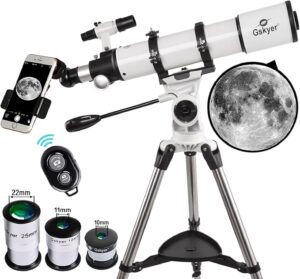
The Gskyer Telescope 600x90mm AZ Astronomical Refractor Telescope is the best 90mm telescope. It is a solid choice for both beginner and intermediate stargazers.
The telescope comes with a sturdy alt-azimuth mount, making it easy to maneuver when tracking celestial objects, which is especially helpful for newcomers who are still learning how to navigate the night sky.
The included eyepieces and Barlow lens offer a variety of magnifications, allowing users to zoom in for detailed views of lunar craters or the rings of Saturn. Furthermore, its optical performance is surprisingly good for a telescope in this price range, providing sharp images with minimal chromatic aberration.
In addition to its performance, the Gskyer 600x90mm is relatively easy to assemble and transport. This makes it a practical option for casual astronomers who want to explore from different locations. Besides, the adjustable tripod adds stability and flexibility, though it can feel a bit lightweight when fully extended.
Pros
- Large 90mm aperture delivers bright, clear views
- Alt-azimuth mount is simple and easy to use
- Multiple eyepieces and Barlow lens for versatile magnification
- Portable and relatively easy to set up
- Good value for beginners
Cons
- Limited deep-sky observation capability
2. SVBONY SV48P Telescope
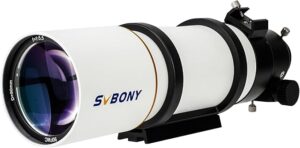
Whether you’re tracking lunar craters or dipping into nebulae and star clusters, the SVBONY SV48P 90mm Refractor delivers an impressive balance of optical performance and accessibility.
With its large 90 mm aperture and F5.5 focal ratio, this refractor gathers plenty of light, producing bright, clear views of the Moon, planets, and many deep‑sky objects. The optics are well‑coated to reduce glare and improve contrast, so objects don’t appear washed out.
Physically, the telescope feels solid and well‑built, and the focuser is smooth, allowing for fine adjustments that make focusing on stars and planets easier, even for first-time users.
Furthermore, assembly is straightforward, and the included finderscope and eyepieces are decent quality for getting started without immediately needing upgrades.
Pros
- Large 90 mm aperture for strong light‑gathering ability
- Bright, clear views of lunar and planetary details
- Easy setup and good build quality
- Smooth focuser and included accessories get you observing quickly
- Great value for beginners and casual users
Cons
-
Slight edge softness or field curvature with some eyepieces
3. Dianfan Telescope for Adults High Powered, 90mm Aperture
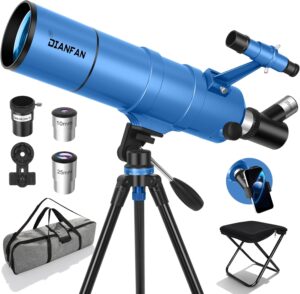
The Dianfan Telescope is a high-powered 90mm Aperture 550mm Astronomical refractor telescope ideal for both beginner and intermediate stargazers.
Its 90mm aperture allows for bright and clear views of celestial objects, making it ideal for observing the Moon, planets, and even some deep-sky objects under the right conditions.
Furthermore, the 550mm focal length provides decent magnification without sacrificing image quality, and the included adjustable tripod makes it portable and convenient for travel or backyard stargazing.
Additionally, the telescope comes with multiple eyepieces, allowing users to switch between different magnifications for a more customized viewing experience.
Above all, its compact design and relatively lightweight build make it easy to transport and set up quickly, which is a major advantage for amateur astronomers who like observing the night sky in different locations..
Pros
- Large 90mm aperture for bright, clear views
- 550mm focal length provides good magnification
- Lightweight and portable for travel or backyard use
- Adjustable tripod included for stability
- Multiple eyepieces allow for flexible magnification
Cons
-
No motorized tracking; manual adjustments required
4. EACONN 90mm Refractor Telescope for Kids and Beginners
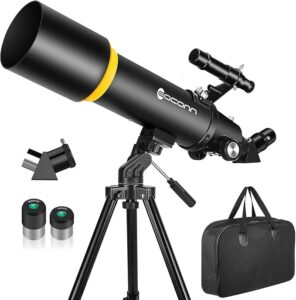
As one of the best 90mm telescopes, the EACONN 90mm Refractor Telescope is a solid choice for kids and beginners starting to explore the night sky.
With its 90mm aperture, it gathers enough light to provide clear views of the moon, planets, and some brighter deep-sky objects.
Furthermore, the telescope comes with a sturdy tripod and simple mounting system, making it easy for young users to set up and adjust. Its compact design and lightweight frame ensure that it is portable, so it can be taken outdoors or moved between rooms without hassle.
Above all, the included eyepieces allow for basic magnification options, giving users the ability to zoom in on celestial objects and practice focusing skills.
Overall, it’s a practical, beginner-friendly telescope that encourages learning and curiosity about astronomy.
Pros
- Beginner-friendly and easy to assemble
- Clear optics for moon, planets, and bright objects
- Lightweight and portable
- Sturdy tripod for stable viewing
- Affordable for families and young users
Cons
-
Limited magnification options for advanced observation
5. Opaita 90mm Refractor High Powered Telescope
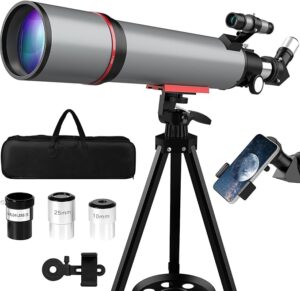
The Opaita 90mm Refractor High Powered Telescope is an excellent entry-level instrument for amateur astronomers and hobbyists who want to explore the night sky in detail.
Its 90mm aperture provides clear, bright images of celestial objects such as the Moon, planets, and star clusters. Furthermore, the telescope’s long focal length allows for high magnification, making it easier to observe planetary details like the rings of Saturn or the craters of the Moon.
Regarding construction, its built with a durable aluminum alloy tube and fully coated optics. This guarantees durability and sharp, crisp images with minimal distortion.
Furthermore, its adjustable mount ensures stable tracking of objects, and the included eyepieces offer versatility for both wide-field and high-powered views. The included finder scope further simplifies locating celestial objects, even for those new to astronomy.
This telescope is lightweight and portable, allowing for easy setup in different locations. It also comes with a sturdy tripod, making it convenient for both backyard stargazing and travel to darker skies.
Pros
- 90mm aperture for bright and detailed images
- High magnification for planetary observation
- Durable aluminum alloy construction
- Fully coated optics for clear, crisp views
- Adjustable mount for stable tracking
- Lightweight and portable
Cons
- Not ideal for deep-sky objects due to limited aperture
- Lacks advanced motorized tracking
6. MEEZAA 90mm Refractor Telescope
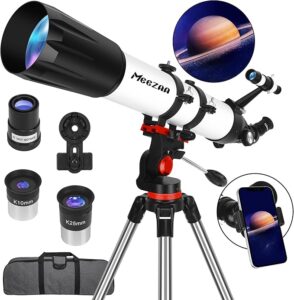
Lastly, we have the MEEZAA 90mm Refractor Telescope. This is an excellent entry-level telescope designed for beginner stargazers and casual astronomers.
With its 90mm aperture, it captures a substantial amount of light, allowing for clear and bright views of the moon, planets, and even some deep-sky objects. The telescope is also lightweight and portable, making it easy to set up in different locations for night sky observations.
Its simple refractor design means minimal maintenance, and the included adjustable mount ensures stable viewing, reducing shakiness while tracking celestial objects. Users also appreciate the included accessories, such as eyepieces and a smartphone adapter, which enhance the viewing experience and make astrophotography accessible even for beginners.
Performance-wise, the MEEZAA 90mm Refractor delivers surprisingly sharp images for its class. The optical quality allows for detailed lunar landscapes and crisp views of planetary features like Jupiter’s cloud bands and Saturn’s rings. The telescope is also user-friendly, with a smooth focus mechanism and straightforward assembly instructions.
Pros
- Bright, clear images
- Lightweight and portable design
- Easy to assemble and use
- Stable adjustable mount
- Includes useful accessories like eyepieces and smartphone adapter
Cons
- Manual tracking can be challenging for fast-moving objects
- Basic mount may struggle with heavier attachments
Key Factors to Consider when Choosing the Best 90mm Telescopes
When choosing the best 90mm telescope, take into consideration these key factors:
Optical Quality
One of the most important factors to consider is optical quality. Telescopes with high-quality lenses or mirrors provide brighter, sharper images with minimal distortion, which allows you to enjoy clearer views of planets, the Moon, and deep-sky objects. Investing in good optics ensures a more satisfying observing experience.
Type of Telescope
The type of telescope also plays a significant role in your choice. Refractors, reflectors, and compound telescopes each have unique advantages. Refractors are low maintenance and great for planetary viewing, reflectors often provide better light-gathering at a lower cost, and compound telescopes offer versatility for both planetary and deep-sky observations. Understanding which type suits your needs helps narrow down your options.
Stable Mount
Next, a stable mount is essential for smooth and steady viewing. Even the best optics are useless if the telescope shakes or wobbles. Look for mounts that provide stability and allow smooth tracking of celestial objects, whether manual or motorized, to make observing more enjoyable.
Eyepiece Versatility
Moreover, eyepiece versatility enhances your viewing experience. The best 90mm telescopes that include multiple eyepieces or accept standard ones let you adjust magnification, providing flexibility to observe planets, the Moon, and distant galaxies with optimal clarity. Having a range of eyepieces also supports experimenting with different magnifications.
Focuser Quality
The focuser quality is another key factor. A smooth and precise focuser allows you to achieve sharp images, particularly at higher magnifications. Cheaper or poorly built focusers can make it frustrating to get objects in clear view, reducing overall enjoyment.
Portability and Weight
Furthermore, weight and portability are important considerations, especially if you plan to travel to dark-sky locations. A lightweight and compact telescope is easier to transport and set up, whereas a heavier telescope might be more cumbersome to move and store, which can discourage frequent use.
Accessory Compatibility
With the best 90mm telescopes, accessory compatibility is important as it enhances your stargazing and astrophotography options. Telescopes that accept filters, smartphone adapters, or motorized tracking systems allow you to expand functionality as your skills grow, making your investment more versatile over time.
Ease of Setup
Finally, ease of assembly and user-friendliness is crucial, particularly for beginners. A telescope that is intuitive to set up and operate, with clear instructions and minimal adjustments, ensures that you spend more time observing the stars and less time struggling with equipment. Simple, user-friendly designs also make astronomy more enjoyable and less intimidating.
Pros and Cons of 90mm Telescopes
Pros:
-
Good Optical Performance . Offers clear and bright views of the Moon, planets, and some deep-sky objects.
-
Portable and Lightweight. The best 90mm telescopes are easier to transport to dark-sky locations compared to larger telescopes.
-
Versatile Viewing. These telescopes handle both planetary and deep-sky observations reasonably well.
-
Beginner-Friendly. Moreover, 90mm telescopes are easy to set up and use, making it ideal for novice astronomers.
-
Accessory Compatibility. Many models allow attachments like filters, smartphone adapters, or motorized mounts.
-
Affordable Option. Lastly, they offer a good balance of performance and cost without being overly expensive.
Cons:
-
Limited Deep-Sky Performance. May not gather enough light for very faint galaxies or nebulae compared to larger apertures.
-
Higher Magnification Limits. Extreme magnification can result in blurry images due to size and atmospheric conditions.
-
Mount Sensitivity. Some lightweight models may have less stable mounts, requiring extra care or upgrades.
FAQs
- Can I use a 90mm telescope for astrophotography?
Yes, especially with a telescope that supports accessory attachments like smartphone adapters or motorized tracking. However, deep-sky astrophotography will require additional equipment.
- Are 90mm telescopes suitable for beginners?
Absolutely. They provide a good balance of portability, ease of use, and clear views of both planets and deep-sky objects, making them ideal for beginner astronomers.
- Should I consider portability when buying a 90mm telescope?
Yes. Lightweight telescopes are easier to transport to dark-sky locations, encouraging more frequent use and a better overall experience.
Final Words
To wrap it up, a 90mm telescope is a versatile choice for both beginners and experienced stargazers, but its performance depends on more than just size. Prioritizing factors like high-quality optics, a stable mount, flexible eyepieces, smooth focuser, accessory options, and ease of use ensures that your telescope will deliver clear, enjoyable views. By carefully considering these aspects, you will choose a telescope that matches your observing style and environment.