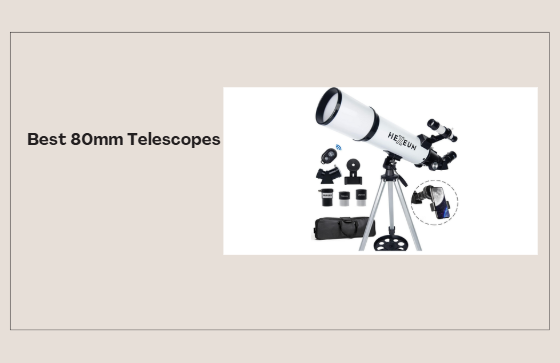
Are you passionate about exploring the night sky and looking for the best 80mm telescopes? If yes, you are in the right place.
Among the most popular telescopes, 80mm options stand out as a versatile choice, offering a combination of clarity, light-gathering ability, and portability that appeals to both beginners and intermediate astronomers. In this buying guide, we will walk you through the best models available and ensure that you make an informed decision to enjoy countless nights under the stars.
What to Look for in the Best 80mm Telescopes
Whether you’re stepping into astronomy for the first time or looking to upgrade your current setup, look for an 80mm telescope with these features beyond the aperture size:
1. Optical Quality. High-quality lenses or mirrors with proper coatings provide sharp, bright, and low-distortion views of the Moon, planets, and star clusters.
2. Focal Length & Ratio. These features determine how magnified or wide your views will be. Shorter focal ratios give brighter wide-field views, while longer ones highlight planetary details.
3. Mount and Stability. A sturdy, well-built mount ensures the telescope stays steady, allowing smooth tracking of celestial objects without constant adjustment.
4. Eyepieces and Accessories. Moreover, a variety of eyepieces, a Barlow lens, and a finderscope or red dot make locating and observing objects easier and more versatile.
5. Portability and Build. Lightweight yet durable telescopes are easier to transport to dark-sky locations, encouraging more frequent use.
6. Value. Last but not least, the best 80mm telescopes should deliver excellent viewing experiences and include quality accessories at a reasonable price.
Best 80mm Telescopes
1. HEXEUM 80mm Aperture Astronomical Portable Refracting Telescope
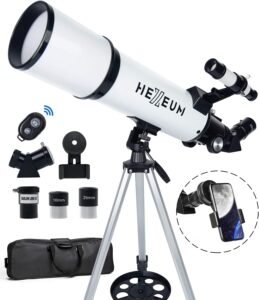
The HEXEUM Telescope is the best 80mm telescope. This is a well-rounded astronomical refractor that offers impressive performance for both beginners and intermediate stargazers.
Its 80mm aperture allows for bright and clear views of celestial objects, from the Moon’s craters to Jupiter’s cloud bands, while the 600mm focal length ensures detailed observation of planets and deep-sky objects.
Furthermore, this telescope is lightweight and portable, making it easy to carry for backyard astronomy or even small outdoor trips. The refracting design reduces maintenance, as there’s no need for mirror alignment, and the included adjustable tripod provides stable viewing.
Above all, the telescope is simple to assemble and the intuitive adjustments make it accessible for newcomers without sacrificing the quality needed for more serious stargazing sessions.
Pros
- Bright and clear 80mm aperture for lunar and planetary views
- Portable and lightweight design
- Low maintenance refractor telescope
- Easy to assemble and adjust
- Stable tripod included
Cons
- Limited capability for faint deep-sky objects
- Not ideal for advanced astrophotography
2. CELTICBIRD 80mm Aperture AZ Mount Refractor Telescope
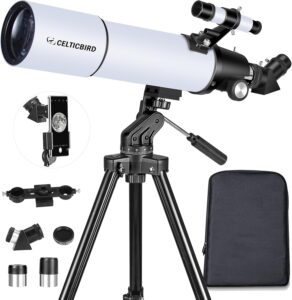
The Celticbird Telescope offers a strong entry point for beginners and hobbyist stargazers alike.
Its 600mm focal length provides moderate magnification, which works well for both terrestrial and astronomical observations. Furthermore, the 80mm aperture captures plenty of light, making it possible to view celestial objects like the Moon, planets, and some brighter deep-sky objects with clarity.
The included AZ (altazimuth) mount makes it easy to maneuver the telescope smoothly in both vertical and horizontal directions, allowing quick adjustments when tracking moving objects in the sky. Additionally, the telescope is relatively lightweight and portable.
Pros
- 80mm aperture captures bright, clear images
- Smooth AZ mount for easy movement and tracking
- Portable and lightweight for easy transport
- Suitable for both terrestrial and astronomical viewing
- Good starter telescope for beginners
Cons
-
Basic eyepieces limit detailed viewing
3. Celestron – PowerSeeker 80EQ Telescope
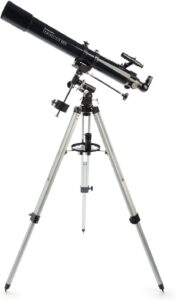
As one of the best 80mm telescopes for beginners, the Celestron PowerSeeker 80EQ Telescope excels in performance and portability.
Its 80mm aperture allows clear views of the Moon, planets, and some brighter deep-sky objects, giving new stargazers a strong introduction to astronomy. Furthermore, the manual German equatorial mount is designed for tracking celestial objects as they move across the sky, which is a useful learning tool for understanding how telescopes function.
Despite being manual, the mount is fairly stable, allowing smooth adjustments in both altitude and azimuth. Besides, assembly is straightforward, and the included accessories, such as eyepieces and a finderscope, provide everything needed to start observing right away.
Overall, it’s a strong entry-level option for beginners who want a hands-on experience with astronomy without spending a fortune.
Pros
- Affordable for beginner astronomers
- 80mm aperture provides clear lunar and planetary views
- Manual German equatorial mount teaches tracking and telescope alignment
- Comes with eyepieces and a finderscope for immediate use
- Easy to assemble and use
Cons
-
Limited performance for faint deep-sky objects
4. EACONN 80mm Aperture 600mm Refractor Telescope for Kids & Beginners
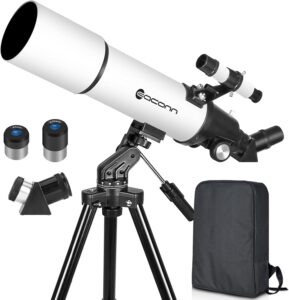
The EACONN 80mm Aperture 600mm Refractor Telescope for Kids & Beginners is a solid choice for those just starting their journey into astronomy.
Featuring a large 80mm aperture, it allows for clear and bright views of the moon, planets, and some brighter deep-sky objects. This makes it ideal for young stargazers and beginners who want to explore the night sky without a steep learning curve
Furthermore, the 600mm focal length provides a balanced magnification range, allowing users to switch between wide-field observations and closer views of celestial objects.
Regarding portability, the telescope is lightweight and portable. This makes it easy for kids to handle and for parents to set up in the backyard or take along for outdoor adventures. Additionally, the included tripod is adjustable, adding convenience and stability during viewing sessions.
While designed with beginners in mind, the EACONN refractor offers room to grow as skills improve. Its simple optical design reduces the need for frequent adjustments, and the included eyepieces provide enough variety to experiment with different magnifications.
Pros
- Easy to set up and use for beginners
- Bright and clear views of the moon and planets
- Lightweight and portable design
- Adjustable tripod for stable viewing
- Comes with multiple eyepieces for varied magnification
Cons
-
Limited for observing very faint deep-sky objects
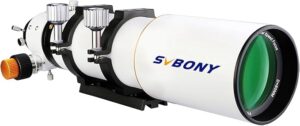
5. SVBONY SV503 80 mm F7 Refractor Telescope
6. Hawkko Telescope for Adults & Kids
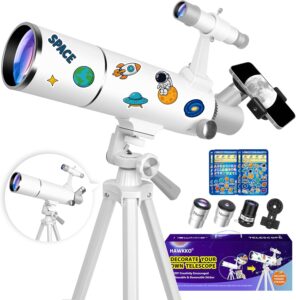
The Hawkko Telescope for Adults & Kids offers an excellent introduction to stargazing for beginners and families.
Its 80mm aperture allows for clear views of the moon, planets, and bright deep-sky objects, while the 500mm focal length provides a balanced magnification that is easy to handle for both adults and children.
Moreover, the telescope comes with a sturdy tripod that is adjustable, ensuring stable observations even on uneven surfaces. Its lightweight design makes it portable enough for outdoor adventures, and the included eyepieces allow users to start exploring the night sky without needing additional accessories.
Assembly is straightforward, and the simple manual makes it accessible for younger users or first-time telescope owners. Additionally, the focus mechanism is manual and the tripod is stable, even in windy conditions.
Pros
- Beginner-friendly and easy to assemble
- 80mm aperture provides clear views of the moon and planets
- Adjustable, lightweight tripod for portability
- Suitable for both adults and kids
- Includes multiple eyepieces for varied magnifications
Cons
-
Limited optical performance for advanced stargazing
7. HUGERSTAR 80mm Refractor Telescope
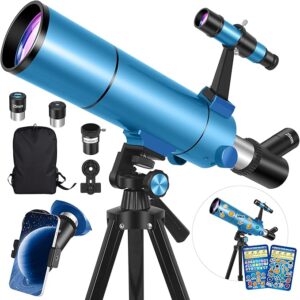
Last but not least, we have the HUGERSTAR 80mm Refractor Telescope. This is reliable and enjoyable telescope for beginners or hobbyists seeking a convenient and affordable entry into stargazing.
As one of the best 80mm telescopes, it is equipped with a sturdy alt-azimuth mount, allowing for smooth movement along both vertical and horizontal axes. This simplifies tracking objects as they move across the sky.
Furthermore, the lightweight and compact design make it easy to transport and set up, which is ideal for families, students, or hobbyists who want to take it outdoors.
Its 80mm aperture provides clear and bright views of the moon, planets, and some deep-sky objects, making celestial observation enjoyable and detailed. Moreover, the included eyepieces and finderscope help beginners quickly locate celestial objects, while the included tripod is adjustable, offering comfort during extended viewing sessions.
Also included is a smartphone adapter that lets you capture and share stunning photos of the Moon and planets.
Pros
- Lightweight and portable
- Beginner-friendly design and easy setup
- Bright 80mm aperture for clear views of the moon and planets
- Smooth alt-azimuth mount for easy tracking
- Adjustable tripod for comfortable viewing
Cons
- Limited deep-sky viewing capabilities
Criteria for Choosing the Best 80mm Telescopes
Here are the key factors to consider when selecting an 80mm telescope:
Optical Quality
The first factor to consider is optical quality. The clarity and sharpness of the images largely depend on the quality of the lenses or mirrors used. High-quality optics reduce distortion, chromatic aberration, and ensure crisp views of planets, stars, and the Moon. Look for telescopes with coated lenses, as these improve light transmission and enhance image brightness.
Focal Length and Focal Ratio
Next, the focal length and focal ratio are essential. A longer focal length provides higher magnification, which is excellent for observing planets, while a shorter focal length gives a wider field of view, ideal for star clusters and nebulae. The focal ratio determines how bright and detailed objects will appear, so balance your choice according to whether you prefer deep-sky viewing or planetary observation.
Mount Type and Stability
Another critical aspect is the mount type and stability. A sturdy mount ensures steady images, especially at higher magnifications. Equatorial mounts allow precise tracking of celestial objects, which is helpful for longer viewing sessions or astrophotography, while alt-azimuth mounts are generally easier for beginners to use. Stability prevents shaking and provides a more enjoyable observing experience.
Portability and Size
Furthermore, portability and size should influence your choice significantly. Some of the best 80mm telescopes are lightweight and compact, making them easy to carry to dark-sky locations, while others are heavier but offer more features. Consider where you plan to use your telescope and how often you will transport it.
Ease of Use
The ease of use and setup is especially important for beginners. Telescopes with simple assembly, clear instructions, and intuitive controls save time and frustration. Some telescopes even include computerized mounts that automatically locate celestial objects, which can be a huge help for new stargazers.
Accessories
Furthermore, accessories and expandability should also be reviewed. High-quality eyepieces, finderscopes, Barlow lenses, and smartphone adapters can enhance your viewing experience. Additionally, the best 80mm telescopes allow upgrades or compatibility with other optical equipment so you can extend the usefulness of your investment over time.
Budget
Finally, budget and overall value are key considerations. While higher-priced models may offer better optics and more features, it’s important to find a telescope that balances quality, durability, and functionality within your price range.
Pros and Cons of 80mm Telescopes
Pros:
- Lightweight and portable, ideal for beginners
- Provides clear views of the Moon, planets, and bright star clusters
- Relatively affordable compared to larger apertures
- Easy to set up and use, especially refractors
Cons
- Limited light-gathering for very faint deep-sky objects
- Smaller aperture means less detail compared to larger telescopes
FAQs
Can an 80mm telescope show planets clearly?
Yes. An 80mm telescope can provide detailed views of planets like Jupiter, Saturn, and Mars, although finer planetary features may require higher magnification and quality optics.
Are 80mm telescopes good for deep-sky objects?
Yes. They show bright deep-sky objects such as the Orion Nebula, the Pleiades, and some galaxies. However, dimmer nebulae or distant galaxies may appear faint due to the limited aperture.
How portable are 80mm telescopes?
Most 80mm telescopes are compact and lightweight, making them easy to transport to dark-sky locations. Refractors are generally more portable than reflectors of the same aperture.
Parting Shots
The best 80mm telescopes strike a perfect balance between performance and convenience, making them an excellent choice for beginners and hobbyists alike. They deliver clear, bright views of the Moon, planets, and many deep-sky objects while remaining portable and easy to handle. By focusing on quality optics, a stable mount, and useful accessories, you will enjoy a rewarding stargazing experience without the complexity or cost of larger telescopes.