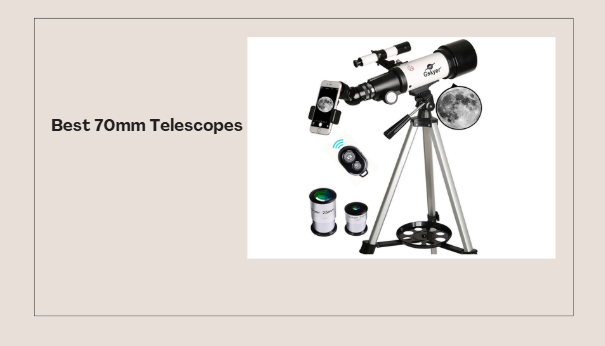
A 70mm telescope is often considered the perfect starting point for anyone curious about the night sky. Compact, affordable, and powerful enough to deliver clear views of the Moon, planets, and some bright star clusters, the best 70mm telescopes are ideal for beginners and hobbyists alike.
But not all 70mm telescopes are created equal. Factors such as lens quality, mount stability, portability, and included accessories can significantly affect your stargazing experience. This guide will help you understand what to look for, compare the best options available, and choose one that brings the wonders of the universe right to your fingertips.
Why 70mm Telescope are Popular for Beginners and Casual Stargazers
70mm telescopes strike the perfect balance between performance, ease of use, and affordability, making them an ideal choice for beginners and casual stargazers. They provide:
1. Perfect Balance of Size and Performance. A 70mm telescope provides a large enough aperture to see the Moon, planets, and bright star clusters clearly while remaining compact and lightweight.
2. Affordable and Accessible. The best 70mm telescopes are generally budget-friendly, making them an ideal choice for people just starting out. You don’t need to spend hundreds or thousands of dollars to get decent views of celestial objects.
3. Easy to Set Up and Use. Furthermore, most 70mm telescopes come with simple mounts and easy-to-follow instructions, which means beginners can start observing quickly without frustration. Altazimuth mounts, in particular, make pointing and tracking objects intuitive.
4. Good for Learning the Night Sky. The moderate magnification and wide field of view of a 70mm telescope make it easier to locate objects and learn constellations. Beginners can gradually explore the sky without feeling overwhelmed.
5. Portable and Travel-Friendly. Because they are lightweight and compact, 70mm telescopes can easily be carried to dark-sky locations or camping trips, allowing casual stargazers to enjoy clear, unobstructed views of the night sky.
6. Versatile Viewing. While not as powerful as larger telescopes, a 70mm telescope is versatile enough to observe the Moon, planets, some nebulae, and bright star clusters, giving beginners a wide range of exciting targets to explore.
Best 70mm Telescopes
1. Gskyer 70mm AZ Mount Astronomical Refracting Telescope
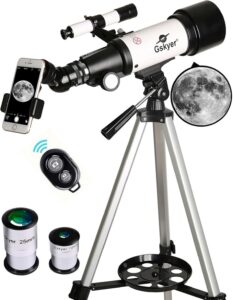
The Gskyer 400mm AZ Mount Astronomical Refracting Telescope is the best 70mm telescope. It is a solid entry-level telescope for beginners and hobbyist stargazers.
Its 70mm aperture allows for bright and clear views of the Moon, planets like Jupiter and Saturn, and some of the brighter deep-sky objects. Furthermore, the 400mm focal length provides a good balance between wide-field viewing and magnification, making it versatile for both celestial and terrestrial observations.
The included alt-azimuth (AZ) mount is simple to use and intuitive, allowing smooth up-and-down and left-to-right movement, which is perfect for beginners learning to track objects across the night sky. Additionally, its lightweight design makes it portable and easy to set up, whether in the backyard or at a darker observing site.
While it is beginner-friendly, the telescope also offers a few features that make observing more enjoyable. It comes with two eyepieces, offering different magnifications, and a 5×24 finderscope to help locate celestial objects more easily. Additionally, the adjustable tripod is sturdy enough for stable viewing and can be extended to suit the user’s height.
Pros
- Bright 70mm aperture for clear views
- Easy-to-use AZ mount for smooth tracking
- Portable and lightweight design
- Includes multiple eyepieces and finderscope
- Adjustable tripod for comfortable viewing
Cons
- Chromatic aberration at higher magnifications
- Limited for faint deep-sky objects
2. ToyerBee 70mm Aperture Refractor Telescope
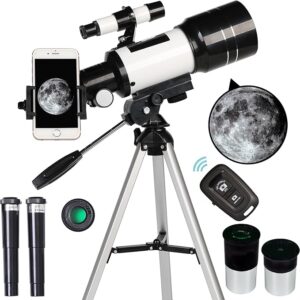
The ToyerBee Telescope for Adults & Kids is an excellent entry-level telescope that caters to both beginners and young astronomy enthusiasts.
Its 70mm aperture allows for clear, bright views of the moon, planets, and some of the brighter deep-sky objects. Additionally, the adjustable magnification range of 15X to 150X gives users flexibility depending on the object they are observing, making it suitable for casual stargazing or backyard astronomy.
The telescope comes with a sturdy tripod that is easy to set up, making it convenient for quick observation sessions. Its lightweight design and compact size make it portable, allowing users to carry it outdoors without much effort.
Furthermore, the telescope includes user-friendly features such as a simple focusing mechanism and pre-assembled parts, which are perfect for kids learning the basics of astronomy.
Pros
- Lightweight and portable for easy outdoor use
- Clear optics for observing the moon and planets
- Adjustable magnification from 15X to 150X
- Beginner-friendly and easy to assemble
- Includes sturdy tripod for stable viewing
Cons
-
Limited advanced features and accessories
3. Celestron Travel Scope 70 Portable Refractor Telescope
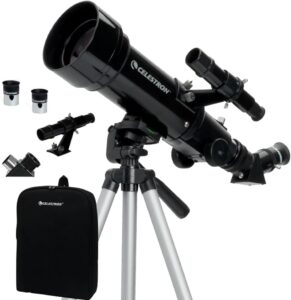
Next, we have the Celestron Travel Scope 70 Portable Refractor Telescope.
The large 70mm aperture allows for bright, clear views of the moon, planets, and some of the brighter deep-sky objects, making it an excellent choice for nighttime observation.
Furthermore, the telescope is lightweight and compact, easily fitting into a backpack, which makes it perfect for camping trips or impromptu stargazing sessions. Its refractor design provides crisp, high-contrast images, and the included 20mm and 10mm eyepieces allow for low- and medium-power viewing, giving beginners a good range of magnification options.
For added convenience, its assembly process is quick and straightforward, and the included tabletop tripod adds stability for handheld use or quick setup in the field.
In addition to its portability, the Travel Scope 70 comes with a backpack for easy transport. This makes it convenient for travel or storing when not in use. It also encourages learning the basics of astronomy, making it a great starter tool for children or adults new to the hobby.
Pros
- Lightweight and portable, ideal for travel
- 70mm aperture provides clear, bright images of the moon and planets
- Simple, beginner-friendly setup
- Includes 20mm and 10mm eyepieces for different magnifications
- Comes with a convenient backpack for transport
Cons
- Limited aperture for deep-sky objects
- No computerized or tracking features
4. Koolpte 70mm Aperture Astronomical Refracting Telescope

As one of the best 70mm telescopes, the Koolpte Astronomical Refracting Telescope is an excellent entry-level telescope for beginners and young astronomy enthusiasts.
The telescope comes with an adjustable tripod that provides stable viewing, making it easy to track celestial objects even for novice users. The included eyepieces offer different magnifications, and the telescope’s simple refractor design means minimal maintenance compared to more complex reflecting telescopes.
Furthermore, this telescopes is lightweight and portable, making it ideal for backyard stargazing or taking on small trips to darker skies. The included 5×24 finder scope with mounting bracket and cross-hair lines makes it easy to locate celestial objects. Also included is a wireless remote that provides a convenient way to explore and capture images.
Pros
- Affordable and beginner-friendly
- Lightweight and portable for easy transport
- Clear views of the moon and planets
- Adjustable tripod for stable viewing
- Minimal maintenance compared to reflecting telescopes
Cons
-
Limited magnification options
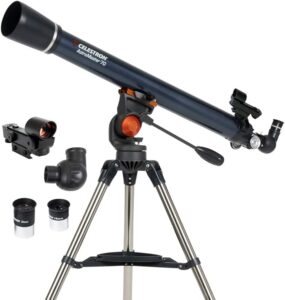
5. Celestron – AstroMaster 70AZ Telescope
6. HEXEUM 70mm Aperture Telescope
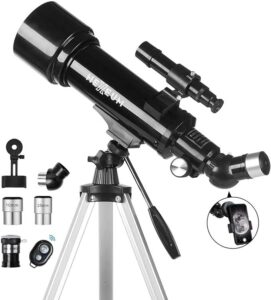
The HEXEUM 70mm Aperture Telescope is an excellent entry-level option for beginner astronomers or hobbyists who want a simple, portable telescope for stargazing.
The telescope comes with an adjustable tripod and an alt-azimuth mount, allowing smooth up-and-down and side-to-side movements. Its lightweight design makes it easy to carry to dark-sky locations, while the included eyepieces provide a range of magnifications suitable for different types of observation.
Furthermore, this astronomical telescope features 500mm(f/7.1) focal length and 70mm aperture, provides stunning views and protects your eyes.
Above all, its simplicity and portability make it particularly appealing for young enthusiasts or anyone wanting a hassle-free telescope.
Pros
- Lightweight and portable for easy transport
- Clear views of the moon and planets
- Easy-to-use alt-azimuth mount for smooth movement
- Affordable and beginner-friendly
- Includes multiple eyepieces for varied magnification
Cons
- Limited to basic astronomical viewing
- No advanced tracking features
7. Celestron – PowerSeeker 70EQ Telescope
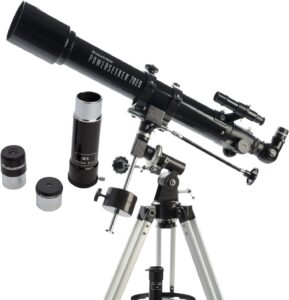
Next, we have the Celestron PowerSeeker 70EQ Telescope. This is an excellent entry-level option for beginners who want to explore the night sky without feeling overwhelmed by complicated equipment.
Its 70mm aperture and fully coated optics allow for clear views of the moon, planets, and brighter deep-sky objects, making it a versatile starter telescope. Furthermore, the manual German equatorial mount provides precise tracking of celestial objects once aligned, which helps users follow stars and planets across the sky.
Regarding portability, its relatively lightweight design makes it portable enough for backyard stargazing or taking to darker skies. Besides, the included accessories, such as eyepieces and a finderscope, add immediate usability without the need for additional purchases.
While the setup might take a bit of patience for absolute beginners, the experience is rewarding and educational, giving users a real understanding of how telescopes work. The PowerSeeker 70EQ also encourages learning the fundamentals of celestial navigation, which is ideal for hobbyists who want to develop practical astronomy skills.
Pros
- Affordable and beginner-friendly
- 70mm aperture with clear, bright images
- Manual German equatorial mount allows precise tracking
- Portable and lightweight
- Comes with essential accessories for immediate use
Cons
- Requires time to learn proper alignment
- Limited deep-sky viewing compared to larger telescopes
8. SVBONY SV503 70mm F6.78 Refractor Telescope
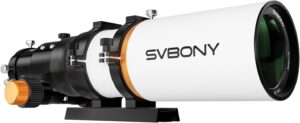
The SVBONY SV503 70 mm F6.78 Refractor Telescope is our last recommendation for the best 70mm telescopes.
This telescope delivers an impressive balance of portability, optical performance, and affordability. The optical tube is sturdy but not overly heavy, making it easy to handle for beginners and intermediate stargazers alike.
Furthermore, the optics are surprisingly clear for the price point, with crisp views of the moon’s surface and bright planets like Jupiter and Saturn. The 70 mm aperture gathers enough light to reveal subtle details in star clusters and some brighter deep‑sky objects, while the refractor design keeps maintenance low since you don’t need to collimate mirrors.
Focusing is smooth thanks to a reliable dual‑speed focuser, and the included accessories make it quick to set up without feeling unbalanced or flimsy.
With all these features, it’s a great stepping stone for someone moving up from binoculars or a beginner telescope, offering reliable performance without breaking the bank.
Pros
- Clear, well‑corrected optics for sharp views
- Good build quality and portability
- Smooth dual‑speed focuser
- Easy setup and low maintenance
- Great value at its price point
Cons
-
Limited light gathering compared to larger scopes
Key Factors to Consider when Choosing the Best 70mm Telescopes
Choosing the best 70mm telescope requires careful consideration of these key factors to ensure you get the most out of your stargazing experience.
Focal Length and Focal Ratio
Firstly, focal length and focal ratio determine the magnification and field of view you can achieve. A longer focal length provides higher magnification but narrower views, making it ideal for observing planets, while a shorter focal length offers wider views, which is better for scanning star clusters or large sections of the night sky. Understanding your observing priorities will help you select the focal specifications that suit your needs.
Optical Design
Secondly, the optical design of the telescope matters. The best 70mm telescopes come in either refractor or reflector types. Refractors are low-maintenance and great for beginners, offering sharp and clear images, while reflectors can provide slightly larger light-gathering power at the same price but may require occasional maintenance, such as mirror alignment.
Mount Type and Stability
Next, mount type and stability are crucial for a comfortable viewing experience. An unstable mount can make even the best optics frustrating to use. Options include alt-azimuth mounts, which are intuitive and easy for beginners, and equatorial mounts, which are more complex but allow for smooth tracking of celestial objects as they move across the sky.
Weight
Furthermore, it is important to consider weight which affects portability. A 70mm telescope is generally compact, but some models can be heavier due to robust mounts or additional accessories. If you plan to take your telescope to dark-sky sites or travel with it, a lightweight and easily transportable option will make observing more enjoyable.
Eyepiece Quality and Versatility
In telescopes, eyepiece quality and versatility influence your viewing options. Many telescopes come with a basic eyepiece set, but having interchangeable eyepieces allows you to adjust magnification and explore objects in greater detail. Look for telescopes that support standard eyepiece sizes so you can expand your collection over time.
Accessories
Moreover, consider additional features and accessories that enhance the observing experience. Built-in finderscopes, smartphone adapters, or even simple star charts can help you locate objects more easily. Some of the best 70mm telescopes also come with computerized or GoTo systems that automatically point the telescope at selected celestial objects, which can be particularly helpful for beginners.
Budget
Finally, budget and long-term value should guide your decision. While it’s tempting to go for the cheapest model, investing in a well-built telescope with quality optics and durable mounts ensures you will enjoy years of stargazing without frustration. Balancing cost with features, portability, and optical performance is essential to choose a 70mm telescope that offers both immediate enjoyment and lasting value.
Tips for Beginners Using a 70mm Telescope
-
Start with the Moon. The Moon is bright, easy to find, and shows plenty of detail even with a small telescope. Observe craters, mountains, and maria before moving on to planets or star clusters.
-
Use Low Magnification First. Begin with a low-power eyepiece to locate objects easily. Once you’ve centered the object, you can switch to higher magnification for more detail.
-
Observe from Dark Locations. Light pollution makes it harder to see faint objects. Try to find a dark area away from city lights for the best views of stars, nebulae, and galaxies.
-
Let Your Eyes Adjust. Give your eyes 10–15 minutes to adapt to the darkness. Avoid looking at bright lights or your phone while observing to see fainter stars.
-
Learn the Night Sky. Familiarize yourself with constellations and bright stars. Star charts or astronomy apps can help you locate objects quickly without frustration.
- Be Patient and Practice. Finding and tracking objects takes time. The more you practice, the faster and easier it becomes. Remember, even short observing sessions are valuable learning experiences.
-
Record Your Observations. Keep a notebook with sketches or notes about what you see. This helps track your progress and makes stargazing more engaging.
Best 70mm Telescopes FAQs
- Can a 70mm telescope show planets clearly?
Yes, a 70mm telescope can provide clear views of planets like Jupiter, Saturn, and Mars. You can see Saturn’s rings, Jupiter’s cloud bands, and the phases of Venus, though fine details may be limited compared to larger telescopes.
- Are 70mm telescopes good for deep-sky objects?
70mm telescopes can show brighter star clusters, the Orion Nebula, and some galaxies, but faint deep-sky objects will appear small and less detailed. They are better suited for beginners focusing on the Moon, planets, and bright nebulae.
- What type of mount is best for beginners?
Alt-azimuth mounts are the easiest for beginners because they move up/down and left/right naturally, making it simple to point and track objects. Equatorial mounts require more setup but are better for tracking stars over time.
Conclusion
A 70mm telescope is an excellent choice for beginners who want a balance between affordability, portability, and performance. By considering factors such as aperture, optical design, focal length, mount stability, and accessories, you should find a model that fits your observing goals. Hopefully, this buying guide has steered you in the right direction.